Jeremy Sencer has been fielding an increased number of calls from charter school workers who are interested in unionizing, a surge that began after teachers at Paul Cuffee School in Providence voted to form a union.
He doesn’t expect the interest to let up.
“Over the next three years, you’ll see a wave of winning elections for charters in [Rhode Island],” said Sencer, a spokesperson for the Rhode Island Federation of Teachers and Health Professionals. “People are watching how it goes for Paul Cuffee.”
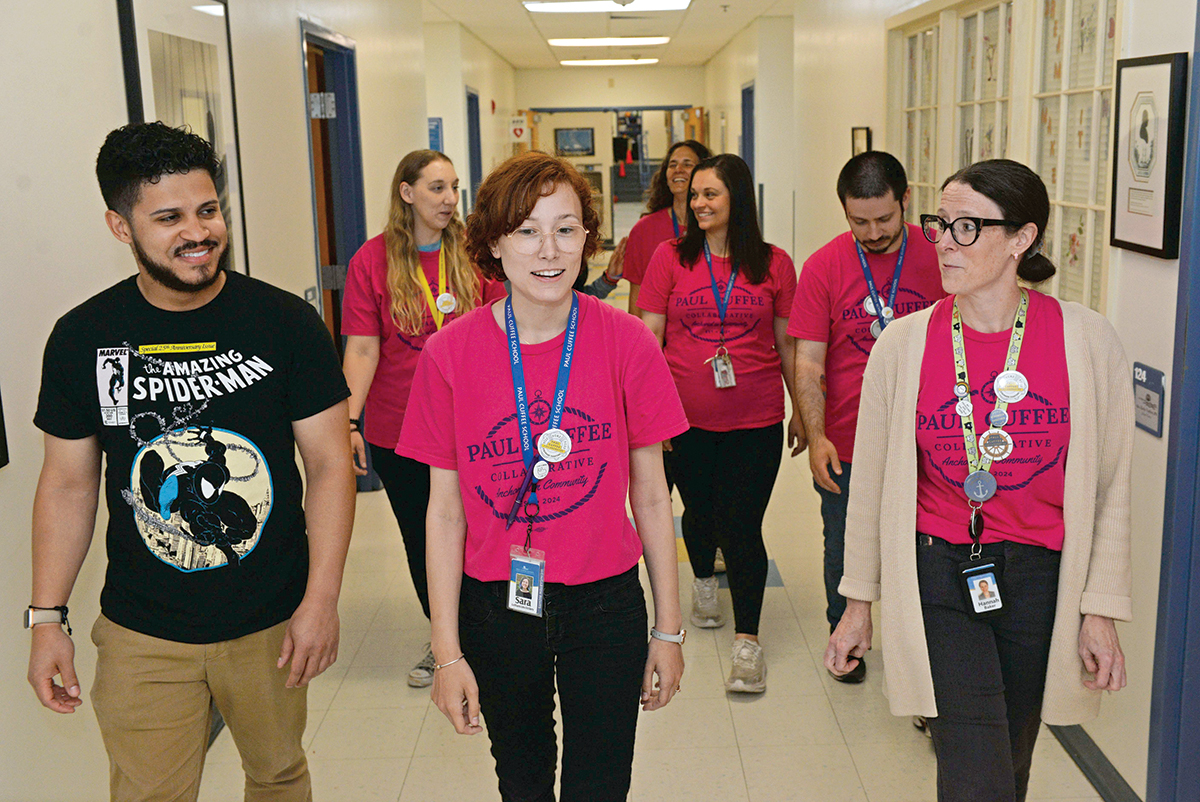
Paul Cuffee School became the state’s first fully unionized charter school in June after workers in the middle school voted to join the RIFTHP. Educators in Cuffee’s upper school had joined in October, followed by workers in the lower school in December.
Now, about 125 faculty members are part of the bargaining unit.
But efforts to unionize began more than a decade earlier.
During the 2014-2015 school year, a new head of school, Chris Haskins, was hired, bringing a management style that several teachers described as a “culture shock.”
Teachers allege that what was once a collaborative environment, with leaders open to suggestions, had become hostile. Some teachers say they began to feel targeted and hesitant to give any feedback for fear of punishment.
“You started to feel fearful and that was a big change,” said Jennifer Bifulco, a third grade teacher at Cuffee.
During the 2015-2016 school year, teachers had conducted a pre-vote to unionize, but the day of the official vote, Haskins filed an appeal, which delayed the process. By the end of the school year, without a vote taken, many frustrated teachers left the school.
With many of the workers involved in the original unionization attempt gone, the organizing efforts stalled.
It regained momentum after the staff at Highlander Charter School’s elementary school voted to join the International Brotherhood of Electrical Workers Local 2323 last August.
“Highlander unionizing really opened our eyes to the fact that a charter school could actually successfully do this, whereas before it felt like charter schools were discouraged and blocked from doing this,” Bifulco said.
Indeed, charter schools have traditionally not been fertile ground for labor unions because the schools are typically created to be more flexible and innovative in teaching styles, autonomous from local school districts but still considered public. Unions are often viewed by charter school administrators as adding layers of bureaucracy.
Just 10.4% of charter schools in the U.S. had staff members who were part of a union as of the 2018-2019 school year, according to the National Alliance for Public Charter Schools.
Meanwhile, teacher unions, including the RIAFT, have lamented the expansion of charter schools in recent years, arguing that they siphon money away from more numerous traditional public schools while accountability is often lacking, unions say.
But since 2016, the R.I. Department of Education has conducted fiscal impact analyses for new or expanding charter schools that are reviewed by the K-12 Council, said RIDE spokesperson Victor Morente. The department also offers municipalities and other stakeholders the opportunity to submit their own fiscal impact analyses that are shared with the K-12 Council.
Sencer argues that unionizing will actually help reinforce the idea of teaching innovation that charter schools were based on. “Their willingness to fight for and win their union is the very thing that’s going to return them to being an innovative place of learning,” Sencer said.
Edward Blackburn, assistant business manager at IBEW 2323, disputes the argument that unionization at Highlander is undermining the mission of the school.
“Unionization efforts at least level the playing field between the rank-and-file workers like the teachers and the [teaching assistants] that are providing the services to the students and the administration,” Blackburn said.
Chiara Deltito-Sharrott, executive director of the Rhode Island League of Public Charter Schools, says the organization supports educators at individual charter schools in making their own decisions about unionizing.
“While some educators have decided to pursue unionization, others have chosen not to, often citing a collaborative working environment and direct access to leadership as reasons for maintaining the current structure,” Deltito-Sharrott said.
When asked to comment about the unionization at the Cuffee School, Kevin Briggs, the school’s chairman, said the board of trustees is “committed to good-faith negotiations that lead to a fair, sustainable agreement for our staff and our students.”
Briggs says the school has offered up to 2% salary increases each year for three years and offered to reduce teachers’ work year from 193 days to 188 days. The union had proposed raises up to 43% and 11 fewer workdays, which Briggs says is not financially feasible.
The union and school plan to continue negotiations, with several bargaining sessions scheduled over the summer.