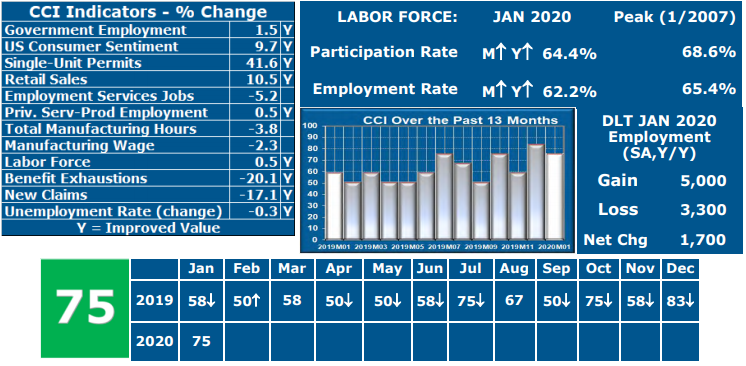
PROVIDENCE – Although the state’s Current Conditions Index showed a 17-point year-over-year increase with a mark of 75 in January, Rhode Island’s economy is not doing as well as previous data indicated, according to a report released Thursday by University of Rhode Island economist Leonard Lardaro.
A CCI value greater than 50 indicates economic expansion, while less than 50 means contraction.
A modernized health plan: Supporting cost management and the employee experience.
The Surest health plan came from a group of innovators wondering: What if health care…
Learn More
January’s performance, while an increase over the year-prior value of 58, comes on the heels of revised data for 2019.
Revisions show that employment service jobs, one of the 12 indicators used to measure economic performance, fell each month of 2019 rather then showing improvement as initial reports showed.
As a result, CCI results in 2019 were lowered for nine months, increased for one month and showed no change for two months.
“Worse yet, for four months last year, the CCI was at its neutral value of 50 while in four other months, the CCI managed to climb only to 58, barely above neutral,” Lardaro writes in the report. “So, 2019 was not a terribly strong year for Rhode Island’s economy.”
He added that from his perspective, the state is now slipping into the early stages of a recession, as are many U.S. and global economies.
“Although Rhode Island’s economy is FILO, the FI (first in) does not apply this time, given the abruptness of the decline in global economic activity. Sadly though, our status as LO (last out) remains entirely in tact, highlighted by our state’s disappointing 2019 economic performance,” said Lardaro.
The state’s labor force remains below its 2010 peak, contributing to an artificially low unemployment rate, Lardaro also claimed.
Lardaro charged that Rhode Island’s economic leaders have overstated the state’s recovery for years – specifically citing the use of the unemployment rate as a bellwether for the economy.
“Many Rhode Islanders have either been left behind our never managed to catch up,” Lardaro said. “Now that a recession of uncertain magnitude and duration has begun, it is appropriate to refer to the old saying about the tide going out. The shallowness of the last recovery will become apparent very quickly, not so much in the magnitude, that is largely out of anyone’s control, but in terms of our ability to move into an eventual recovery.”
Of the economic indicators measuring economic growth, new jobless claims dropped sharply, as the January report does not include the most current numbers that reflect the impact of the new coronavirus on the state’s economy.
Laradro said that the individual indicators for Janaury were “now meaningless.”
“Fasten your seat belts. This is going to get ugly,” he said.
CCI indicator changes year-over-year in January:
- Government employment increased by 1.5%
- U.S. consumer sentiment was up by 9.7%
- Single-use permits grew by 41.6%
- Retail sales increased by 10.5%
- Employment services jobs decreased by 5.2%
- Private service-producing employment increased by 0.5%
- Total manufacturing hours dropped by 3.8%
- The manufacturing wage fell by 2.3%
- The labor force grew by 0.5%
- Benefit exhaustions decreased by 20.1%
- New claims dropped by 17.1%
- The unemployment rate fell by 0.3%
Elizabeth Graham is a PBN staff writer. You may reach her at Graham@PBN.com.