
Driving down Rhode Island’s rural streets? Prepare for a bumpy ride.
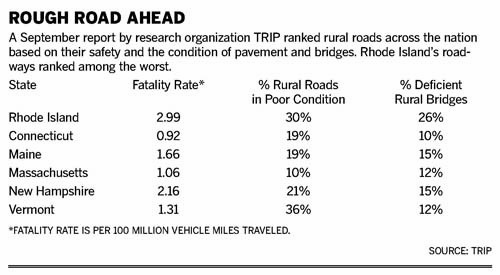
A September report pegged Rhode Island’s 283 miles of rural roadways among the worst and most dangerous in the nation.
Washington, D.C.-based transportation research organization TRIP said 30 percent of Rhode Island’s rural roads are in poor condition. Only Vermont and Idaho had a higher percentage of rural roads in poor condition. Oklahoma tied with Rhode Island. In addition, TRIP said 26 percent of rural bridges – 41 in all – were deficient, behind only Pennsylvania, where 28 percent of bridges are deficient.
Safety-wise, the state’s rural roads averaged three deaths per 100 million vehicle miles traveled, third-highest rate behind South Carolina and Florida.
In its Sept. 1 report, TRIP called rural roads important to keeping commerce moving.
“The strength of the nation’s rural economy relies greatly on the quality of its transportation system, particularly its roadways, which link rural America with the rest of the U.S. and to markets in other nations,” the report said.
In Rhode Island, however, rural roads comprise just a sliver of the state’s roadway network. There are about 1,200 miles of state-maintained roads in Rhode Island, including some rural roads, according to the R.I. Department of Transportation. In addition, there are hundreds of locally maintained roadways.
Given the small sample size in Rhode Island, DOT Deputy Chief Engineer Robert Smith cautioned against reading too much into the report. But he agreed repairs are needed.
“I don’t think our rural roads are much different than all of our roads,” Smith said.
The problem, like so many others in government agencies, is money. The federal government provides the lion’s share of DOT’s funding, but for most projects, the state must match 20 percent of the cost. For big projects, that can quickly add up to tens of millions of dollars and take money away from small, rural roads.
“It’s definitely a balance and sometimes a difficult balance,” Smith said.
This year, the agency plans to repave about eight miles of Route 146 in Exeter. The rural roadway only carries about 4,000 vehicles a day, but Smith said the road serves an important part of the local street network.
The report comes as Gov. Lincoln D. Chafee has sought to change how the DOT is funded. Currently, the state matches federal money by issuing bonds. That leaves the department paying millions of dollars a year in interest. This fiscal year alone the department, with a $453.8 million budget, expects to pay $43 million in debt service.
Earlier this year Chafee proposed dedicating some motor vehicle fees to the department. When lawmakers rejected the idea, his administration proposed implementing tolls on Interstate 95 near the Connecticut border. That request is now pending with the federal government.
Smith said toll money would likely be restricted for maintaining the interstate highway system in the state. But tolls could free up other pools of money that the DOT could shift to rural roads.
Safety was an area where TRIP said Rhode Island could do better. Fourteen people died along rural roads in Rhode Island in 2009, the year TRIP used as a basis for its report.
That translated to an average of three deaths per 100 million vehicle miles, more than three times the death rate on the state’s nonrural roads.
Improving safety was a big factor in the decision to go forward with repaving Route 146, Smith said. And, he said, it’s a major component of prioritizing which roads and bridges are repaired first. •











I live in rural RI and work in Providence. The bumpiest ride in this state, by far, is on Pine Street and Weybosset Street, east of Dorrance. Enormous, unfilled potholes, blocked sidewalks, missing bricks, etc. And it is even worse for pedestrians. I”ve taken one bad fall walking from the Arcade garage and so have several coworkers.