To entice Toray Plastics (America) Inc. to expand in Rhode Island, state economic-development officials reached into their toolbox and tapped the R.I. Renewable Energy Fund. Whether the $750,000 from the fund will be enough to convince Toray to expand here remains to be seen. But officials say the fund has worked before.
Over the years, the fund has paid for projects such as solar panels on the roof of United Natural Foods in Providence and for feasibility studies. The R.I. Economic Development Corporation, which manages the fund, says its grants and low-interest loans have created 115 direct jobs largely in the areas of construction and design and 302 indirect jobs.
“The REF is a strong program, it has worked well,” EDC Executive Director Keith W. Stokes said.
In a March report, the agency said that for every $29,323 invested, one direct job was created and for every $11,133 invested, one indirect job was created.
Since the EDC took over management of the fund in July 2008, the agency has awarded $2.7 million to 49 projects undertaken by governments, nonprofit groups and private companies.
Stokes said the fund is important because the Northeast has some of the highest electricity rates in the country. Offering to subsidize renewable energy systems such as solar panels and wind turbines can drive down those costs.
And there has been no shortage of demand for money for such projects. The EDC said it received 35 applications asking for a total of $9.8 million in 2010. That year, it awarded a total of $619,622 to eight projects. The year before, the corporation awarded $593,238 to 31 projects.
In August, Toray became perhaps the most prominent recipient when it received a $750,000 grant to pay for a solar farm. The EDC board awarded the money after executives said they were mulling whether to undertake a $200 million expansion at its Quonset plant or at a facility in Virginia where electricity is cheaper.
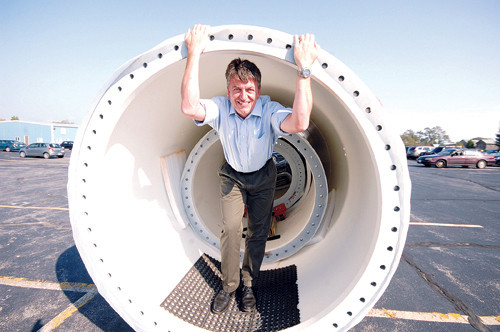
Other companies say the fund is an enticement to stay in Rhode Island. In 2009, Hodges Badge Co. received a $225,000 grant to help pay for a wind turbine at its Portsmouth factory. Once operational, the 250-kilowatt turbine is expected to save the company $100,000 a year.
“There are enough other costs in this state that make Rhode Island not the best place to be, so if we can save $100,000 a year on electricity that makes this place better to stay,” President Frederick J. “Rick” Hodges said.
Without the grant, Hodges said he’s not sure the company would have moved forward with the $850,000 wind turbine. He coupled the grant with a federal stimulus grant managed by the state and federal tax credits. All told, the grants and tax credits should shorten the payback to three or four years, down from nine without those incentives.
Hodges said the fund also proved helpful because unlike some incentives – such as tax credits – the fund pays upfront. That’s critical for companies without the cash flow to tackle a pricey project.
“I would say that this is a useful tool to have in the arsenal of tools that EDC needs to keep the state competitive,” Hodges said.
But Hodges is still waiting to realize savings from the turbine. The turbine now sits in the factory’s parking lot as the company waits on special power cables to arrive from India.
Other projects receiving money from the fund also remain on the ground. In North Kingstown, Mill Creek Marine is still working to piece together the funding and permitting required to erect a 100-kilowatt turbine. In 2010, the indoor marina and serving shop received a $322,183 low-interest loan to help pay for the $600,000 project.
“Anything I can do to effectively reduce my overhead represented by energy costs certainly makes funds available for more fun things I can invest in the business,” he said.
That’s just what EDC officials want businesses to do. Fund Director Julian Dash said the agency is increasingly favoring applications that create jobs and can lead to investment.
To ensure the future viability of the fund – supported primarily by a surcharge on electric bills – the agency has been moving away from providing straight grants.
Before the EDC took over the fund, it had awarded just one loan. In 2010, 65 percent of money awarded was considered recoverable. Excluding strategic-planning grants, that number jumps to 80 percent. All the loans have come with interest rates between zero and 2 percent.
Dash said that the long-term goal is to build the fund to a point of self-sustainability, where loan repayments and interest fund new rounds of loans and grants.
The agency will be helped thanks to an infusion of federal stimulus money. In August, the agency announced $2.5 million would flow through the fund for energy projects that create jobs, reduce energy costs or change the market. The federal money comes with fewer rules than state money and means that the fund, for the first time, can consider projects that do not directly produce electricity, such as geothermal systems.
The fund may also see less demand from traditional renewable energy projects. The General Assembly recently passed legislation that sets up a fund to help pay for electricity-producing projects that tie into the grid.
“Up until this point we’ve been the bread and butter for all renewable energy projects,” Dash said. •