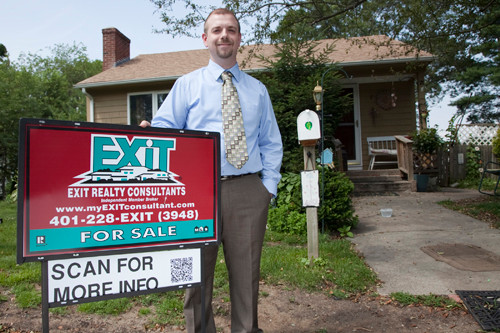
When Rhode Island Association of Realtors President Stephen Antoni attends real estate conferences, there’s always a buzz about Quick Response codes. The square barcodes connect smartphone users with digital content and, depending on who’s talking, are – or will soon become – the industry’s most invaluable marketing tool.
“It certainly has drawn a lot of attention nationally,” if not yet in Rhode Island, Antoni said.
Proponents laud the ability of the codes to send smartphone users to websites without the pesky and time-consuming requirement to type in an address. A quick scan by the phone suffices, as free software interprets the puzzle of black and white squares. The codes can also be programmed to convey brief text messages.
As the theory goes, anything that encourages potential buyers to learn more about a home for sale is a good thing.
“It’s really a noninvasive way of getting the listing in front of them,” said Manny Menezes, owner of Exit Realty Consultants in East Providence.
New for-sale signs for Exit properties feature QR codes that point to more information and photos about the property. The firm is also putting them in print advertisements.
Menezes said the codes are generating traffic to the company’s website. They also keep the company fresh in an industry where technology – from blogs to Twitter to Facebook – is constantly forcing reinvention.
“We try to stay on the cutting edge of what’s going on in the real estate market, as well as what customers are looking for,” Menezes said. “Right now, customers are looking for those QR codes.”
The concept of scanning a barcode – QR or otherwise – with a smartphone appears to be catching on. In 2010, Scanbuy reported that its barcode-reading software saw a 1,600 percent increase in traffic during the year as users scanned codes across industries.
Meanwhile, a 2010 survey of 400 people by advertising firm Austin and Williams said 52 percent of respondents had seen or heard of a QR code and 28 percent had scanned one. Nine percent reported regularly scanning a code at least monthly, according to the New York-based firm.
“It’s becoming something different,” said Nathan King, a digital strategist at the firm and the survey’s author. “A lot of people are trying them in their marketing campaigns.”
Antoni himself said the potential user base at the moment does not justify him entering the QR world. But he sees potential for QR codes to grow as the younger generation ages and starts buying homes in greater numbers.
But for now, the lack of demand has kept Antoni and others on the sidelines. Residential Properties has held back from posting the squares on for-sale signs, business cards and other marketing material. Technology Director Tom Flanagan said he has heard the “passionate debate” about the codes and watched some firms go all-out with QR codes.
“It’s taken the real estate [community] by storm but I think people have to, instead of just plastering them everywhere without an rhyme or reason, take a step back and come up with a plan,” he said.
For example, do firms really need to put a QR code on their websites? Flanagan said a simple link works just as well. And including one in a television ad? Flanagan does not believe the vast majority of people will reach for their cellphones, aim them squarely at the television and capture the code – all in a few seconds.
So Residential Properties is instead deploying them discretely, largely in print advertisements as part of targeted campaigns. Flanagan said he sees opportunity for them, especially in campaigns aimed at the tech-savvy, younger generation. When Residential Properties does unroll QR codes, they always complement the larger campaign.
So far, the codes have generated modest traffic – less than a few hundred visitors – to the company’s website, Flanagan said.
At Exit, the traffic may also be modest. But Menezes is a believer.
“I think it started off as being more of a novelty than anything else but I see it fitting into this business,” Menezes said. •