University of Rhode Island student Colby Cotter has launched a battle to trim his college expenses. His weapon of choice? An Amazon Kindle. Looking to save hundreds of dollars, he aims to trade printed textbooks for electronic versions hosted on his Kindle.
Cotter is by no means alone. As college bookstores stock up for the start of fall semester, many managers expect an increase in the number of e-textbooks sold. But college administrators say e-textbooks are far from taking college campuses by storm.
“It’s really slow growth from the standpoint of being assigned from faculty and also student use,” said Paul Whitney, administrator of the URI Bookstore.
Across the United States, e-textbooks comprise about 1.5 percent of the textbook market, according to Xplana, a division of textbook and course-material supplier MBS Direct. Xplana expects e-textbooks to comprise 25 percent of new textbook sales for the higher education and career-education market within five years, fueled by the proliferation of e-readers, a new software standard for e-textbooks and their price. Local college bookstores, though, are still waiting for the tipping point.
At URI – the state’s largest university by enrollment – just 849 e-textbooks sold last academic year, representing a sliver of all sales, Whitney said. College administrators at campuses elsewhere in Rhode Island also reported e-textbooks comprising a slim portion of sales.
Administrators see a combination of factors stemming a rapid adoption of e-textbooks. Publishers do not offer a full suite of titles in e-book format. While laptops are ubiquitous across college campuses, OnCampus Research reported in March that just 13 percent of college students own an e-reader.
Students also say they just plain like the printed word. The OnCampus report said that three-quarters of students favored printed textbooks over their electronic counterparts. Over half of those students said that they simply preferred good, old-fashioned ink, with a smaller subset wary of the electronic content expiring.
Price is the primary reason that CCRI bookstores will stock more titles this fall than ever before. Director of Bookstores Don Baker said that the stores plan to offer between 40 and 45 titles this fall, up from about 20 last year.
“If we can save the kids money here and there we’ll certainly do that,” Baker said.
At CCRI, a typical full-time student can expect to spend about $500 a semester on textbooks of the printed variety. At a commuter school where students pay about $3,300 a semester for tuition, that represents a significant portion of college expenses.
And prices are going up. According to Bowker’s PubTrack, the average textbook price in higher education last year was $104.14, up 24 percent from $83.73 five years ago. For digital textbooks, Xplana expects prices to fall during the next two years and provide an “aggressive stimulus” for sales of digital textbooks.
Whitney said prices must fall for students to flock to e-textbooks. He said in some cases the gap between print and digital is so small he wonders if publishers are intentionally trying to steer students toward printed books.
But there is little doubt that even small discounts at least garner attention from students such as Cotter.
“The one thing I did think about was getting strange looks in the classroom with a Kindle out and everybody [else] out with textbooks,” Cotter said. “But if I’m saving money I think I can get over that.”
In some ways, the electronic books also save bookstores money. They do not need to be lugged around or fill valuable shelf space. But the margins are typically similar to those of traditional textbooks.
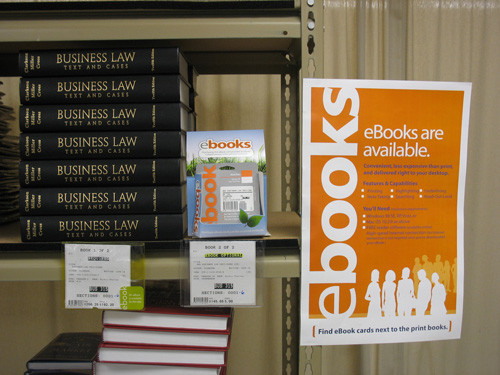
So local college bookstores are doing what retailers facing competition do: holding prices down and staying on top of customer service. It’s even little things too, like at URI where workers moved the cards containing e-book activation numbers next to their printed siblings rather than place them in an area by themselves. That alone has helped boost sales, Whitney said, though many students have no idea the bookstore started offering e-books in 2005.
“A lot of the students are still not quite aware they exist,” Whitney said.
For e-books to really take off, faculty will need to back the idea or students must start demanding them, local administrators said.
One barrier may be sentimental. E-textbooks typically disappear after an allocated time, leaving students with no physical reminder of the course.
“A professor who is passionate about his or her subject matter wants the student to be that way and have something to remember the course by,” said Jane Fusco, a spokeswoman for Rhode Island College.
Some disciplines, however, may be more likely to warm up to e-textbooks, said Laura de Abruna, provost at Roger Williams University. Architecture students may appreciate the depth, colors and perspective an e-reader can provide when showing architectural renderings. But for the classic English major, an e-reader may diminish the charm.
“What you don’t want to do is take “Pride and Prejudice” and turn it into that kind of experience,” de Abruna said. •