Companies that offer 401(k) benefits and the employees that participate in them might be in for a big shock next year.
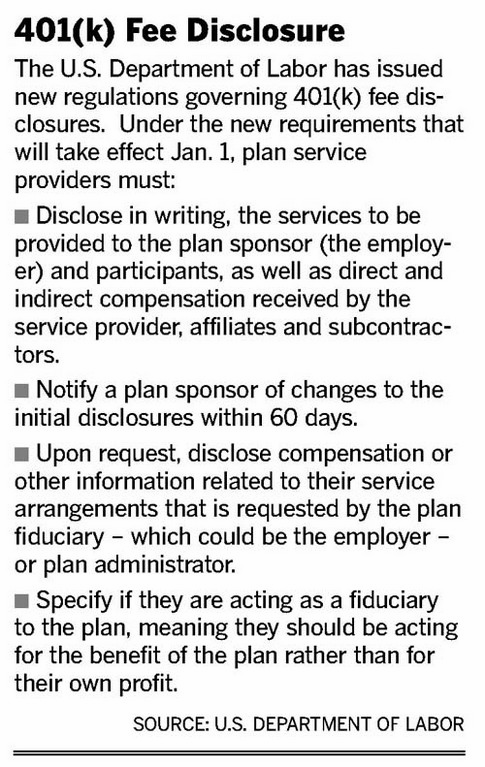
That’s when new U.S. Department of Labor regulations will require providers of those retirement plans, including large firms such as Fidelity Investments – to divulge their fees to both employers and their workers. Benefit advisers and administrators will be compelled to do the same.
Right now, there’s no requirement to disclose the cost of administration, recordkeeping and advisory services tied to 401(k) plans. So, often companies selling retirement plans to employers don’t clearly highlight deals such as revenue-sharing agreements that the providers might have with mutual fund companies.
And there might be other charges for marketing and distribution that have been equally difficult to ferret out.
As of January, those costs that in many cases are paid unknowingly by the workers participating in the retirement plan will be itemized for employers and employees in their quarterly statements.
Department of Labor officials acknowledge that many indirect compensation agreements have reduced the administrative costs, but their complexities have made it challenging for beneficiaries to understand how service providers are paid and how much they’re getting.
Jim Sampson, managing principal of Warwick-based Cornerstone Retirement Advisors LLC, believes both employers and employees will be surprised by what they see after the new rules kick in.
“A lot of companies don’t really understand … the fees that are built into their company’s plan,” Sampson told Providence Business News recently. “And employees? The majority have absolutely no idea about the fees. We commonly joke that employees think their 401(k) is free.”
Sampson said the new Department of Labor regulations, due to take effect Jan. 1, will allow people to get a clearer picture of what they’re paying for retirement-plan services.
Fees have been part of the 401(k) industry for years, but the money being paid to advisers, administrators and other vendors started getting more attention when financial markets collapsed in 2008 and 2009, decimating retirement nest eggs.
Mercer Bullard, a University of Mississippi law professor who also leads consumer-advocacy group Fund Democracy, which pushed for more fee transparency, said measures in Congress requiring fee disclosures encountered “intense pushback” from the financial-services lobby.
Ultimately, the regulations came out of the Department of Labor, where the financial-services lobby “isn’t as well-connected,” Bullard said.
The new rules initially were intended to take effect in July, but they were delayed when some 401(k) service providers said they didn’t have enough time to comply. Now the measures are set to start Jan. 1.
And there are more revisions on the horizon. Another Department of Labor rule change that still is being worked on would expand fiduciary duties to everyone who advises a retirement plan.
The Investment Company Institute, a national association of mutual fund companies, said it has supported the Department of Labor initiatives.
“We think it’s going to provide both the participants and the plan sponsors who monitor plans and service providers with important information they need to make important decisions,” said Michael Hadley, ICI’s associate counsel for pension regulation.
Hadley thinks the new rules are similar to disclosures already provided by large 401(k) service providers for years, although he acknowledged that the new requirements “may require them in a slightly different format, and you need to be careful about what you say and how you disclose it.”
Part of the reason 401(k) fees have been difficult to determine for participants is the complex mix of advisers, brokers, record keepers, investment providers and administrators involved in maintaining retirement plans. In many cases, vendors are serving in more than one of those roles.
Often, fees and costs are identified in the initial contracts with employers, but not outlined again in future statements.
Why should the average 401(k) participant care?
The GAO study of retirement plan fees outlined this scenario: A $20,000 investment in a 401(k) that earns 7 percent annual return, minus a 0.5 percent charge for fees will leave the account-holder with $70,500 after 20 years. The same investment with a 1.5 percent fee ratio would be worth $58,400, or about 17 percent less.
The GAO recommended regulatory changes requiring more transparency.
It’s unclear what kind of reaction the new fee disclosure will get.
Many employees might not read their statements close enough to notice a difference, but a loud minority of employees could be enough to get people worked up, experts said.
And some investment professionals worry that some participants will be flustered enough by the fee disclosures to withhold contributions, said Jamie Worrell, founder of Providence-based GPS Investment Advisors. “[The 401(k) industry] doesn’t want people to think that because they’re seeing a fee that they’re not getting value for it,” he said.
Sampson said there’s another possible scenario: Employees seeing the fees for the first time will think they’re new.
Employers that pay a vendor an annual fee to administer their 401(k) system may be astounded, too. “Most companies have no clue what they’re paying,” Sampson said. “They don’t have to write out a check [for many of the fees], so for them, it’s out of sight, out of mind … companies on the smaller end are absolutely oblivious to it.”
Sampson doesn’t hide the fact that he believes there are opportunities for his company and other registered investment advisers (RIA) to pick up some additional business. As with other RIAs, Cornerstone’s flat fee is already disclosed to client. Sampson foresees employers upset about high fees retaining RIA firms.
“I think it was Warren Buffett who said, when the tide goes out you get to see who’s been swimming naked,” Sampson said. “Well, the tide is about to go out.” •