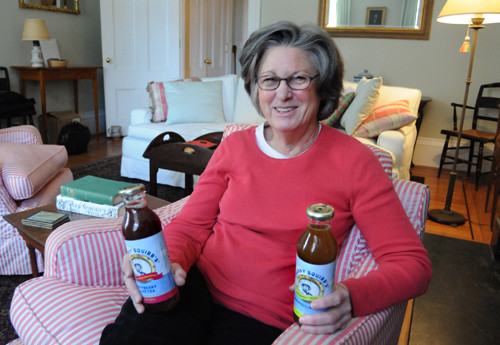
No one made iced tea like Robin Squibb’s grandmother did. She can remember as a child summering in Rhode Island, sitting on the expansive porch of her grandmother’s seaside home in Saunderstown, sipping the delicious lemon/mint iced tea, whose recipe had been in the family for generations. “There was always a pitcher of iced tea in the ice box,” Squibb recalled.
Born in 1890, her grandmother was Sarah Harris Squibb, known as “Sally,” a remarkable woman whose ancestors reportedly came to Rhode Island with Roger Williams and who, among other accomplishments, loved to sail Narragansett Bay and even engaged in sailboat races – a rarity for women in the 1910s and 1920s. Everyone in Saunderstown – family, friends and neighbors – raved about granny’s iced tea.
Now, at least in New England, she will be best known for handing down her tasty iced-tea recipe to her granddaughter.
In less than two years, Robin Squibb, 65, a Providence resident, has made a successful business out of producing and marketing Granny Squibb’s Iced Teas.
Owner of Granny Squibb Co. LLC, Squibb said the beverage – described on its label as “astonishingly delicious” – will be available in 250 stores throughout New England by the end of April. That is an impressive leap from the 175 regional retail outlets that Squibb said carried her iced tea at the end of 2010.
The first bottles of Granny Squibb’s Iced Teas only went on the market in May 2009.
At Brown University’s Blue Room, a snack bar at the new Robert Campus Center, 48 cases were sold in February alone (with 12 bottles per case), Squibb said.
She started with just two flavors (lemon/mint and mojito/lime), but in May will add two more: raspberry/lime and unsweetened lemon/mint.
Squibb has her product bottled at a New Jersey plant; the need for pasteurization, she said, limited her choices because she would prefer doing business with a Rhode Island bottler. She has no office and works out of her home, sometimes using local student interns to help with such business details as the preparation of marketing materials.
The tea is made of natural ingredients, with actual fruit juices instead of flavoring. “It costs more, of course, to use fruit juice rather than flavors, but we’re sticking with juice,” Squibb said. She shuns false advertising about, for instance, antioxidants that other beverage brands so readily boast. “Ready-to-drink tea does not necessarily contain antioxidants, or enough of them, to benefit you,” she said.
And the product comes with a genuine family story connected to the sea, accounting for the maritime touches Squibb uses in her marketing.
On the label of the bottle, the black and white photo of a woman in sailing garb at the helm of a boat is, in fact, Sally Squibb in her younger days. A tiny drawing on the label depicts the Dutch Island Lighthouse on Narragansett Bay. Another sketch shows the two-masted schooner that Sally Squibb and her family once sailed.
There can be little doubt that Granny Squibb Co.’s product is riding the wave of popularity for “buying local.”
“[Buying local] makes sense financially,” Squibb said, because local products require less transportation than others, and “it helps the local economy as much as anything and I think more and more people care about that.” She suggested consumers today also are losing trust in large corporations and she pointed to the “astoundingly misleading” advertisements of some product brands as a major reason for this.
She moved to Providence in 2003, uncertain of her next career move. She remembered how everyone loved her grandmother’s iced tea and she had several people tell her that someone should market it, so she started exploring that idea in earnest.
At first, she couldn’t find a food scientist to prepare an iced-tea formula she found satisfactory for mass production. “Nothing came close. It didn’t taste like granny’s,” she said, so she eventually prepared the recipe herself. She has since retained a nutrition specialist to oversee content.
While she could make wonderful iced tea, Squibb knew absolutely nothing about starting and running her own business.
“I just kept asking everyone’s advice,” she said, eventually acquiring the essential information she needed from programs at the Center for Women & Enterprise, the Small Business Development Center at Johnson & Wales University and the Rhode Island Center for Innovation and Entrepreneurship at Brown University, all in Providence.
So now, Squibb has managed to make and bottle some of that summertime Saunderstown experience she so cherished as a child. What would Sally Squibb think? “We’ve all agreed, my cousins and I, that granny would be horrified to see her picture on the bottles. She was way too modest for that,” Squibb said, adding however that her grandmother certainly would be proud of the successful business she is building. •