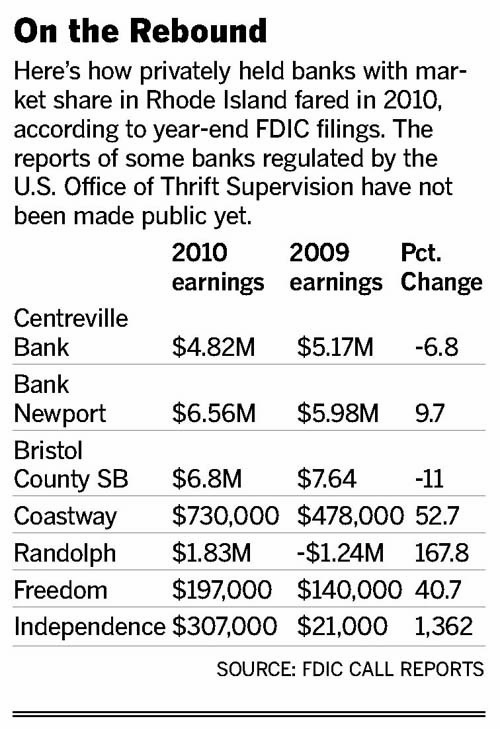
Most of the banks with market share in Rhode Island rebounded in 2010 from lackluster performances a year earlier, reporting higher annual profits in year-end regulatory filings.
Eleven of 14 banking institutions with an Ocean State presence that filed reports with the Federal Deposit Insurance Corp. posted higher net income – in some cases much higher – even though some saw a decline in revenue at the same time.
Privately held BankNewport, for example, reported that its interest and noninterest income declined more than 6 percent in 2010, to $59.02 million. Nevertheless, the bank’s profit climbed more than 9 percent to $6.56 million over the same period.
FDIC data indicate the bank benefited from lower interest rates on deposits, which cut interest expenses by $6.14 million in 2010.
While publicly traded banks release earnings quarterly, the FDIC reports provide a more comprehensive snapshot of the health of banks since even privately held banks are required to report their financial status.
That said, four other banks that do business in Rhode Island are considered thrifts – Sovereign Bank, Union Federal Savings Bank, Admirals Bank and Home Loan Investment Bank – and fall under the reporting guidelines of the U.S. Office of Thrift Supervision. A spokesman for the regulator said those year-end reports will be released in the coming weeks.
Still, it’s clear 2010 was better for most banks than a year earlier when earnings were weighed down by the recession.
Profits climbed higher and, for the most part, lenders reduced the money they set aside in anticipation of bad loans, an indication of improving credit quality.
Last month, publicly traded Bancorp Rhode Island, parent of Bank Rhode Island, and Washington Trust Bancorp, the parent of The Washington Trust Co., reported record 2010 fourth quarters and much improved full-year performance. Newport Federal Savings Bank, also publicly traded, said its full-year net income more than doubled to $1.8 million.
Webster Bank and RBS Citizens, the holding company for Citizens Bank, showed significant improvement after posting big losses in 2009 on writedowns and loan chargeoffs.
While most of the privately held local banks had turnaround years, too, Warwick-based Centreville Bank – No. 9 in Rhode Island by deposits – and Taunton-based Bristol County Savings Bank, which has a branch in Pawtucket, reported smaller profits in 2010, largely because of shrinking revenue figures and bigger loan-loss provisions.
Meanwhile, Bristol County Savings saw its net income shrink by more than 10 percent in 2010 to $6.8 million. The bottom line was hit in part by the bank’s decision to add $4.6 million to its loan-loss provision in 2010 – up from $2.71 million added in 2009 – as the amount of loans Bristol County Savings deemed uncollectable grew significantly. The bank recorded $4.47 million in loan chargeoffs in 2010, up nearly $3 million from a year earlier.
But most local banks saw credit quality – as well as their profits – improving.
Cranston-based Coastway Community Bank posted a net income of $730,000 for 2010, up from $478,000 a year earlier, as it collected $18.97 million in interest and noninterest income, up almost $2 million from 2009.
The smallest banks in the market – Freedom National Bank in Smithfield, and Independence Bank in East Greenwich – held their own, too.
Freedom, which has $86.24 million in assets, said it finished 2010 with a $197,000 profit – up 40 percent from $140,000 a year earlier. A $215,000 increase in revenue to $5.24 million helped partially offset a sizeable increase in loan-loss provision, from $190,000 added in 2009 to $547,000 added last year.
And Independence Bank, with $70.49 million in assets, posted a net income of $307,000 in 2010, up from $21,000 in 2009. The bank said it had $5.97 million in revenue for 2010, down from $5.53 million a year earlier. But the bank also lowered its full-year, loan-loss set-aside from $606,000 added in 2009 to $162,000 added last year.
Randolph, Mass.-based Randolph Savings Bank, which has offices in Cranston and Coventry, swung to profitability in 2010, posting a $1.83 million profit for the year compared with a $1.24 million loss in 2009. The bank also cut the amount it added to its loan-loss provision in half, to $1.34 million. •