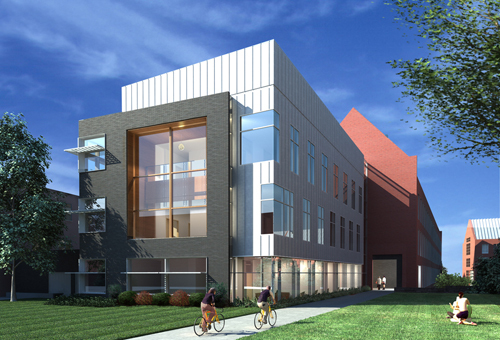
The University of Rhode Island is poised to expand and improve the education pharmacists receive at its well-regarded College of Pharmacy with the ongoing construction of a new $75 million home for the pharmacy school, which is on track to open in early 2012 in the north district of the South Kingstown campus.
The five-story, 150,000-square-foot structure, marked by a New England-style gable roof and plenty of windows, was designed by Payette Associates Inc. in Boston, funded in large part by a $65 million voter-approved state bond, with the rest of the funding coming from private and industry gifts.
While the structure no doubt will be a stunning addition to the URI campus in architectural terms, what goes on inside is what matters the most.
The new building and its accoutrements will improve teaching methods and educational opportunities in pharmacy at the state’s largest university, according to Ronald P. Jordan, dean of the College of Pharmacy at URI. Those changes range from increasing the size of laboratories to sophisticated advances in simulation and 3-D presentations.
“The role of the pharmacist is changing and becoming more important than ever,” Jordan told Providence Business News. Pharmacists today deal a lot more directly with patients and customers than in the past, he said, and work more closely on a routine basis with doctors and nurses.
Consider, for instance, the six-year program to earn a doctorate degree in pharmacy. The program now can accommodate 100 students but, with the added space and amenities of the new building, it will be expanded to 130 students, Jordan said, so the college will be sending 30 more new pharmacists into the work-world each year compared to the current level.
The amount of space the pharmacy college now occupies at Fogarty Hall will double in its new home, Jordan said, increasing not only the size of laboratories and classrooms but also their number. One use of the new space will see parts of the building devoted to what Jordan called “neighborhood areas,” such as a reading room, where pharmacy students can congregate and soak up the educational atmosphere.
An auditorium in the new college will be equipped with 3-D capabilities, Jordan said, explaining that use of 3-D projections is essential to the teaching of various subjects related to pharmacy, such as chemistry, biology, anatomy and physiology.
The auditorium will be named for URI alum Ernest Mario, who sponsored its construction, Jordan said. He also revealed that college officials are working to obtain a Champlin Foundations grant to further enhance the school’s 3-D capability.
Pharmacy students already train at a simulation center, where various health care settings are replicated, but the new college will have a “significantly” larger center that will look and function as an actual hospital environment for the team-training of pharmacy and nursing students, Jordan said. He explained the two types of students often train together because they must learn each other’s roles. Already in use are high-tech mannequins and actors recruited to portray patients.
In addition to state-of-the-art classrooms and wireless access throughout the building, Jordan is excited about the up-to-date laboratories that will be part of the college’s new home. Research experience in the labs is a crucial part of a pharmacist’s education, he said, and an aspect that URI in particular emphasizes. He noted, with pride, that the pharmacy college this year brought in $11 million worth of research awards, the highest amount in the college’s history.
A program that began last September and relies on extensive laboratory experience, Jordan said, is the bachelor of science program in pharmaceutical sciences, which prepares students for careers in the pharmaceutical, consumer products and health care industries, to cite just a few. The program accommodates 50 students.
In the new building, there will be a high-tech manufacturing center that will “allow us to actually manufacture [pharmaceutical] products” in a certified clean space, Jordan said. The center will be used to train students and will enable the college to work with pharmaceutical companies on the testing, development and approval of new products, he explained.
According to data supplied by the college for 2007-2008, the most recent year available, 527 students were enrolled in URI’s doctorate program in pharmacy, 53 were graduate students and 14 were conducting post-doctoral studies. The graduation rate was 95.4 percent and placement rate upon graduation was 100 percent. Such a high placement rate is generally the case at most pharmacy schools due to the need for pharmacists; one industry group estimates that there are 7,000 to 10,000 vacancies nationwide at any given time. •