When the value of Brown University’s $2 billion-plus endowment began to plunge last year, administrators knew budget cuts wouldn’t be too far behind.
And the university’s ambitious $800 million, 10-year capital plan seemed a likely place to use the knife.
Other schools suffering similar double-digit endowment losses postponed or canceled construction projects, and questions arose about the scope of Brown’s plans, which included several new building projects in the coming years.
“We took a good, hard look at it, and we said we can’t do all of it,” said Elizabeth “Beppie” Huidekoper, the school’s executive vice president for finance and administration. “We didn’t know where the bottom was, and we probably still don’t.”
Yet, despite the financial woes, university officials are pushing forward with a capital plan that they insist, while less ambitious, addresses the school’s needs for the next few years.
A proposal to erect separate fitness and aquatic centers on Hope Street at the cost of $60 million has been changed so it combines both uses in one building. Savings: $20 million.
And a new $69 million, 80,000-square-foot building for brain behavior studies has been scrapped. Instead, university administrators have proposed to renovate a 75,000-square-foot building. Savings: $27 million.
Also gone from the plans: construction of a new $80 million medical-education center in Providence’s Jewelry District. It has been replaced in the capital plan by more renovations. Savings: $35 million.
The changes and other tweaks add up to about $150 million in cuts, but Huidekoper maintained last week the plan remains “robust.”
“We haven’t stopped,” she said. “We’re thrilled we’re able to go forward.”
The sickly economy has certainly thrown up its share of roadblocks in the last year. The school’s endowment tanked along with the financial markets, sinking 26.6 percent – or $740 million – to $2.04 billion as of June 30. Those losses led to widespread budget cuts, including layoffs, and other positions left unfilled.
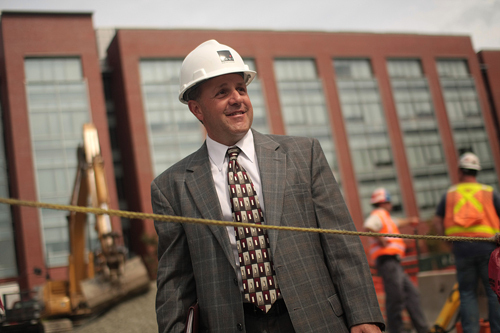
Last week, tradesmen toiled in a gaping, dusty hole along Angell Street that will eventually be the basement of the $45 million, four-story Perry and Marty Granoff Center for the Creative Arts.
Elsewhere, scaffolding covered the Stephen Robert Campus Center at Faunce House, which is undergoing $20.8 million worth of renovations.
The ongoing work follows a recently completed $12 million restoration of Rhode Island Hall – which houses the archaeology department – on the campus’ main green. That was part of the $35 million construction work completed during the summer break.
And that was in addition to the more than $250 million worth of capital projects completed on campus since 2002.
The work at Brown is certainly welcome for the construction industry as a whole. State labor officials said the sector lost 900 jobs in August, many of them specialty-trade contractors.
The desperation is showing. Maiorisi said contract bids for some projects have come in as much as 30 percent lower than projected as companies cut charges to be more competitive.
Some at Brown are pleased that a few capital projects have been scaled down.
For instance, the university had planned an $80 million medical-education building in the Jewelry District slated to be completed some time in 2012 or later. But only half of the price tag would have been covered by donations.
Now it’s Plan B, a $45 million proposal to renovate a Brown-owned building at 222 Richmond St. Projected completion date: fall 2011.
The Brown medical school faculty “is thrilled that it is going to happen faster,” Huidekoper said. •