Regardless of the problem – recession, health care, climate change – technology is an oft-cited solution. A new machine or computer program will provide the cure for what ails us, or so the thinking goes.
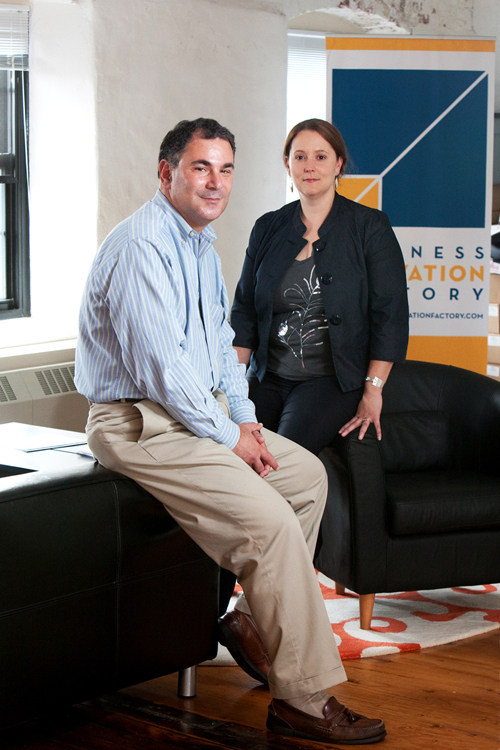
Not so fast, says Saul Kaplan, who has been working full-time as head (official title, chief catalyst) of the nonprofit Business Innovation Factory (BIF) since departing as the R.I. Economic Development Corporation’s (EDC) chief in December.
“We have more technology than we know how to use today,” Kaplan said recently. “The problem isn’t technology, the problem is us humans – we’re stubbornly resistant to change, and the organizations we live and work in, whether public or private, are also stubbornly resistant to change. That’s the problem.”
And BIF, he hopes, can help to develop solutions.
The Business Innovation Factory is hard to pigeonhole. It was founded five years ago by Kaplan as an independent nonprofit, but started off housed and led by officials at the EDC. Part think tank, part research-and-development shop, BIF is flexible in its activities but firm in its guiding principles.
“BIF is a laboratory for social innovation,” Kaplan said. “We focus on systems-level change,” whether those systems are companies, government agencies or society at large.
BIF has seven full-time staff members and about a half-dozen project consultants. The organization is funded by its seven member companies – which include some of the state’s largest firms, like CVS Caremark Corp., Lifespan Corp. and Hasbro Inc. – who get early access to BIF’s research and V.I.P. access at the organization’s events.
But what does BIF actually do? Its primary activities are its “laboratories,” research projects focused on three areas: health care, education and energy. “It’s our belief that all of these have in common that they are systems issues – that they are well-intentioned systems that have evolved, but that we need to rethink each … that tweaking the current system is not going to take us where we need to go,” Kaplan said.
Those three areas also happen to be the exact same ones that are the top priorities identified by the Obama administration, and Kaplan thinks that is no coincidence. “I think these are the three big, compelling social challenges of our time,” he said.
“I worry about the same thing in health care,” he said. “Just putting billions of dollars into the current system with new technology might make the current system a little more efficient, but it isn’t going to create the kind of systems change we need.”
In addition to its health care laboratory, the Nursing Home of the Future, BIF recently started a new Student Experience Lab to focus on improving the collegiate education experience. In addition, Kaplan hopes later this year to launch a third lab focused on energy that would take a group of Rhode Island homes and experiment with new methods of increasing their energy efficiency.
In addition to the labs, BIF’s marquee event is its annual summit, which brings together leaders from the corporate, academic, nonprofit and government worlds to share and discuss ways of successfully pushing innovation. This year’s “storytellers,” as the unpaid speakers are called, include new media guru Jeff Jarvis and Coca-Cola Co. executive Keith Wilmot.
Tickets to the two-day, 300-seat event at Trinity Repertory Company in October start at $1,000 and are selling faster this year than in previous years, said Melissa Withers, who followed Kaplan from the EDC to become BIF’s executive director. “We sold out in each of the past three years, and we’ll hopefully sell out earlier than before if this keeps up,” Withers said.
Kaplan, who also has begun writing a regular column for BusinessWeek magazine’s Web site, said he sees the growing interest in BIF’s annual summit as evidence of the organization’s growing national reputation. But, he added, there is much more to do.
“I often say it’s both a blessing and a curse to be an innovator, because you’re constantly challenged to find a better way,” he said. “There’s always a better way.” •