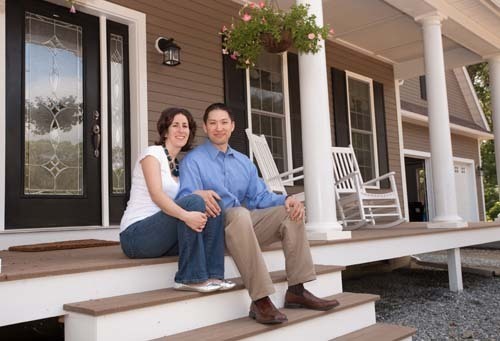
Keith Marshall, manager of communications and marketing at Bank Rhode Island, hasn’t sneezed much since moving into his new, green home. Not that he was sneezing a lot before his move, but in his new home there’s little or no dust to cause him to sneeze.
The house, with six inches of insulating foam and windows meant to conserve energy, doesn’t have the coveted National Green Building Association’s Leadership in Energy & Environmental Design (LEED) certification. But it is still tight enough that most air pollutants can’t make their way inside.
“It’s so airtight in my house, that we have to have an air-exchanger to let in fresh air, otherwise we wouldn’t get the right amount of oxygen,” said Marshall, who moved into the house with his wife, Marlene, in May. “The cool part about that is that even the air-exchanger is energy efficient.”
The home is the first that MEJJ Development has completed at its Cumberland development, The Wooded Acres at Overhill. Another two are in construction. All the homes will all be green, said Joseph J. Samra III, who runs the company. While the homes don’t have LEED certification, they are designed to be gold-level certified by the National Green Building Program, a National Association of Home Builders program.
The R.I. Builders Association recently endorsed that program, which was founded last fall.
“LEED is a great process, but what’s great about the NAHB process is that it was created from the perspective of the builders,” Samra said. “Whereas LEED can be seen as being very heavy from the engineering and architectural [demands], this understands where builders are coming from.”
One of the biggest differences between the two systems is that the NAHB program allows the builder a greater ability to choose which elements will be the most green. So if a builder wanted to increase the water efficiency or indoor environmental quality levels and only do the minimum for lot preparation, doing so would be allowed by the NAHB program. That leaves the builder with the ability to choose the cheapest of the green elements.
“The great thing about the NAHB process is that it’s more cost-effective and a little bit less paperwork,” Samra added. “So it’s a faster turnaround and does the exact same thing.”
The Marshalls’ house is set to cut the couple’s annual energy bills by about $1,500, according to Samra.
“It’s green for the mainstream, so the decisions that we made are pretty much within reach of the middle-class buyer,” Samra said. “And the payback is seen in five to seven years.”
The construction cost was about 2 percent to 3 percent greater than the typical cost for a similarly sized 3,000-square-foot home in a similar location, Samra said. The added cost to build a LEED home can be “five or six times” greater than being NAHB-certified.
The whole point of creating a green building is making it affordable over time, added John Tabor Jacobson, a commercial developer working at JTJ Investments Inc.
Although the rise of the LEED designation for projects and professionals has quickly become prestigious, Jacobson said he’s wary of it becoming the “rule” for construction.
And a lower-cost ‘green’ design will further help development in the area, he added, “because if someone can rent my place … and it’s the same price as another development that’s not green, they’re going to go green.”
Keith Marshall would certainly agree.
“I don’t know why anyone wouldn’t want to live in a green home,” he added. “From the new construction side, it is so cost-effective now. We don’t have solar panels and we don’t have radiant heat because of the price, but there are so many other things you can do.”
In his new home there are design elements that, he said, make sense for any homeowner. The toilets, for example, allow a choice of flushing: about 0.6 gallons or 1.2 gallons per flush, depending on the use. The house has a tankless hot-water heater. And its siding, made from recycled wood and concrete, should last for at least five decades, Marshall said.
“Never mind being environmentally conscious, say you have someone with bad allergies or asthma, it will be more appealing because of the filtered air,” Marshall said. “And, if anything, it would help the resale value.” •