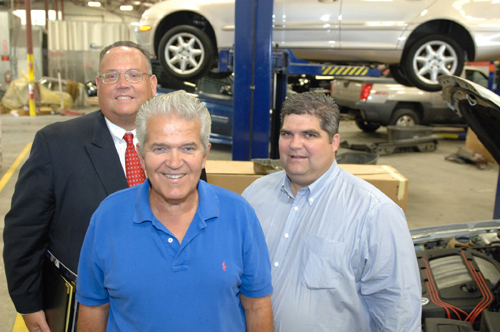
Carl Garcia’s father and namesake had worked since 1961 in automotive repairs, before going out on his own in 1994 when he opened Carl’s Collision Center in a 5,500-square-foot Fall River garage. The father and son worked together for years and recently, the younger Garcia started to take on a larger role in the company.
“I had this vision of this perfect kind of body shop that I wanted us to become,” the younger Garcia said in a recent interview. “I probably had 10 or 12 employees at the time and I wanted to double my work force, get Mercedes-certified. I had this dream of working on high-end cars, becoming the Nordstrom of the auto-body industry.”
Now, Garcia is in a 33,000-square-foot building and has built a “library” of information about cars he’s fixed and painted. He employs about 60 people and has a workload of about 120 cars each week. “I had big dreams, but they actually all came true,” he said.
But with that growth, Garcia started to worry about 18 months ago. How would the company that he helped build make the generational leap? It was still owned by his father, who was semi-retired and living in Florida for more than half the year.
Cue David J. Correira, an attorney and principal of the real estate planning firm Correira & Iacono LLP. “Just because there’s a down economy, it doesn’t mean there aren’t opportunities for estate planning,” Correira said recently, “whether it’s officially moving [the elder Garcia] to Florida and eliminating income tax and estate tax or taking advantage of discounted values and discounted interest rates to restructure a business.”
Correira added that businesses should be looking at future planning at all times. In boom times, many are worried that their gains will be too heavily taxed. But in a down economy, when there seems to be a lot of “motivation” from fear of losing assets, Correira’s business picks up. “Of course, a lot of times it’s fear and a lot of times it’s greed, which is fine because that’s what drives capitalism,” he said. “Greed does not have to be a four-letter word. It’s a motivator in capitalism and there’s nothing wrong with it.”
He added, “Whether it’s transferring a business or restructuring a business to get children involved, you now have a situation where the transfers are going to be based on lower value – therefore, there’s a potential to get assets out of your estate and gift assets at a lower value.”
And that’s what Correira helped the Garcias with. Under Correira’s guidance, the younger Garcia recently bought some controlling shares and other stock in the company. “So now the children can purchase from a family member an asset at a reduced price and a reduced interest rate,” Correira said. He added that interest rates for gifts – if the company had been gifted – have dropped from about 6 percent to about 2 percent.
Under Correira’s guidance, Carl’s Collision also took advantage of a 1031 Exchange, which helped cut the capital gains tax they earned from selling their previous building. That tax, including federal and state, is between 15 percent and 20 percent, Correira said, but “by doing a 1031 Exchange, you can sell a business property and purchase another business property, essentially rolling over the net sales price into the next entity. So you’re not paying any capital gains tax. That was something the Garcias were able to do.”
There had been an estate succession plan for Carl’s Collision, Garcia said. But it was not comprehensive.
And for those who haven’t overextended themselves, like Carl’s Collision, now is a good time to lay the groundwork for growth, Correira said. “In this downward economy, I see this as the planning stage,” Garcia added. “It’s allowing me to build equity in my business.”
And the transfer of some of the business wasn’t the only proactive step that Garcia took for the company’s security. “Right when this downward economy started, we went and refinanced our business and put all of our notes in line,” he said. “We rewrote the mortgage on the building. We set up a line of credit that could help us through this economy, so that we could prepare ourselves to be ahead of the curve when the economy does change.”
That includes investing in a new kind of painting material and also increasing Carl’s Collision’s geographic reach. Many of the cars that they now handle come from Boston and some from as far as New York, he said. He’s training his employees and attempting to increase “cost effectiveness.” Sometimes he’s out on the floor, “asking my employees, ‘How much primer do you really want to use on that car?’ ”
And that’s what estate planning is about, Correira added. Along with ensuring that the assets that have been built are secure, “it’s also about moving the business to the next generation, so the next generation can start implementing their plan now.” •