As Brown University’s multibillion-dollar endowment started to lose value last year, the university had to make some tough choices about its capital projects. The school, in the middle of a 10-year master-planning project that included new laboratories, walkways and infrastructure, had planned to grow through alumni giving and structuring its debt based on the size of its endowment.
Not only did the endowment take a hit of almost 30 percent – it has dropped from $2.78 billion to about $2 billion – but alumni donors have reduced their spending since the recession started, Executive Vice President for Finance and Administration Elizabeth Huidekoper said in a recent interview. The way the university funds its projects is not expected to change, “therefore, our ability to carry the cost of incremental debt is not what it was,” she said.
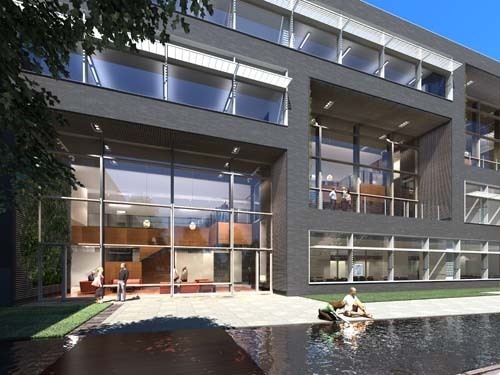
That spelled trouble for the Mind Brain Behavior Building, a planned project now on hold. “At this point, we’re saying we can’t anticipate doing any debt funding,” Huidekoper said. “We should not plan on debt funding and we’ll have to gift-fund. But … the ability to fundraise hasn’t been increased in this [downturn].”
“We have to prioritize,” Huidekoper said.
Prioritizing of projects based only on need – not based on a school’s “wish list” – is happening at colleges throughout New England, said Mark J. Zarrillo, a principal and architect with Symmes, Maini & McKee Associates. Zarrillo has for years specialized in campus redesigns and new higher education buildings.
SMMA, which opened a Providence office last summer, has five higher education projects under way – including a renovation of Providence College’s Slavin Center and a few renovations at Suffolk University in Boston. All of the current construction projects were started before the economy soured.
“They aren’t big projects, but they are projects that are continuing because the schools have decided they need to supply these student services,” Zarrillo said, adding that there’s been a jump in building redesigns to replace stalled new construction.
Zarrillo added that the staffs for university capital projects can now pursue those smaller projects more easily, because of dropping construction costs. “So for that reason, there is no lack of RFPs out there for us to respond to,” Zarrillo said. “The problem is that when we respond, there are 30 other firms” to compete with.
The University of Rhode Island, for example, has funded much of the last five years’ campus growth and redesign through voter-approved general obligation bonds – repaid by the state – and government appropriations.
“The endowment loss, which everybody has exhibited, has no impact on our operational money,” Vice President of Administration Robert Weygand said, adding that the supplemental budget recently approved by lawmakers cut just $1.5 million from that operational money. “We can sustain that.”
The school has put out an RFP for a $75 million College of Pharmacy building – part of a new technology-based quadrangle on the school’s Kingston Campus – that will be funded by a bond and about $10 million in gifts, about $6 million of which must still be raised. Also on campus, a new dormitory to house about 350 students is now being designed by Lerner, Ladds + Bartels Inc. And Roger Williams Dining Hall is being redesigned to be a student-wellness center.
“There has been no indication that those will be postponed or delayed in any fashion,” Weygand said.
At Roger Williams University, the school’s campus-wide, five-year strategic plan is set to wrap up this fall, said President Roy J. Nirschel. The plan includes building a 125,000-square foot dormitory, a 10,000-square-foot admission center, an expansion of the school’s marine science center, new parking and tweaks to campus infrastructure and sewer systems.
The projects total about $95 million and were fully funded years ago, before the recession started, Nirschel said. So in RWU’s case, the successful campus growth was largely the luck of timing – not only were the projects planned, funded and ready to start before the economy turned sour, but construction costs started dropping when work did begin.
But at PC, where Zarrillo designed the Slavin Center renovation, the school’s administration has had to prioritize construction projects.
Assistant Vice President for Capital Projects Mark Rapoza said that the 38-year-old, 62,455-square-foot Slavin Center is getting an approximately 8,800-square-foot addition, including a glass curtain-wall atrium. The estimated $6 million project broke ground in the fall and is expected to be completed on time by August 14, he said, around the time that students return to school.
Chris Fortunato, associate vice president for student affairs, said the building was deeming more important than other projects because of the social benefits that it will bring to the campus. The redesign includes a 24-hour restaurant, radio and TV production center and public meeting space.
“Father [Brian J.] Shanley, our president, has made it clear … that obviously, given the slowing economy that we’re in, it may in fact impact the pace of certain capital projects that are strategic to the school,” said Edward J. Caron, vice president of college relations and planning. Caron said there are projects on campus that have been “deferred.” But because the school hasn’t resubmitted those changes to the city as part of a master plan update, he declined to name them.
At Brown University, Huidekoper said the bigger capital projects – like the Mind Brain Behavior Center – get put on hold because there are projects with higher priority, including replacing utilities and updating the computer network on campus.
And even for those schools that have been successful with capital projects this year, the need for new, expanded and state-of-the-art academic space is never-ending.
“This is the second wave of about $100 million worth of projects over the last eight years,” RWU’s Nirschel said. “So we’re going to catch our breath, celebrate the grand opening this fall and then look at some other projects going forward.” •