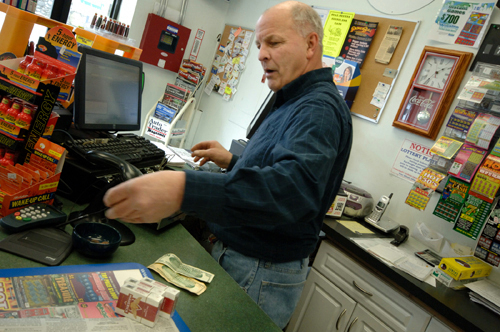
A year ago, weak sales forced Steven Biron to lay off workers at New England Farms, the convenience store he owns near the Rhode Island-Massachusetts border in Burrillville.
But then Bay State lawmakers hiked their cigarette tax, making a pack nearly $1 more expensive there than in Rhode Island – and Biron’s business boomed as smokers streamed across the border to stock up. Sales of lottery tickets, food and other items jumped as well, and Biron hired two more workers to keep up.
But with Smith Hill lawmakers considering a $1-a-pack hike in the state cigarette tax, which would make Rhode Island’s the highest rate in the country, Biron fears his sales soon could plummet once again.
“I can almost guarantee that people who are still going to smoke will still pay the money, but now they are not going to buy the candy bar, they are not going to buy the lottery ticket,” he said.
The proposal to hike the cigarette tax from $2.46 per pack to $3.46 would provide most of the $24.1 million in tax and fee increases called for by Gov. Donald L. Carcieri in his plan to close the state’s $357 million budget deficit. In a speech on Jan. 7, he said the proposal “eliminates this deficit, and does so without raising broad-based sales or income taxes.”
Plenty of people will feel a cigarette tax hike, though. The number of Rhode Islanders who smoke is a declining but still sizable 17 percent of adults, or roughly 141,000 people, according to the Campaign for Tobacco-Free Kids, an advocacy group.
“We’re going to drive business away from the state,” said Diana O’Donoghue, executive director of the New England Convenience Store Association, adding that it could lead stores to cut jobs. “It’s an unbelievable burden.”
Forecasts of how much money the tax increase will generate have been revised downward since Carcieri’s speech, but state tax experts still estimate it could result in $13.1 million more revenue in the current budget year and $29.9 million more next year.
While upset about the proposed tax hike, Biron and other independent store owners are even more incensed about the governor’s proposal to eliminate the state law that sets a minimum price for cigarettes.
Cigarette sales make up 40 to 50 percent of convenience store sales in Rhode Island, according to O’Donoghue. Without a price floor, her members fear larger retailers like Wal-Mart and CVS would undercut convenience store business by selling cigarettes as a loss leader.
But Carcieri’s spokeswoman, Amy Kempe, said removing the minimum-price rule would reduce the tax hike’s impact of consumers.
The House Finance Committee sided with the store owners, voting on Feb. 6 to approve the tax increase but also to keep the minimum-price rule in place. Carcieri, however, signaled his opposition to the committee’s version of the bill. The full House in turn voted to send the package back to the committee. The tax hike, which would have taken effect Feb. 17, now faces an uncertain future.
Kempe criticized lawmakers for not acting on the governor’s full supplemental spending plan, which included the proposed tax hike and other structural reforms. But a House spokesman said legislators had hoped to act on the tax hike as soon as possible to help stem the red ink.
Lawmakers have voted to increase the state cigarette tax eight times since June 1993, when it stood at just 37 cents, according to the Rhode Island House Fiscal Office. O’Donoghue called it “a regressive tax,” and estimated it costs the average smoker more than $1,400 a year.
At the same time, smokers are also being hit by increased prices from tobacco companies and a 61-cent increase in the federal cigarette tax set to take effect April 1.
Paul Dion, chief of the R.I. Office of Revenue Analysis, has estimated the average price in Rhode Island could wind up at $8.93 per pack, compared with $9.05 in Massachusetts. •