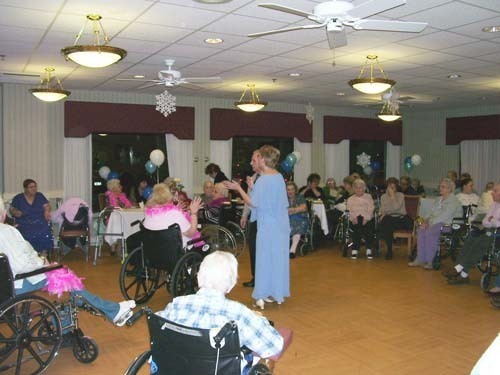
Bunny Placco searched “far and wide” before picking a nursing home for her mother, Barbara Holmes, when she became too frail to live with her. As a volunteer at Women & Infants Hospital, she’d visited many homes before, but she was still overwhelmed.
Not knowing where to begin, she visited places she knew about or were recommended by friends. She met with a consultant who was of no help.
So she made a short list, based on the best word-of-mouth information she could gather, and visited several homes. Some were nice and homey. One was enormous and institutional. The fanciest one she visited felt all wrong, with big, fake floral arrangements.
The Tockwotton Home stood out immediately.
“My immediate reaction was not only how beautiful it was, but the openness and the warmth that was extended to me when I came in,” she said. Dottie Shea, the nursing director, offered to visit her mother in her house, and came over for tea one afternoon.
Holmes, now 96, has been at Tockwotton for four years, and it’s a great fit for her, Placco said. Oh sure, there are problems, with the laundry and boredom and not enough people who are as sharp-minded as Holmes to spend time with. But overall, the food is good, the place is always homey and serene, and the staff does a great job.
Placco’s approach to picking a home is what many in the industry would tell you is the ideal: get good recommendations, figure out what your parent’s needs and preferences are, then visit each home, look around, have conversations and find the best fit.
Yet this is the Internet era, and health care leaders across the country are pushing consumers to be more systematic to find the best values and the best care. It’s called “consumer-driven health care,” and last month, the Centers for Medicare & Medicaid Services made it easier to do with nursing homes, unveiling a five-star rating system on its Nursing Home Compare site.
Visit www.medicare.com/NHCompare and you can find a rating for the 15,800 nursing homes nationwide that accept Medicare or Medicaid payments: an overall rating, plus individual ratings for performance on annual inspections, staffing ratios and “quality measures” – a distillation of 11 of 19 measures that CMS tracks, from how many residents get flu shots during flu season, to how many have bed sores, to how many are depressed or anxious.
The goal, CMS said in a written statement, is “to provide unbiased information for the public on key measures surrounding quality of care.”
Tockwotton got four stars – though only one star for “quality of care,” a rating that administrator Kevin McKay said he is still trying to understand, but that may be due in part to the fact that Tockwotton is small, it steers stronger and healthier seniors to its assisted living unit and it has several residents in hospice care.
But while plenty of local nursing homes got good ratings, Tockwotton’s one star for quality wasn’t the only surprise. Virginia Burke, executive director of the Rhode Island Health Care Association, which represents mostly for-profit nursing homes in the state, noted that “some of the best nursing homes in the state” got only two stars.
And even though Rhode Island’s nursing homes have the fewest violations, on average, per inspection and led the nation in 2007 in family and resident satisfaction surveys, Burke noted, the star system doesn’t reflect that. Because each state has different regulations and inspectors, the system instead ranks homes relative to others in the same state.
“When you compare them to themselves, there’s got to be an A, B, C and D, and when you compare them to the country, maybe those homes would be five-star homes,” said Hugh Hall, RIHCA board chair and administrator of West View Health Care Center, which got five stars.
Jim Nyberg, director of the Rhode Island Association of Facilities and Services for the Aging, which represents nonprofit homes, offered similar criticism, noting that while his group supports “a consumer-friendly nursing home rating system based on reliable, quality information that the public can understand,” this one could be misleading, because it’s based on data “subject to a great deal of variability.”
Orlando Bisbano Jr., a RIHCA board member and administrator of Orchard View Manor Nursing & Rehabilitation Center, in East Providence, said the way CMS processed the data makes it inscrutable even for nursing home experts, and even more for consumers.
“It literally is a black box that they throw the numbers into and the stars come out of it,” he said. His own facility does very well in family and resident satisfaction surveys, and R.I. Department of Health surveys and quality indicators place it at or above average, but CMS gave it two stars in everything but staffing (for which it got three).
It doesn’t make sense, Bisbano said, and it’s a bad way to guide consumers, because the stars aren’t based on well-proven measures of actual quality of care, and they certainly won’t reflect what people are most concerned about, which is what it’s like to live in that facility.
Gail Patry, director of long-term care at Quality Partners of Rhode Island, said the best approach is to use the five-star system, plus reports available on the Department of Health Web site, plus resident and family satisfaction reports, in combination with one another, and all just as a starting point – never as a replacement for visiting a home.
“Are the residents engaged, or are they just sitting there with a far-away look?” she said. “Are there signs the nursing home encourages individuality, like when you look at the people’s rooms, are there signs that there are people living in them, or does it look like the Comfort Inn, and all the rooms look the same?
The state’s own focus is shifting more toward what consumers’ priorities are, said Ray Rusin, director of facilities regulation at the Department of Health, such as individualized care, and tools will get better, locally and nationally, over time. •