
Gov. Donald L. Carcieri’s chief energy adviser says the state’s ambitious plan for a huge offshore wind-energy farm is still on track despite running into some complications in recent weeks.
Rhode Island officials working on the wind project were caught off guard by two developments: first, the abrupt departure of the CEO of Deepwater Wind (READ MORE), the firm picked to build the project; and second, the unexpected emergence of a competing proposal from a company based in Seattle. (READ MORE)
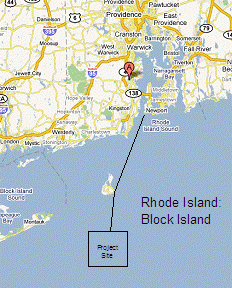
It is the latter that has caused the most alarm among state policymakers, because the proposal – to build 100 large towers south of Block Island that would generate electricity from wave-driven “oscillating water columns” and also from wind turbines – has placed Rhode Island at the center of an ongoing turf war between two federal agencies. The outcome could potentially tie up a section of the ocean that has been seen as a promising location for the wind farm.
The Federal Energy Regulatory Commission (FERC) has begun its review of the new permit application, filed by a year-old, Seattle-based company, Grays Harbor Ocean Energy Co.
Grays Harbor has asked to be granted the exclusive rights for at least three years to a 96-square-mile area of federal waters 12 to 25 miles to the south of Block Island. The company proposes to put up a 5-megawatt demonstration project in 2011, followed by the full project in 2016.
FERC estimates the project would generate an average of 300 gigawatt-hours of electricity per year, which would be transmitted to Block Island and the mainland. The company predicts the total cost of the project would be between $400 million and $600 million. The public has until Jan. 28 to comment on the proposal.
In an interview, Grays Harbor president W. Burton Hamner described himself as a clean-technology consultant and a coastal-zone management expert. He expressed enthusiasm about the project’s potential, saying it would provide renewable energy and new jobs.
State officials and the U.S. Army Corps of Engineers did not find out that FERC had received Grays Harbor’s application until Grover Fugate, executive director of the R.I. Coastal Resources Management Council (CRMC), received a copy that had been forwarded to him by the U.S. Minerals Management Service (MMS).
“It would have been nice if [FERC] had let us know – to be collegial,” Fugate said.
Hamner said he had planned to reach out to the state, but FERC processed his application more quickly than he had expected. He plans to visit Rhode Island in January to explain his proposal.
Fugate said it was unclear from the documents he reviewed whether Grays Harbor’s proposal is within the scope of the R.I. Ocean Special Area Management Plan (SAMP), the coastal-zoning rulebook that his agency is currently developing with the support of the University of Rhode Island Coastal Resources Center and Rhode Island Sea Grant, and the participation of the U.S. Minerals Management Service, Army Corp of Engineers, R.I. Department of Environmental Management and other agencies. (READ MORE) But since the SAMP is not yet finished, FERC is not required to follow it, he added.
Andrew C. Dzykewicz, commissioner of the R.I. Office of Energy Resources, said he was “very surprised” when Fugate informed him of Grays Harbor’s plans. The state has not decided how it will proceed, but Dzykewicz was scheduled to speak with Hamner last week.
Industry experts say FERC’s quick action on the Grays Harbor project is part of a larger battle between FERC and MMS over which agency has jurisdiction over offshore hydroelectric projects. FERC staked its claim to regulate those projects in October, citing its authority over onshore hydroelectricity. But MMS says a federal law passed in 2005 gave it jurisdiction over all ocean energy projects.
“To be honest, my first thought when I saw this was, what took somebody so long to do that?” said Carolyn Elefant, counsel to the Ocean Renewable Energy Council, a trade group that lobbies for the industry in Washington, D.C.
“It was an inevitable product of the overlap between MMS and FERC jurisdiction, and this is the kind of thing we’re going to see more of,” she said. Elefant and other observers expect the Obama administration or Congress to resolve the issue next year.
The permit request filed for the Block Island project was one of seven nearly identical applications (for projects on both coasts) that Grays Harbor filed with FERC on Oct. 22. Elefant said she fears that companies will try to start “banking” offshore energy locations, and Dzykewicz expressed the same concern.
“These people seem to have filed FERC permits pretty much on top of every site that has already been picked by somebody else in different jurisdictions,” he said, referring to Grays Harbor. “We’re somewhat concerned about the tactic they’re using, frankly.”
Hamner denied that his company was angling for squatter’s rights at the offshore locations. “The site we picked is the only site that is feasible for the technology package that we have determined will work,” and applying to FERC is also far less expensive than applying to MMS, he said.
There are also questions about how much potential there is for wave energy off Rhode Island. Fugate said studies by the Army Corps and the electricity industry have found that wave-energy projects “wouldn’t be economical” along the state’s coast using existing technology.
To deal with that, Hamner said, Grays Harbor is now looking at the possibility of adding a natural gas power plant to the offshore platform as a way of stabilizing its electricity output.
Separately, the corporate leadership of Deepwater Wind has also been in flux following the abrupt departure of the company’s CEO, Chris Brown, who had been the public face of the company in September when it rolled out a plan to build a 100-turbine wind farm off Rhode Island’s coast.
Brown’s departure, at some point last month, was not disclosed publicly until Deepwater received inquiries about it from Providence Business News.
Tony Meggs, chairman of Deepwater’s board of directors, said the company’s chief operating officer, Chris Wissemann, will serve as interim CEO while the company looks for someone to replace Brown. Wissemann, a Brown University graduate, founded one of Deepwater’s predecessor companies.
Dzykewicz said Brown’s departure would not affect the development of the wind farm. “This is a very vibrant industry – people move around all the time,” he said. “Do you like consistency? Sure. Was it a surprise? Yeah. But is it a big deal? No.”
Dzykewicz expressed continued confidence in the state’s choice of Deepwater, saying the company is in better financial shape than some of the other firms that were under consideration. He also said an agreement laying out the terms of the partnership between Deepwater and the state should be completed before the end of the year.
But state Sen. Joshua Miller (D-Cranston) said the sudden departure of Deepwater’s most visible executive raised concerns.
“It seems very messy,” he said. “There is, maybe, some instability in the company, and [the Carcieri administration is] in a better position than I am to find out what kind of instability it is, and whether that should be a concern to the project or the state as we pursue renewables.”
Miller also said there has been “a troubling lack of openness” from the administration about the wind project. But Dzykewicz rejected that criticism, saying: “I don’t know how we could have been more open.” •



