NEW YORK – The outlook for the U.S. economy dimmed as leading indicators fell sharply last month, in their fourth decline of the past half-year, The Conference Board said today in a report that included downward revisions for both September and August.
Its Leading Index – a predictor of the nation’s economic performance over the next three to six months – fell 0.8 percent in October to 99.6 points (2004 = 100) after edging up 0.1 percent in September and falling 0.9 percent in August and 0.7 percent in July, the trade group said.
Analysts had expected a 0.6-percent October decline would follow the board’s initial estimates of a 0.3-percent September gain and a 0.5-percent August decline (READ MORE), based on the median forecast from a Bloomberg News survey of 56 economists. (Their predictions called for an October decline of 0.2 percent to 1.2 percent.)
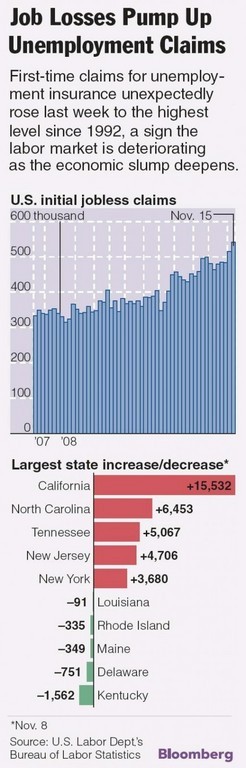
Six of the index’s 10 leading indicators fell last month, led by stock prices. Also losing ground in October were building permits; consumer expectations, as measured by the Reuters / University of Michigan Consumer Sentiment Index; supplier deliveries; average weekly initial claims for unemployment insurance, which rose in October; and manufacturers’ new orders for nondefense capital goods, the board said
A seventh indicator, average weekly manufacturing hours, was unchanged from September. Improvements were seen in the other three leading indicators, led by the nation’s real money supply (M3); also growing were the interest-rate spread and manufacturers’ new orders for consumer goods and materials. (READ MORE)
“In the past two months, without the very large positive contributions from inflation-adjusted money supply,” which this month added 0.71 percentage points to the gauge, in its largest contribution of the past seven years, “the Leading Index would have been substantially weaker,” Conference Board economist Ken Goldstein said in a statement today.
Over the past six months, the Leading Index has fallen 2.4 percent, with three indicators advancing, for an annual rate of decline of 4.7 percent, the group said. That was far steeper than the 1.2-percent decline of the preceding half year, when the index fell at an annual pace of 2.3 percent. “In addition,” Goldstein wrote, “weaknesses among the leading indicators have remained widespread.”
Meanwhile, the Lagging Index edged up 0.1 percent in October to 113.3 points, after rising a revised 0.3 percent in September and 0.4 percent in August, the board said. Improving last month were commercial and industrial loans outstanding and the ratio of installment credit to personal income, which fell as consumers cut back on discretionary spending. The ratio of manufacturing and trade inventories to sales was unchanged from September. Worsening last month were the average duration of unemployment; the average prime interest rate charged by banks; the U.S. Consumer Price Index for services (READ MORE); and the change in labor costs per unit output.
The Coincident Index – a measure of current economic activity – rose 0.2 percent in October to 105.6 points, ending a five-month decline that included drops of 0.7 percent in September and 0.4 percent in August, the board said. Increases were seen last month in three of the index’ four components: industrial production; personal income less transfer payments, and manufacturing and trade sales. Non-farm payrolls – the other indicator – fell sharply last month. (READ MORE)
Over the past six months, the Coincident Index has fallen 1.2 percent, or 2.4 percent per year – “a much quicker pace than the 0.4 percent rate of decline (a -0.7 percent annual rate) for the previous six months – and all of the coincident indicators decreased,” Goldstein said.
“Both the leading and coincident indexes have been on a downward trend for at least a year now, and the pace of their declines have accelerated in recent months,” he added. “The composite indexes are now decreasing at rates last seen in 2001. … Taken together, the persistent and extensive deterioration of the composite indexes continues to suggest that the economy is unlikely to improve soon, and economic activity may contract further in the near term,” Goldstein said.
“The economic contraction appears to be worsening,” agreed Sal Guatieri, a senior economist at BMO Capital Markets in Toronto, according to Bloomberg News. “The stock markets are plunging, people are retrenching and manufacturing activity is virtually falling off a cliff,” he added. “The increase in layoffs [which continued last week, according to a report today by the U.S. Department of Labor] can only worsen the economic downturn in the near term.”
The Conference Board – a nonpartisan, nonprofit business membership and research organization whose U.S. offices are in New York City and Chicago – produces The Consumer Confidence Index, the Leading Economic Indicators and other reports. Additional information is available at www.conference-board.org.
Additional information, including the Unemployment Insurance Weekly Claims Report, is available from the U.S. Department of Labor’s Employment and Training Administration (ETA) at www.dol.gov.
Building a Strong Data Foundation in the Age of AI
Artificial intelligence (AI) has become a key priority in the boardroom and across management —…
Learn More