If your size was measured in tons, not pounds, you would no doubt cherish your moving space. The elephants at Roger Williams Park Zoo certainly do, and these days they have plenty of it to enjoy.
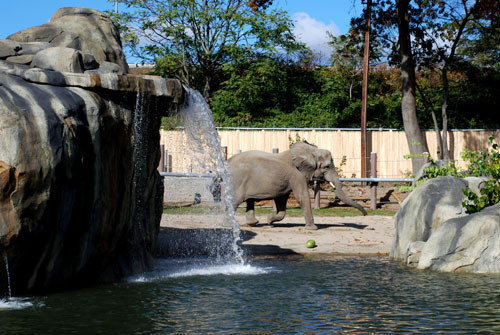
The recently completed $11 million renovation of the zoo’s Africa exhibit means extra room and some swanky amenities for the herd of three females. Their outdoor stomping grounds now cover close to an acre, and feature mud wallows, waterfalls and a bathing pool so deep the hulking creatures can submerge and use their trunks as snorkels. The heated floors of their new indoor digs are covered by rubber mats in some areas, sand in others, to keep their big feet comfy.
Happier, healthier animals were a major goal behind the exhibit makeover, but not the only one. The design is also intended to create a more exciting experience for visitors as well – and with good reason. More than 525,000 people flock to the city-owned attraction each year, and they spend a whopping $13 million when the come. As Mayor David N. Cicilline said during a recent tour of the refurbished exhibit, the zoo is “a key driver in our tourist economy.”
“Half our visitors are from out of state, mostly from Massachusetts and Connecticut, though we do draw from New Hampshire and Maine as well,” said Jack Mulvena, executive director of Roger Williams Park Zoo. “These day trippers are stopping for gas and going to dinner. We hear from families who tell us they’re also going to Providence Place mall or to a restaurant on Federal Hill.”
Without something fresh and new, according to Mulvena, those crowds could someday be a trickle. “Big new exhibits offer a significant reason to come to the zoo,” he said. “Most zoos need to add to their collection regularly. It’s an important driver for attendance. You want to draw people back for repeat visits.”
With the latest changes, the zoo aims to provide an animal encounter the director describes as “up close and personal.” The bathing pool and the mud wallow mean visitors will see elephants behave as they do in the wild. And a raised viewing deck that also overlooks the giraffe yard provides the perfect vantage point. What’s more, the Africa exhibit includes two new species, wildebeests and wild dogs. Interpretive graphics throughout the exhibit highlight the interconnection of animals, land and people.
That is all just a peek at what’s to come. The zoo has developed a master plan that includes a new children’s zoo focusing on New England wildlife, and a renovated and expanded exhibit space for North American animals. Polar bears – missing from the zoo for the past several years – will romp on a tundra landscape and swim in a 10,000-gallon pool shared with arctic penguins. The plan also calls for a bigger, state-of-the-art veterinary hospital. Target date for completion is 2012.
Roger Williams Park Zoo is the largest in New England, and some consider it one of the country’s best. A major re-design that replaced cages with outdoor habitats organized by continent won national acclaim back in the 1980s, and for a time attendance soared to more than 750,000 a year. But while the zoo still draws more visitors than any other in the region, in recent years attendance figures have declined.
“The last major exhibit was added 12 years ago, and it’s safe to say that has had a significant impact on attendance,” Mulvena said. “It’s been relatively flat for the past five or six years.”
The director predicts the master plan projects will turn that trend around. “I think we’ll see a jump in the spring or summer,” he says. “Of course, that may be tempered because we’ve always had elephants and giraffes. But when we open the new children’s exhibit – in 2010 or 2011 – I expect we’ll see a big jump.”
He’s quick to add that boosting attendance is just one of several reasons for adding new exhibits. The zoo also aims to teach and inspire.
“Most zoos strive to be an educational resource,” Mulvena said. “The closer the experience, the more impact it has on the visitor. It makes them think about their relationship to nature, to the environment. We’ve done research that shows people who come to the zoo gain more appreciation for conservation of natural resources.”
The whole master plan was originally expected to cost $35 million. That amount has since climbed about $5 million, because construction estimates for the North American exhibit were higher than expected. Rhode Island voters have already approved a $15 million bond issue for the project. The zoo has launched a capital campaign to raise the rest of the money. Foundations, corporations and individual donors have provided $10 million to date. Mulvena says he’s confident the capital campaign will be successful.
The director predicts the zoo will weather the current economic tough times with no major cutbacks. That’s largely because the city provides only $1.8 million of the $7.6 million operating budget; the rest comes from ticket sales, sales at zoo shops and refreshment stands, and fundraising. “Our goal has always been to have a diversified revenue stream,” he says. “That means we’re insulated – if one source is off, we should be able to pick it up somewhere else. It would be a rare year when you would have a major loss in several areas. We’re on very firm ground.”
Admission to the zoo is now $12 for adults, $6 for children, with Providence residents entering free on the first Saturday of every month. •