The federal farm bill takes a lot of flack when Congress reauthorizes it every five years. But here in Rhode Island, the legislation is providing money for a voluntary conservation program that is helping to ease pressure on the local water supply and advance other environmental goals.
The 12-year-old Environmental Quality Incentives Program (EQIP) lends money and expertise to farmers and landowners to help them make their property more efficient. The program’s mission is twofold: to promote agricultural production and to maintain environmental quality.
Over the past year, EQIP has provided nearly $4.5 million in funding and assistance to 517 farmers and landowners in Rhode Island. It is run out of the local branch of the Natural Resources Conservation Services (NRCS), part of the Warwick office of the U.S. Department of Agriculture (USDA).
EQIP applicants must submit their materials by Nov. 1 in order to qualify for the next round of grants. In order to qualify, farmers must make $1,000 a year from their property. Last year there were over 100 applicants in the state.
“Conservation practices on farms normally take up farmland, because of structures for runoff water or to store manure,” said Peter Bonome, a soil conservationist at the Warwick NRCS office who has worked with farmers on EQIP. “They tend to not have monetary benefits to the farmers. So we put a financial incentive in.”
The amount of money varies in each case, but Bonome says it usually covers between 40 and 75 percent of the installation costs for whatever conservation system a farm is implementing. The NRCS also sends experts, free of charge, who consult with farmers to create the right system.
In Rhode Island, water conservation practices are a top EQIP priority. In some cases, government officials have helped farmers install drip irrigation systems – known as “micro-irrigation” – which deliver a precise amount of water to each plant, rather than spraying it and wasting a significant amount. Micro-irrigation can reduce a farm’s water consumption by 90 percent compared to conventional irrigation, Bonome said.
“And their water bills go down, so there is a secondary benefit to the farmer,” he added.
In recent years, EQIP has also been working to build independent water sources, such as a man-made pond or well, on farms. More than a dozen have been built in recent years on Aquidneck Island, where water is a particular concern because of limited supply.
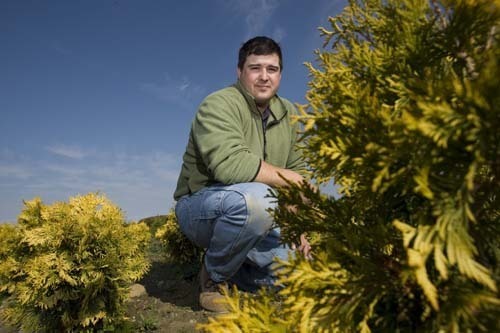
In Middletown and Portsmouth, for example, Rhode Island Nurseries, which grows landscape-sized plants and shrubs, uses more than 8-million gallons of water to irrigate its five farms.
Rhode Island Nurseries’ owners first considered the idea of digging their own pond earlier this decade, when an extremely dry summer raised concerns about the possibility of water restrictions. But the costs were prohibitive – about $165,000 for a single pond – until EQIP agreed to pay part of the cost.
With the EQIP money in hand, the owners dug a 4.25-million-gallon irrigation pond at their farm in Portsmouth. Within the next two years, they hope to link the existing pond to a second farm, and eventually build a second pond, as well. The goal is to eventually obtain 75 percent of the water used on the farm from irrigation ponds, rather than the municipal water supply.
Jesse Rodrigues, the farms’ general manager, said digging the ponds will allow the nurseries to be prepared for a future when water supply may be limited. “It’s definitely a good investment,” he said.
Apart from water and soil conservation programs, EQIP money is also being used to help farms convert to organic farming, because “small-scale farming seems to be a sustainable form of farming for Rhode Island,” Bonome said. •
To receive Environmental Quality Incentives Program information and an application packet, call the USDA’s Natural Resources Conservation Service at 828-1300 or stop by the Rhode Island NCRS office at 60 Quaker Lane, Suite 46, in Warwick. EQIP information and application materials also can be found online, at www.ri.nrcs.usda.gov.
Beyond Cash Donations: How New Forms of Giving Are Transforming Not-for-Profit Accounting
Evolving Funding Landscape for Not-for-Profits Not-for-profit organizations are being asked to do more with less,…
Learn More