WASHINGTON – Nationwide, the number of workers filing first-time unemployment claims fell 4.0 percent last week, retreating from the previous week’s seven-year high, according to a report today from the U.S. Department of Labor’s Employment and Training Administration.
The ETA credited a decline in claims related to last month’s Gulf Coast storms.
Your Business Has Gone Global. Has Your Insurance?
A decade ago, “doing business internationally” was mostly a large-company concern. Today, a manufacturer in…
Learn More
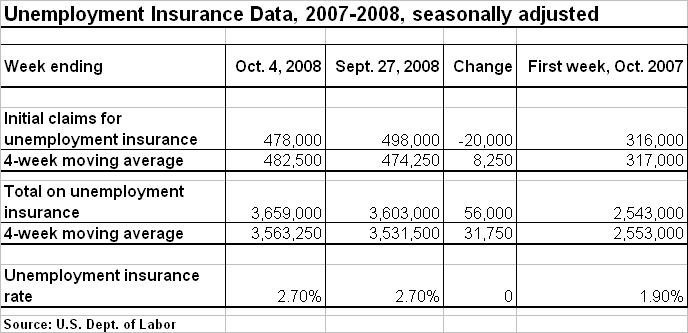
Initial claims for jobless benefits dipped to a seasonally adjusted 478,000 in the week ended Oct. 4, it said. That was 20,000 fewer than the revised 498,000 new claims reported for the week ended Sept. 27. (READ MORE) Compared with the 316,000 initial claims registered in the same week of 2007, however, new unemployment filings rose 51.3 percent.
Analysts had expected the government to report 475,000 jobless claims last week, down from the preceding week’s initial estimate of 497,000, based on the median forecast from a Bloomberg News survey of 37 economists. (Their estimates of new claims in the week ended Oct. 4 ranged from 450,000 to 500,000.)
“The effects of Hurricane Gustav in Louisiana and the effects of Hurricane Ike in Texas added approximately 17,000 claims to the total,” the ETA noted in its report. Excluding those new claims, last week’s total would have been 461,000. By comparison, new claims so far this year have averaged 390,000 per week, an increase of 21.5 percent from the 321,000 per week reported for all of 2007.
Meanwhile, the total unemployment rolls continued to grow. In the week ended Sept. 27 – the most recent for which such estimates are available – the number of people collecting jobless benefits rose to 3.659 million from the preceding week’s 3.603 million and the year-ago 2.543 million.
But the insured unemployment rate (the share of the U.S. work force receiving unemployment benefits) was steady for a third week at a seasonally adjusted 2.7 percent, up from 1.9 percent a year earlier.
Mixed results were seen in the latest figures on extended benefits. In the week ended Sept. 20, the number of people claiming extended jobless benefits under the federal Emergency Unemployment Compensation Act (EUC) fell to 1.067 million, 364,677 recipients fewer than the week before. Yet the number of people receiving extended jobless benefits under state guidelines in Alaska and Rhode Island rose to 1,208, an increase of 83 from the week ended Sept. 13.
The Ocean State – which posted an August jobless rate of 8.8 percent (READ MORE) – had one of the highest insured unemployment rates nationwide, moving up to eighth place in the week ended Sept. 20 from ninth the week before, the report showed said.
The nation’s highest insured unemployment rate again was Puerto Rico’s 4.7 percent. Filling out the Top 10 were California, Michigan and Nevada (with jobless rates of 3.2 percent); New Jersey and Oregon (3.1 percent); South Carolina (3.0 percent); Pennsylvania (2.9 percent); Rhode Island (2.8 percent); and Arkansas and North Carolina (2.7 percent).
“All the labor market indicators are consistent with an economy in decline,” Ken Mayland, president of ClearView Economics LLC in Pepper Pike, Ohio, told Bloomberg News.
Additional information, including the full Unemployment Insurance Weekly Claims Report, is available from the U.S. Department of Labor’s Employment and Training Administration at www.dol.gov.