In the last few years, several large, highly visible steps toward sustainability have been taken at Portsmouth Abbey School, where a Rhode Island School of Design-created “solar house” is about to be opened next to the towering wind turbine.
But those steps are just part of 15-year-old, eco-friendly plan for the campus. For that long, the school has been taking smaller, less-visible steps toward the same goal, Director of Operations and Project Manager Paul Jestings said last week.
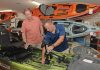
He was working on final touches on that house, laying carpet and installing the backup electrical systems. Jestings previously worked as a planning engineer at the school. In that position, he started the push for the entire school to install compact fluorescent light bulbs and occupancy sensors that would keep electricity costs low. Jestings also installed high-efficiency, low-emissions Viessmann boilers in most of 28 campus buildings. There are now 52 such boilers on the campus of the Catholic high school, which has about 350 boarding and day students in Portsmouth. The Rev. Hugh Diman, an English Benedictine monk, founded the school in 1926.
“They’ve proven to be very reliable,” he said of the boilers. “They already meet and exceed the standards for European emissions. So they more than exceed any standards that have been adopted in this country. So we’re also putting [out] a lot less [nitrous oxide] emissions that a normal campus.”
The school has been investing heavily. Its wind turbine cost about $1.2 million and last year the school finished a $6.5 million energy-efficient dormitory. The RISD-designed building’s renovations were financed by alumni fundraising, he said. And all together, the school has spent “hundreds of thousands” on smaller sustainable investments, Jestings said.
“Once the wind turbine went online, the monastery gave us permission to take the spin-off money that we’re saving from using the turbine and put it toward ‘green’ initiatives throughout the campus,” he said. (The turbine will likely pay for itself this year, he added.)
The more-than-200-acre school campus is part of a 500-acre piece of land that’s owned by the monastery, Heydt said. Part of the land has a long-term lease taken out by the owners of Carnegie Abbey Club golf course. That lease still has 95 years left, she added
In September 2007, the school opened a 24,000-square-foot dormitory, which houses about 34 students, designed by Architectural Resources Cambridge Inc. The new dorm has hot-water solar panels, flooring created from recyclables, low-flow shower heads and toilets, low-VOC construction materials and energy-recovery ventilators.
Older buildings have new windows and have been redesigned to use little water. The school’s maintenance staff drives electric vehicles and dining staffers are in the process of creating a “tray-less” dining experience, the school said.
Another dorm is being planning for boys, Jestings said. Another science building will be built within 10 years, he said. But the solar house might remain the only one of its kind on campus.
“We have other things on the drawing board, as far as faculty housing,” Jestings said. “They’ll be similar to this, but not as sophisticated because – if you don’t get grant money – the photovoltaic system alone was $75,000. If you had to pay for that up front, the payback would just not be practical in New England.”
Portsmouth Abbey spokeswoman Kathy Heydt said the new house, which will be occupied by the assistant headmaster, has a roof garden, “heliotropic” louvers, lighting that can change easily with whatever function a room is being used for.
It was built by RISD students and a professor and entered in the 2005 U.S. Department of Energy Solar Decathlon in Washington, D.C. After the competition, which was won by another entrant, the building was stored at a facility in Quonset Business Park, Heydt said.
“They weren’t really sure what to do with it, until they heard about our turbine, our green dorm and some of the initiatives that we’d been working on,” she said. “So they got in touch with the school to see if we’d be interested in it. And, of course, it was right up our alley, right along the lines of what we’ve been trying to do.”
It also solved a housing problem – the boarding school needed another house for on-campus faculty.
Bringing it to campus wasn’t without problems, Heydt said. It was a great match, but it was a tiny building – about 800 square feet – and not large enough to use for housing. So in 2007, the school brought in Newport Collaborative Architects, she said. The architects added another room – half below ground level – that doubled the living space. They also “softened” the building’s look, she added.
NCA Senior Associate Michael DeMatteo said his firm didn’t make many major changes to the exterior of the building, “because it already had a lot of integrity.” Instead, they focused on how to fit the whole building into the campus.
While the building was intended to be self-sufficient, it did need heating and cooling systems installed.
Jestings last week was finishing up those electrical, heating and cooling systems, he said.
While it is only a small part of a larger master plan, the placement of the house is intended to be “dynamic,” Heydt said.
“It’s situated right next to the turbine,” she said. “And it’s very dramatic-looking. It’s a little Jetsons house, with metal tubes on the outside. It’s a cool little thing. …We love to have the interesting design aspects, but we also like to further our interests in saving energy. And we hope other people look at it and get ideas for themselves.”
This week, science teacher and Assistant Headmaster John D. Perreira is expected to start moving into the new house, Jestings said. A grand opening will be held this month on a yet-to-be-determined date. •