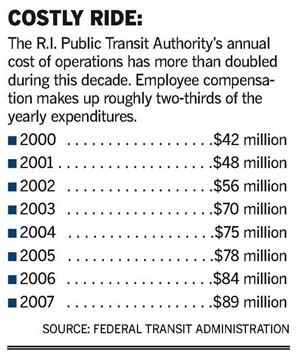
 READ MORE) / " title="OPERATIONS COSTS have more than doubled in the past decade. But a recent Sierra Club report last month still found RIPTA expenses are comparable to those at similar regional transit agencies. (READ MORE) /"/>
With ridership up 34 percent since 2005, the R.I. Public Transit Authority should be riding high. Instead, the perennially cash-strapped agency is facing its most serious budget crunch yet.
RIPTA’s problems stem from a strange paradox: more ridership is bad for the agency’s bottom line. That’s because as more people choose not to drive their cars and take the bus, state gas-tax receipts have declined – and RIPTA’s 7-cent share of the gas tax makes up a sizable chunk of its annual budget.
At the same time, RIPTA is paying more for fuel, just like the drivers flocking to its buses from their garaged cars. In addition, after more than a decade federal officials this year stopped the state from using Medicaid money to provide free bus passes to low-income residents. That took another $7 million out of RIPTA’s budget for the coming fiscal year.
RIPTA also has seen its compensation costs soar this decade. The quasi-state agency’s annual spending on salaries, wages and benefits has grown by 87 percent over seven years – an average growth of more than 9 percent per year – from $33 million in 2000 to $62 million in 2007, according to the Federal Transit Administration.
RIPTA’s chief financial officer, Maureen Neira, attributed much of the rise in compensation costs to the addition of two new programs – a paratransit service for disabled riders, which required 80 new drivers, and maintenance for the R.I. Department of Transportation, which meant the addition of 5 mechanics – that required RIPTA to hire 85 more employees. Excluding those new hires, compensation costs grew by about 19 percent from 2003 to 2007, she said in an e-mail. In addition, RIPTA’s fuel costs nearly tripled over the same period, rising from $2.1 million to $5.8 million, Neira said.
The increase has led critics – most notably Robert Batting, who abruptly resigned from the RIPTA board in August – to charge the authority’s officials with mismanaging its finances.
“I think that management is directly responsible – as is true with most businesses – for the way something runs,” said Batting, who had served on the board for five years. “So, yes, I think there are a number of areas where things have been mismanaged.”
However, RIPTA is not alone in finding itself in a financial hole at the moment. Public transit systems nationwide have struggled to cope with the surge in ridership that has accompanied record-high gas prices. In a survey released earlier this month by the American Public Transportation Association, 65 percent of transit agencies reported not having enough revenue to add service, even as 86 percent said more people were using their systems.
RIPTA officials are forecasting an estimated shortfall of $10.8 million in the authority’s $101 million budget for the next fiscal year, and are threatening to scale back bus service by as much as 20 percent, or more than 4 million rides, starting in January. In addition, RIPTA spokeswoman Karen Mensel said the agency is leaving jobs unfilled, deferring capital projects and cutting back on maintenance supplies. The basic bus fare was increased by 25 cents to $1.75 earlier in the year.
But RIPTA officials also say that in the end, they hope the headline-grabbing service cuts may not be necessary – which in turn has led Gov. Donald L. Carcieri’s office to accuse the agency of fear-mongering.
“RIPTA needs to see fully the challenges of doing more or even the same with less,” the governor declared earlier this year, though he said he supports the authority’s “core mission.”
UPDATE: On Friday, Sept. 19, Carcieri named a panel of state officials to study the agency’s finances and develop a rescue plan. (READ MORE)
Officials at the agency reject the charge that RIPTA is inefficient. A 2007 study by outside consultants gave RIPTA high marks for its financial management, although it also said the agency has high utility and self-insurance costs and is under-funded compared with similar-sized agencies.
“We’re not like state government,” said Mark Therrien, an assistant general manager at RIPTA. “We’ve been in this situation so long, we’re a very efficient operation. We don’t have a lot of waste here. I can say that with confidence, having been here for years. We uncover it, and we deal with it.”
Therrien acknowledged that the agency has struggled to control overtime and other labor costs, a particular concern of Batting’s. “We’re getting better at it,” he said.
RIPTA also has struggled with instability on its board after the resignation of Batting, who had become chairman in April, when Providence City Planning Director Thomas Deller was booted from the job. The new chairman, John Rupp, said the board is now ready to settle down and get to work on stabilizing RIPTA’s shaky finances and charting a path for the future.
“Everybody has been saying, as a board, that if we pull through this, it’s only with the understanding that this is a huge ‘lessons learned’ to advance forward,” Rupp said. “If we are going to argue that we have to avoid these service cuts because of the need for a strong, robust public transit system, then we damn well better build one.”
More broadly, RIPTA faces a long-term fiscal challenge as the gap between its revenue and expenses grows.
Mensel said one misconception many people have is that public transit should be self-sufficient. In practice, almost all public transit systems receive financial subsidies. “People don’t understand how transit is financed,” she said.
Since 1991, state and local revenue has provided around 75 percent of funding for public transit each year, according to the Federal Transit Administration.
The state has been forced to pay more of RIPTA’s annual operating budget since 1998, when the federal government started to phase out its contribution.
State spending on RIPTA grew from less than $17 million in 1998 to nearly $40 million in 2007 – nearly half the authority’s annual budget. By contrast, revenue from fares covered only 26 percent of RIPTA’s operating expenses in 2007.
Scott Wolf, executive director of Grow Smart Rhode Island, said the public seems to hold public transit to a higher standard than public roadways. “There’s no hue and cry about road and bridge repair money – somehow that’s not viewed as a subsidy by the state to people who drive automobiles,” he said. “And yet money going directly to support the bus system is viewed as a subsidy.”
Carcieri’s Blue Ribbon Panel on Transportation Funding in Rhode Island is looking at RIPTA. John Simmons, executive director of the R.I. Public Expenditure Council and a panel member, said state leaders have failed to be proactive with RIPTA, just as they have with other infrastructure needs. “We made other choices,” he said.
Simmons’ group released a report in 2002 warning that RIPTA was on an unsustainable fiscal path and offering suggestions for fixing it. Nothing happened.
Nevertheless, Rupp, the new RIPTA board chairman, said he is optimistic that a long-term solution can be found. With a fixed, annual subsidy from the state, he said, RIPTA could be on a sustainable path in just three years.
Meanwhile, others are calling for the state to embrace an ambitious new vision for public transit. A recent report by the Sierra Club’s local chapter argued, “Rhode Island must aggressively commit to long-term transit investment, starting now.” The report called for beefing up the current bus system and expanding with light rail and bus rapid transit. The authors also reiterated the oft-made point that Rhode Island’s size and density positions it well for mass transit.
Carcieri’s spokeswoman, Amy Kempe, said the governor sees public transit as “critically important” to the state’s economy now and in the future. Administration officials are meeting with RIPTA executives and board members to discuss a solution to the authority’s short-term funding crisis, she said, emphasizing that creating more efficient bus routes will be a key part of any compromise.
Kempe also agreed that a long-term solution is needed to deal with RIPTA’s financial troubles.
Even as RIPTA wrestles with the current fiscal crisis, officials say they are keeping an eye on the future. The board recently voted to conduct an 18-month study of alternatives similar to those suggested by the Sierra Club in its “Fare Choice” report last month. (READ MORE) Rupp said they could be financed creatively through public-private partnerships, special tax provisions and other methods.
In the end, said RIPEC’s Simmons, it’s up to the state’s leaders – and its citizens – to decide how and whether to invest more in public transportation.
“The fundamental question,” he said, “is, ‘What do we want from RIPTA?’ ” •