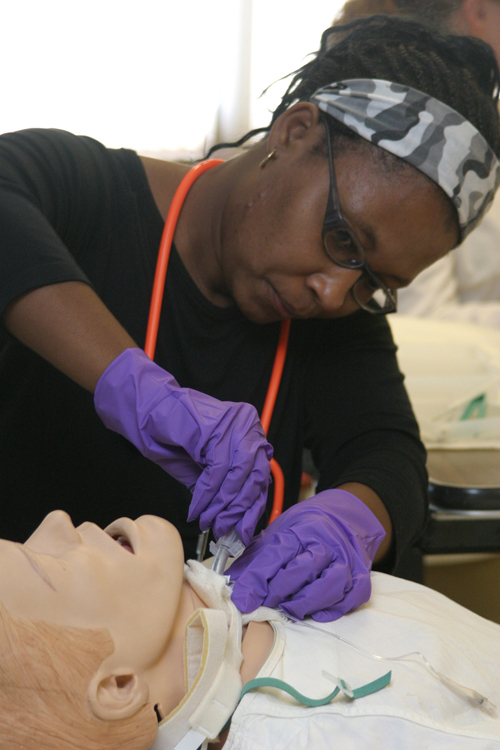
When a nurse arrives at The Miriam Hospital, fresh out of college, she doesn’t go straight to the bedside – first, there’s an orientation period, about three months for medical/surgical work, more for critical care and other specialties.
It’s similar at other hospitals: There are strict standards, set by the state, professional groups and accrediting agencies that govern nurses’ training, credentialing and competency testing.
But since January of last year, The Miriam has been going farther: New nurses are now encouraged to do a year-long “residency,” with structured hands-on training and seminars designed to sharpen their clinical, decision-making and leadership skills.
The program is voluntary, but virtually all newcomers sign up, said Maria Ducharme, director of inpatient nursing. It really helps them get started in a profession that can be very demanding and require a great deal of expertise from day one.
Many young nurses find it tough to go from school into hospital work, Ducharme said, and “we know [nationally] that we lose a lot of people within the zero- to three-year time frame.”
Before the residencies, The Miriam’s one-year retention rate was in the “low 60s to 70s,” she said, and some hospitals across the country lose up to 60 percent of their new nurses. In the first year of the residencies, the retention rate was 84 percent, she said.
As a matter of fact, The Miriam, which employs about 600 nurses, had no vacancies as of last week. “We’re in a great place,” Ducharme said.
Compare that with the crisis forecast by a 2002 Rhode Island SHAPE Foundation study, which found an 8-percent shortage of nurses that would grow to 25 percent by 2010.
The shortage made itself felt across the state’s health care industry, leading hospitals to hire “traveling” nurses (essentially, temps), recruit nurses from abroad, and provide rich incentives for nurses to work extra shifts – Rhode Island Hospital, for example, pays double for many overtime shifts, not just the standard time-and-a-half.
The shortage was also linked to a practice banned in Rhode Island this year after long legislative battles: mandatory overtime, in which employees are forced to work extra hours. A law that went into effect March 4 allows it only in true emergencies.
Within the health care industry, and in public-policy circles, addressing the shortage has become a top priority, leading to new investments by the state in the public colleges’ nursing programs and to collaborations between the colleges and the hospitals.
The efforts have paid off. All three schools have increased their enrollment – the University of Rhode Island, for example, has gone from admitting about 60 new nursing students per year to about 150, said Nursing Dean Dayle Joseph, while the Community College of Rhode Island has gone from about 300 to about 425, said Nursing Dean Maureen McGarry.
New programs continue to be developed. Last month, Rhode Island College announced a new partnership with the Providence VA Medical Center that will boost RIC’s enrollment and create new clinical placements for RIC students at the VA over the next four years.
Also last month, CCRI “pinned” the first 67 graduates of the Summer Nursing Admission Program, a partnership with Care New England and Lifespan that has allowed nearly 100 students to earn their associates’ degrees in nursing in 16 months instead of the typical two years. The health systems covered the cost for their employees, about $8,550 each.
This month, Lifespan launched a new collaboration with Salve Regina University that will allow registered nurses who want to earn their bachelor’s degrees to take their coursework at Newport Hospital, with the company footing the bill.
URI is slated to announce another major initiative – a collaboration with CCRI and RIC – this month. A state Senate commission has just begun looking at what further measures should be taken, focusing on education especially.
And separately, leaders from CCRI, RIC and URI as well as the health care industry recently formed a local affiliate of the Massachusetts Organization of Nursing Executives, aiming to implement certain MONE initiatives in Rhode Island, such as a set of standards for nursing competencies that educational programs should develop.
Brandon Melton, senior vice president of human resources at Lifespan, said in an interview that he’s concerned about the momentum being lost because the crisis has subsided.
Lifespan has been doing better, Melton said: While four or five years ago, the system employed more than 200 “traveling” nurses, now only Rhode Island Hospital needs them, and only about 40 there – a tiny fraction of Lifespan’s 3,000-plus nursing work force. As for nurses from abroad – another response to the shortage – there’s only about two dozen, he said.
Yet a bad economy may be skewing the numbers, Melton suggested. In the last six months, Lifespan has gone from about two-thirds part-time nurses to about two-thirds full time, he said.
In the future, things could change again, Melton said, and more important, the demographic trends that first raised concerns about a major nursing shortage are just beginning to make their mark. The baby boomers are only just hitting their 60s after all.
Lifespan has forecast labor trends as far as 2025, Melton said, and the shortage won’t get really bad until 2015, and then it will keep worsening even past 2025. But the system can’t magically produce thousands of new nurses then; it needs to build them up over time.
“I’m sensing a false sense of security because some of the stopgap measures that have been put in place have worked,” he said. “I think we have to be very humble and cautious.” •