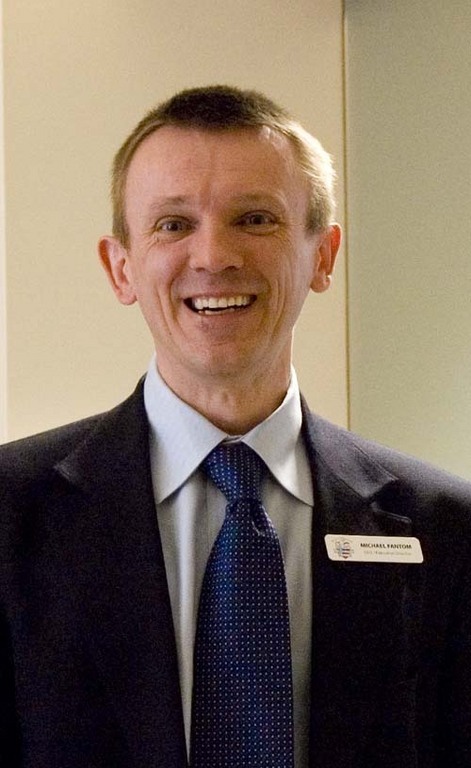
Michael Fantom says the mission of the Providence Ronald McDonald House can be boiled down to this: providing a home away from home for families of hospitalized children. His mission as CEO is raising the profile of the organization, pointing out its relevance in the community. He must be doing something right. Fantom’s three-year contract was recently renewed for another term.
In an expansion of the program in March, the Ronald McDonald House opened a special family room in Hasbro Children’s Hospital, an inviting place where patients’ relatives can go for a quiet respite.
Fantom predicts that expansion is only the beginning.
PBN: Give me some statistics about the Providence Ronald McDonald House. How many people stay there and where do they come from?
FANTOM: Next year will be our 20th year, and we serve 300 to 350 families a year. So collectively over the last 19 years, we’ve probably serviced over 5,000 families. … Around 40 percent are from Rhode Island, and the rest come from Massachusetts, Connecticut, New York and farther a field. And because of certain niche [medical research] programs, this is only going to grow.
ISO 9001:2026: A Practical Opportunity to Build for What’s Next
For Rhode Island manufacturers, ISO 9001 has been much more than a certificate on the…
Learn More
PBN: Let’s talk about the changes you see coming in the medical industry locally and how they will affect the Ronald McDonald House.
FANTOM: We see families from neonatology through to the 21st birthday. … There’s a lot of hyperbole about what the future is going to bring. There are discussions about Care New England and Lifespan merging, which is going to play a factor for us because we’re very close to the hospitals… If the Brown [University] medical school is relocated then that will bring with it those niche research groups. You have families around the country and the world who are desperate for the cutting-edge care for their children [that the research groups can provide]. I think there’s going to be significant changes in medical research within the Providence area. Families are going to want to access that, and I believe that one of the stumbling blocks is where are people going to stay.
PBN: How do you prepare for the growth you’re predicting?
FANTOM: We’re reviewing our facilities at the moment. We’re a 16-bedroom facility, so we can accommodate 50 people at one time. We have a couple of areas where we can expand. So there’s expansion conversation going on about adding two or three bedrooms.
PBN: Where you’re located now [on the outskirts of the Lifespan campus in Providence] there’s isn’t much undeveloped land. Are there any available properties nearby?
FANTOM: Not really very close. If you go farther into South Providence, there are properties. … We’ve had discussions about maybe buying a three-floor property and renting out floors. Then, as we see greater growth in the hospital system, we take over the floors. … I believe within five years, we are going to be – well, we’re full now. So we need to grow. We’re pretty much going on wait lists most of the time, and that’s without the potential growth.
PBN: What sort of illnesses are the children of these families dealing with?
FANTOM: Some of them are coming because of premature birth, so they’re coming from Women & Infants Hospital. We get a lot of families from Newport because any birth complications in the Newport area and they’ll come up to Women & Infants. At the moment, Women & Infants accounts for 49-50 percent of our families. … There are cancer families, there are neurological families, there are a lot of behavioral families. Behavioral issues account for a significant percentage.
PBN: With growth comes the need for more money. What is the local organization’s financial picture?
FANTOM: As a starting point, we ask our families to contribute $10 a night, if they can afford it. We have 16 rooms, so each room costs us about $25,000 to run [each year]. So we have a budget of a little over $800,000. Then we have 125 active volunteers at the moment. If we didn’t have any in-kind and volunteer support, our budget would probably be [more than] $1 million. We’d be struggling to find that kind of money.
PBN: The sagging economy must have an affect on the organization.
FANTOM: It does, positive and negative. We’ve lost a couple of [fundraising] events because they’ve lost [corporate] support. … We just had a big family motorbike event. While it was still tremendously successful in our eyes, it was down on numbers last year. On the positive side, our individual giving is up by about 25 percent.
PBN: You’ve recently signed on for another three years as CEO. What are some of you’re accomplishments?
FANTOM: I’ve got three areas that I came in and focused on really clearly: Focusing on families, keeping them together and enhancing their coping skills; focusing on the hospitals, telling them that we’re helping enhance that family-centered care… and I’ve focused on our internal program so we have a very safe, stable community. We have a lovely New England bed and breakfast. … People have had these nightmare scenarios in their heads [about what a Ronald McDonald House will be], and you come in and there are quilts on the walls. Outside there are lots of cars, lots of asphalt; inside it’s like a little haven. •
interview: MICHAEL FANTOM
POSITION: Chief executive officer of the Ronald McDonald House of Providence.
BACKGROUND: Fantom has been the CEO of the Ronald McDonald House in Providence since 2005. Before that, he was the youth development director at Crossroads for Kids in Boston, a nonprofit assisting disadvantaged families, from 2001 to 2005. He started his career in 1992 as a bilingual elementary school teacher in Argentina. He then moved to teaching in Edinburgh, Scotland. Before coming to the United States, Fantom worked for the National Asthma Campaign, a nonprofit for children with asthma and eczema in the United Kingdom, from 1995 to 2001.
EDUCATION: B.A. in primary education and theater studies, 1992, University of Lancaster, United Kingdom.
FIRST JOB: Fantom worked weekends as a clerk in a golf shop in his hometown of Edinburgh, Scotland, but it wasn’t a shop at one of the area’s famous courses such as St. Andrews. It was a standalone store.
RESIDENCE: Duxbury, Mass.
AGE: 43