The reports came within days of each other: First Standard & Poor’s Ratings Services dropped the rating for $10.6 million of 1994 bonds sold for The Westerly Hospital from “BB” to “BB-”; then Fitch Ratings downgraded $18.6 million worth of 1999 bonds issued for St. Joseph Health Services of Rhode Island to “BB” from “BBB-.”
In both cases, the outlook was deemed “negative.” And in both cases, the reasons for the downgrades were similar – big operating losses in fiscal 2007, declining patient volume, and concerns about the hospitals’ ability to turn themselves around. (READ MORE)
All this, and Landmark Medical Center getting a court-appointed special master to try to save it from receivership and a possible closure? (READ MORE) June was not a good month for community hospitals in Rhode Island.
And while both St. Joe’s and Westerly officials say they expect their finances to improve, and Landmark officials express confidence that they will keep the Woonsocket facility in business, insiders and outsiders alike agree that the financial situation for local hospitals is very tenuous.
As Edward J. Quinlan, president of the Hospital Association of Rhode Island, puts it, this is a “low-cost, low-reimbursement” state, meaning hospitals are pretty efficient in their operations – and thus don’t have a lot of fat to trim in tough times – but they are also paid less than their peers in other states.
Indeed, a 2006 report from the R.I. Department of Health (based on 2004 data, the latest available at the time) showed that Rhode Island ranked 22nd in the nation for hospital-unit expenses – the cost hospitals incur per adjusted admission – with an average cost of $6,846, 3 percent lower than the national average of $7,091 and 10 percent lower than the New England average of $7,624.
Rhode Island’s hospital reimbursement rates, meanwhile, ranked 41st in the nation, at $6,242 per adjusted admission ($788 less than the actual cost), and 10 percent less than the national average of $6,932.
Moreover, because Rhode Island has no public hospitals, private hospitals (all nonprofits) have to care for the poor, and with rising unemployment, a dramatic increase in the uninsured rate and a steady increase in high deductibles and other cost sharing, hospitals have seen a sharp rise in uncompensated care.
“Hospitals’ bottom lines are obviously going to be significantly affected by the state of the economy,” Quinlan said in an interview. The rating downgrades at St. Joe’s and Westerly, he said, are “a more public confirmation” of the financial problems that hospitals have been talking about for several years.
Yet each hospital also faces its own specific challenges, based on its demographics, the services it provides and its management.
St. Joseph, which is associated with the Roman Catholic Diocese of Providence, operates the 271-bed Our Lady of Fatima Hospital in North Providence, the 115-bed St. Joseph Hospital for Specialty Care in Providence and the 62-unit and St. Joseph Living Center, an assisted-living facility. It had $177.6 million in total revenue in fiscal 2007, which ended last Sept. 30.
Facing low reimbursements and a slow but steady decline in patient volume, Fitch noted, St. Joseph’s operating performance has “consistently worsened” since 2004, and in fiscal 2007, the system lost $3.4 million. In the first six months of fiscal 2008, Fitch added, St. Joseph lost about $1.8 million from operations.
Even after cutting the equivalent of 40 full-time jobs last April, Fitch said, St. Joseph’s management still projects the full-year loss to be $3.6 million. And the system’s cash and unrestricted investments “have steadily declined since 2005,” Fitch said. As of last Sept. 30, the system had about $22.5 million in unrestricted cash and investments, down from $30.8 million at the end of fiscal 2006 and $34 million at the end of fiscal 2005.
For the 125-bed Westerly Hospital, meanwhile, investment income has been a saving grace amid similar trends in operations – most notably, a sizable drop in patient volume.
In the first eight months of this fiscal year, said Chief Financial Officer Jeanne LaChance, the hospital lost $594,000 (an improvement from $3.8 million in the first eight months of fiscal 2007), but investment income more than offset that loss, putting the bottom line at a net gain of $522,000 (last year, investment income shrank the total loss to $2.2 million for the first eight months).
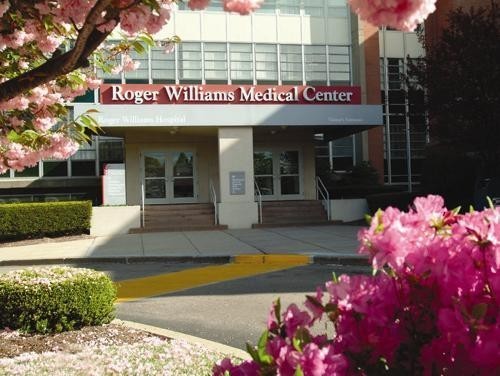
At both Westerly and St. Joseph, officials say they are actively working to turn things around. Westerly has seen a small rebound in its patient volume and now seems to be stable in that regard, LaChance said. In addition to its job cuts earlier this year, St. Joseph is seeking to consolidate inpatient services on one campus; it’s also looking at a possible merger with Roger Williams Medical Center.
Still, there is plenty to worry about, Quinlan said.
There are many “well-established problems” in Rhode Island, from the low reimbursements, to work force shortages, to spiraling utility costs, to an adverse medical liability environment, and “none of these issues have really been resolved in recent years,” Quinlan said.
Now, with the recent state budget cuts, Medicaid reimbursements are going to decline, he said. And Medicare reimbursements, which the state can’t control, are also a concern.
As LaChance at Westerly put it, when asked whether she expects the hospital to fully recover: “It depends on what’s thrown at us … a lot of what happens to us is not within our control.” •