
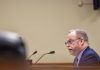
The $9.6 million increase from R.I. general revenue that the House Finance Committee tacked onto the uncompensated-care line item in the proposed state budget for fiscal 2009 isn’t enough – hospitals will still have a shortfall for the unpaid care that they provide, said Edward J. Quinlan, president of the Hospital Association of Rhode Island.
It would create “additional hardships” during the coming fiscal year, he said. The $9.6 million was added before the House Finance Committee on June 11 approved a $6.89 billion state budget for the fiscal year beginning July 1. The full House approved the budget last Wednesday; the Senate gave its approval a day later. (READ MORE)
“What House Finance has proposed would still create a $6 million deficit,” he said, adding that the increase is higher than what was first proposed, but is still inadequate. “It’s a significant improvement to the administration’s proposal, but it will leave hospitals $6 million below the historic equitable distribution of funds.”
Here’s how it works: State taxes on hospitals generate funds that are then matched by the federal Medicaid program, creating a pool of funds. A portion of that money then goes to hospitals, while some goes back to the state. Historically, and during recent years, those funds have been equitably split between the hospitals and the state coffer, Quinlan said, adding that “this year, that equitable distribution will not take place.”
The payment to hospitals for uncompensated care will be $99.5 million from all funds and $47.2 from general revenues, according to the line item.
Because of other changes in the state, it’s not a good year for that shortfall, Quinlan said. Uncompensated care is the most important issue that hospitals in the Ocean State have been watching during the budgetary process, but there are others issues, Quinlan said.
The deficit is “at a time, incidentally, in which other changes in Medicaid, such as RIte Care, will add additional stresses to hospitals,” he said, “because patients no longer eligible for enrollment will continue to need care and will seek care at hospitals. Hospitals will not be reimbursed for those patients.”
The budget also identifies a federal waiver for Medicaid dollars, which would account for an extra $67 million savings, Quinlan said. “And it would appear that even if that waiver were not filed with the federal government, they will still need to identify $67 million in saving in the Medicaid program,” he said. “It’s unclear from where those savings will come, even at this point.”
Last week, Quinlan pegged the uncompensated care provided annually by Rhode Island’s hospitals at more than $100 million. He had said in March that that amount for 2006 was $124.9 million, a 16-percent increase over 2005.
The R.I. Department of Health’s Center for Health Data & Analysis placed the number of uncollectible or charitable services far lower, at $26 million in 2006. That was a 5.7-percent increase from the year before, according to the state report. The percentage as a total of the hospitals’ operating costs, however, barely changed – it fell from 1.06 percent to 1.05 percent during 2006.
During that year, 11 of the state’s hospitals had between less than 1 percent and 3.2 percent in unpaid care, state figures show. The other two – Roger Williams Medical Center and Memorial Hospital – were able to offset the entirety of their uncompensated care costs with revenue, according to the report. Butler Hospital, South County Hospital and Newport Hospital ran the highest for uncompensated care during 2006. (READ MORE)
In Rhode Island, hospitals have annually been running losses on their operating costs. During fiscal 2007, hospitals in the Ocean State ran a $30 million deficit, Quinlan said. “And that trend line will continue during this fiscal year and this shortfall makes things that much worse,” he said.
Although the economy and jobless rate – both of which have worsened this year – have always had an effect on the state’s hospitals, there has also been an increase in hospitals’ “bad debt,” Quinlan said. That increase is being caused by hospitals not being able to collect from patients who have high-deductible insurance plans, which are growing increasingly common, he said.
The R.I. Health Department report also added the new hospital charity-care regulations, implemented in April 2007, to the potential causes for future growth in uncompensated care. Those regulations, according to the department, “provide a consistent standard for applying charity care across hospitals, based on federal poverty levels.” With those changes, a family of four earning between $41,300 and $61,950 might be eligible for some charity care. •
A modernized health plan: Supporting cost management and the employee experience.
The Surest health plan came from a group of innovators wondering: What if health care…
Learn More
The Hospital Association of Rhode Island is a statewide trade organization providing advocacy, representation, education and other services to its member hospitals. To learn more, visit www.hari.org.









Before we even question whether the State’s hospitals might be able to operate more efficiently, or even be consolidated, their operating loss is still substantially less than the profit recorded by the insurers during the same period. So Rhode Islanders in the aggregate are already paying more than enough to support their health care providers,and for the health care they need, the money just isn’t getting to the right place.