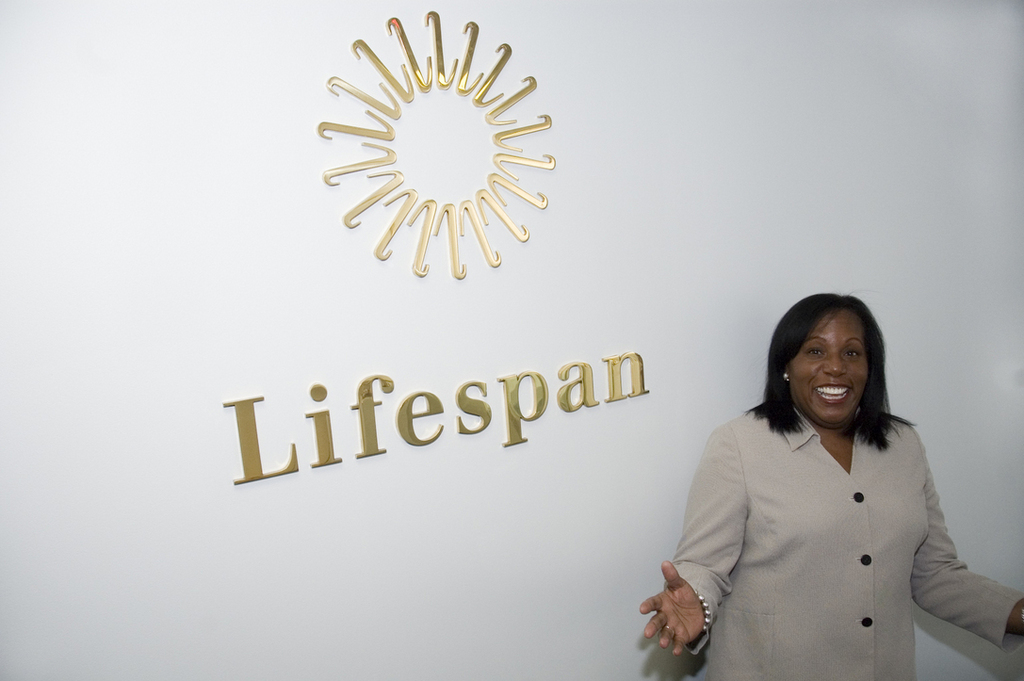
For more than four years, Gertrude Jones has led the charge for diversity in the work force at Rhode Island’s Lifespan hospitals. The Providence-born Jones last month was chosen as a speaker at The Providence Human Relations Commission’s “Is There Discrimination in the Workplace?” workshop.
She spoke recently with Providence Business News about working with local and national diversity experts to bring new resources to employees and about a new diversity-education nonprofit group that she’s working to establish.
PBN: How was your position established at Lifespan?
JONES: When Lifespan merged with the first two or three hospitals, there was only an affirmative action officer at one of the partner hospitals, so they kind of took that position and said, “We’ll elevate it and make it the affirmative action officer” for the then-configuration of the corporation. He was here for, I believe, two years or three years and then they made the decision to turn the title into director of diversity instead of just an affirmative action EEO officer. That position was morphed the year before I was hired.
ISO 9001:2026: A Practical Opportunity to Build for What’s Next
For Rhode Island manufacturers, ISO 9001 has been much more than a certificate on the…
Learn More
PBN: Why does Lifespan need a diversity director and what types of issues do you deal with on a regular basis?
JONES: They’re two different jobs when you look at them.
Affirmative action officer is mainly work force development – it came out of the Civil Rights Act of 1964, affirmative action being mandatory for companies with over $50,000 in federal contracts or over 50 employees. So you have to have an affirmative-action plan, but that’s for work force only.
When you talk about director of diversity, it’s more all-inclusive … diversity encompasses that but also includes health care disparities and culture competency – how culturally competent our health care providers and our employees are. So as we’re interacting with our community, our patients, our providers, how culturally competent are we?
As you know, in a global society now, our work force has changed and is drastically changing. Some have estimated that by the year 2050, we will be a country with a majority of minorities. That has been reduced to, some are saying, 2040. It’s actually becoming a much more diverse work force than it was previously … So, again, as the world changes, we need to be ahead of it on all those fronts. If you look at our inclusion stuff, we talk about our … veterans, people with disabilities. I, as director of diversity, have to look at all of that and ask, ‘Where is Lifespan in all of that?”
During my very first week at Lifespan, during my presentation to the executive staff that makes up the diverse leadership council, I said, “Lifespan is the leader in health care diversity,” meaning we would take a look at all those fields and get out in front of them in terms of health care.
PBN: Tell me about “getting out in front” and what types of proactive steps Lifespan is taking.
JONES: We have looked at some of the best practices in health care around the country and I’m fortunate to be part of a very high-level national organization that’s out of the American Hospital Association. That’s called the Institute for Diversity, and it’s a group of diversity practitioners from around the country – specifically in health care. [We’ve modeled our programs] from many of their best practices, things that are working well in their organizations and in corporate America as well.
Some of those things that Lifespan is doing are included in our employee-resource groups – we have an African-American and black employee resource group and we have a Latino employee resource group called ALL, Active Latinos at Lifespan. Those are found to help out in many ways in an organization because it gives you internal marketing-feedback groups. For instance, if you plan on doing something in the Latino community – in terms of opening a health care center or looking at medicines for the population – you have an internal group that you can first present it to, to see how it plays out. And … we are going to roll out our GLBT [gay, lesbian, bisexual and transgender] group.
We have our high-level diversity leadership council. That’s the very-highest level of the organization – our CEO, our chief nursing officer, legal counsel, senior vice president for HR – and they created the strategic plan for diversity for the corporation, under which most of my work is operating under. It looks at some over-arching goals in terms of governor’s leadership, work force development, communications and community. It’s really the leaders of Lifespan who are leading the diversity work, I’m just implementing it. Our CEO, George Vecchione, from the beginning has been very supportive. Having him support and lead that diversity leadership council is a best practice.
Having the employee-resource groups is a best practice. Having ongoing cultural competency training and sexual harassment training … that’s another best practice. Then there are our cultural celebrations. I like to leave that until last, because it’s the old way of looking at diversity – where we say “OK, let’s have some dinners and have everybody bring in whatever your cultural dinner is …” which is great, but the other stuff is more important in the business case and as far as Lifespan being the leader in diversity.
PBN: Does the fact that Lifespan is a health care corporation change your role? Would your job differ if Lifespan were in a different industry?
JONES: Absolutely, because our business is patients. For everything that we do, the end goal is patient satisfaction, improving health care for our patients … We’re talking about actual human beings, in terms of their bodies and care, versus being at a corporation.
PBN: Do you maintain affiliations with any local universities and organizations?
JONES: There’s something I started a little over a year ago – another best practice. I was at a diversity conference, and I heard from one of the diversity practitioners that he was having lunches with some of his colleagues in the business in his hometown … and then, after a while, there were 10 or 15 of them meeting every month, having discussions on their work. I said, “Well I can do that.” So I’m doing the same thing now, meeting with several diversity practitioners around the state from higher ed., secondary ed., the state, The Providence Journal, Blue Cross & Blue Shield of Rhode Island and The University of Rhode Island. These are my friends and colleagues, so instead of having these one-on-one lunches and dinners, we said, “Why don’t we all come together as a group.” We’ve actually renamed ourselves and are now calling ourselves the Diversity and Inclusion Professionals. We’re actually investigating forming a 501 (c) (3) or 501 (c) (4) organization to help other people who are doing diversity work in Rhode Island. •