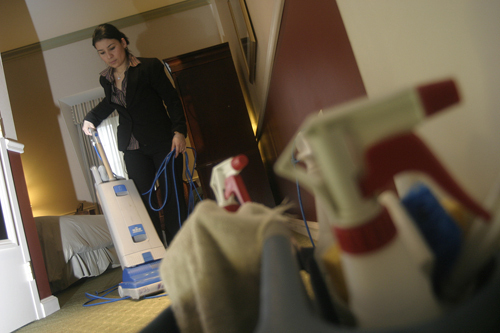
When Newport’s busy tourism season hits in late spring, the Hotel Viking could find itself unable to fill 16 open positions. At the Hyatt Regency Newport, the number could be as high as 30.
It’s not that the hotels can’t find workers to fill the positions, which include housekeeping and culinary work. In fact, both establishments find the opposite to be the case, with workers from a list of different countries expressing interest in working at the hotels on a temporary basis.
But what could prohibit the workers from coming to Aquidneck Island is a lack of temporary work visas available to bring them here – thanks in large part to a recently-expired federal act.
Every year, the federal government sets aside 66,000 H2B visas for non-skilled seasonal workers, doling them out on a first-come-first-served basis. The visas are split evenly between the first and second halves of the year, accommodating both summer and winter tourism markets.
Several years ago, however, workplaces petitioned the federal government to expand the H2B visa program in order meet needs of the hospitality and tourism industry.
The U.S. Congress and President George W. Bush took action in 2005, passing and signing the Save Our Small and Seasonal Business Act. The most significant effect was to exempt returning seasonal workers from counting against the national cap, allowing people that had worked at an establishment on a H2B visa during the previous three years to not count against the 66,000 quota.
But the act was not made permanent, and despite a last-minute attempt to extend the bill for one year as part of the 2007 Department of Defense authorization bill, it expired on Sept. 30.
The failure to reauthorize the bill is expected to have negative consequences for the hospitality industry throughout the region and nation, but hits especially hard for Newport, where some of the city’s busiest facilities were anticipating being able to bring back workers on H2B visas. (As of Jan. 2, all 33,000 national visas for the summer season had been filled, but all of Rhode Island’s applications were still pending.)
Evan Smith, president and CEO of the Newport County Convention & Visitors Bureau, said in an interview this month that if Congress fails to take action before Newport’s summer season hits, more than 100 positions throughout the city’s hospitality industry may have to go unfilled.
It’s not that businesses haven’t attempted to employ non-immigrant workers, Smith said. To the contrary, he said, they’ve tried everything to attract workers to the positions without relying on visas.
But for a variety of reasons, including a lack of long-term availability of college students and heavy competition for employees in the hospitality industry, the businesses have been unable to fill the positions without the foreign workers, who largely have been attracted from Jamaica and Eastern Bloc countries.
“They’ve exhausted their efforts,” Smith said. “In the absence of American workers, this program has been a marvelous solution to a very difficult problem.”
The Hotel Viking has placed numerous newspaper ads and undertaken other efforts in attempt to lure local workers to the positions, which hotel Human Resource Director Sue O’Donnell said mainly include housekeeping functions. However, there has been virtually no response.
“This is the type of program that works perfectly for our seasonal needs,” O’Donnell said. “We rely on these people because we literally can’t find American workers.”
The 16 positions the hotel hopes to fill with workers returning on H2B visas may have to go unfilled, she said. And if that’s the case, O’Donnell said, “a lot of people, including managers, would have to pitch in.”
At the Hyatt Regency, where 32 positions were filled with workers on H2B visas during last year’s peak season, Director of Sales and Marketing Bill Clarke would not elaborate on what steps would be taken if no relief is granted from the federal government. However, he said that the Hyatt, which is currently in the middle of a $34 million property upgrade, would take whatever measures it deemed necessary to serve customers.
“We will not allow our guest service to be sacrificed, one way or another,” Clarke said.
Despite Newport’s busy tourism season not kicking off until May, the matter is of immediate concern because lodging and other accommodations need to be made for the workers, many of whom leave their families for six months to work on the visas.
While no bill is presently before Congress, U.S. Sen. Barbara A. Mikulski, D-Md., and U.S. Rep. Bart Stupak, D-Michi., are leading an effort to urge the president to work with the U.S. Department of Homeland Security, the Department of Labor and the leaders of Congress to ensure that small businesses throughout the country don’t feel financial ramifications because of the lack of available H2B visas.
Locally, businesses such as the Hotel Viking and organizations such as the Newport CVB are appealing to the state’s congressional delegation to support any bill that would help.
(According to the Web site www.savesmallbusiness.org, which tracks the status of proposed measures related to the H2B visa program, U.S. Representatives James Langevin and Patrick Kennedy and U.S. Sen. Jack Reed, all Rhode Island Democrats, supported the act in 2006 but failed to take a stand on it 2007. U.S. Sen. Sheldon Whitehouse, another Ocean State Democrat, who just began his second year in the Senate, is listed on the site as “n/a,” but Smith said Whitehouse has offered his support to an extension.)
It’s difficult to pinpoint exactly what is preventing the Save Our Small and Season Business Act from being renewed, as little has been publicly said against it. But Smith said part of the issue may be recent concerns over immigration and terrorism.
“My own intuition tells me that part of this thing is the fact that they don’t want to create an opportunity for terrorism to come,” Smith said. “And part of it is, with just cause, let’s hire Americans first. But when you can’t hire Americans, what are you going to do?”
And in O’Donnell’s view, any negative characterization of workers on an H2B is erroneous. Many of the workers she hopes to bring back this summer have been with the Hotel Viking for five or six consecutive seasons. Most perform their jobs well and approach their temporary employment with the utmost respect.
“They come here to work,” O’Donnell said. “They’re supporting their families – they work very hard, and they’ve got great work ethics. And, for the most part, I’d say most are truly appreciative of the opportunities that are given to them.” •