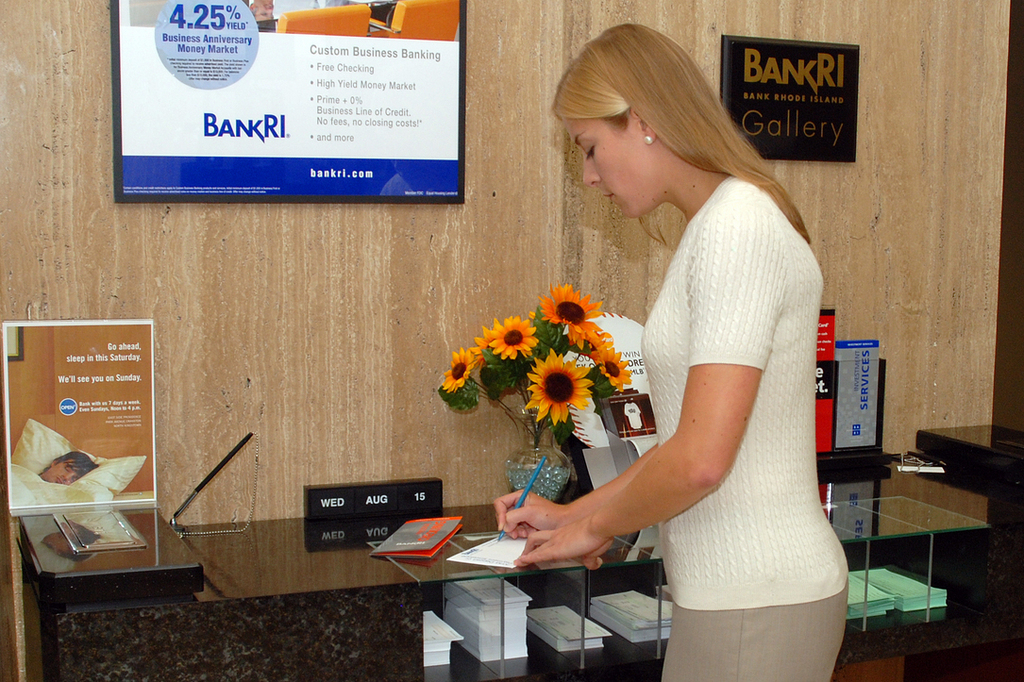
James DeRentis has difficulty remembering the last time he pulled out his checkbook and actually filled in a check.
If he buys something, he puts it on a credit card or a debit card. When he pays bills, he does it with a few keystrokes online. “I’m almost completely electronic,” DeRentis said last week. “I very rarely use checks.”
When DeRentis, chief business officer at Bank Rhode Island, wants to know about one of the biggest trends in banking in recent years, he need look no further than himself.
In paying bills or making purchases, DeRentis and most everyone else is eschewing checkbooks and turning to debit cards and online payments. Local banks report a gradual decline in the number of personal checks they are processing and an increase in the number of electronic transactions.
A local bank executive recalled how a sales representative for one of two remaining check printers in the United States told him that customers used to order new checks an average of every nine months. Now, it’s every two years.
Federal Reserve System figures confirm that it’s a national trend. A recently released study found that 37 billion checks were paid in the United States in 2003, down from 42 billion in 2001 and 50 billion in 1995.
In fact, the Federal Reserve Banks have reduced the number of locations where they process checks from 45 to 22 since 2003. As a result, the banks expect to reduce their work force by 1,740 in the coming years.
In another nod to the trend, Fiserv, an information management company that counts some of the top U.S. banks among its clients, agreed earlier this month to acquire CheckFree, an online bill-payment company, for $4.4 billion.
Providence-based Citizens Bank uses CheckFree for its online banking, but not Fiserve. Bruce Hrovat, Citizens’ executive vice president of operations manufacturing, said “it’s too early to tell” what effect the pending merger would have on Citizens’ online service.
The use of personal checks has been around since ancient Roman times, and the premise of making a paper pledge to pay for goods received immediately hasn’t changed much since then, until now.
At The Washington Trust Co., the number of checks processed in June was 10 percent lower than a year earlier, according to Michael Rauh, executive vice president of retail banking. Electronic transactions were up 12 to 16 percent in that same period. Use of online bill payment increased 15 percent, and debit card use increased 14 to 16 percent, he said.
“The number of checks has been diminishing, and the number of electronic transactions is on the rise,” Rauh said last week. “But it’s not a one-for-one exchange. We’re just seeing an increase in the number of transactions.”
DeRentis said the number of checks processed by Bank Rhode Island declined in the “low single digits” last year. Automatic payment use increased 30 percent and debit card use increased 10 percent over the same period.
Citizens’ Hrovat said his bank is experiencing a 10- to 14-percent annual increase in debit card usage and a 15-percent increase in online bill payments. Check processing has declined 5 to 10 percent a year, he added.
“It’s a matter of convenience,” Hrovat said.
It is a convenience for the financial institutions as well as the customers. Electronic banking saves paper, time and labor costs.
Rauh acknowledged that electronic banking allows for some back-office job reductions, but growth in other areas has kept Washington Trust’s employee headcount on the rise.
“The cost per transaction is probably less” when compared with processing paper checks, Rauh said. But because there are more transactions occurring, the savings is likely nullified, he added.
Electronic banking is encouraged at BankRI, DeRentis said, but not to the extreme. “It is more efficient,” he said. “But we do like to talk to our customers, too, and stay in contact with them.”
Will there ever be a time when personal checks will disappear entirely?
“It’s hard to imagine that it would ever go to zero,” Rauh said. “But in 10 to 20 years, it’s going to be an insignificant number.” •