Steve Durkee, a principal at Durkee, Brown, Viveiros & Werenfels Architects, began his relationship with AS220 on a personal level, by attending shows and art events. “I was hanging out at AS220 long before I started to work for them,” he said.
Then, in 1992, the nonprofit – originally based in an old jewelry factory on Richmond Street – bought a building at 115 Empire St. AS220 had raised $1.2 million, just enough to buy the property and bring it up to code, and the job Durkee was hired to do was just “bare-bones.”
Durkee helped coordinate a group of artists and volunteers to make basic structural repairs and win the approvals needed from the city to occupy the space. And in the 15 years since, he has worked with AS220 to turn the Empire Street building into the arts mecca it is today, complete with live/work studios, a large performance space, a bar and a restaurant.
Most recently, he oversaw the design of the Dreyfus Hotel, AS220’s latest initiative, with Virginia Branch, associate and principal architect on the project.
These are the kinds of relationships you find in Providence’s arts community. Constrained by limited budgets, but also fueled by seemingly endless creativity, groups large and small, for-profit but mostly nonprofit, spend years building out and perfecting their spaces, forging long-term partnerships with the architects, designers and contractors who work with them.
Across the city, numerous projects have followed a similar pattern:
A vacant, neglected building is bought by people with a mission-based approach. They develop the building gradually, often over the course of years, in close collaboration with the design and construction team. And the owners remain on site, either living or working there, which provides an exceptional understanding of their market and end user.
The Steel Yard, The Hive, the Dreyfus, AS220, Firehouse 13, and The Dirt Palace are centers for creativity, “and they were all virtually abandoned buildings that were ripe for something,” said Durkee, who helped officially, or acted in an advisory role, on each of these projects.
In June, a study conducted by Americans for the Arts showed nonprofits arts and cultural groups were generating $111.81 million a year in economic activity for Providence. But to be successful, Durkee said, they need good physical spaces.
And while there’s an element of prestige for architects, designers and contractors involved in some of these projects – the high-profile Dreyfus, for example – not everyone is suited to the task. “People on the creative side tend to be more involved in the process,” said Durkee, and over time, the people working on the project come to embrace their clients’ mission.
The varied programming and innovative buildings of community-based art initiatives have been proven to attract large numbers of people. The high volume of traffic also becomes an audience for the architectural, design and contracting work.
Lucie Searle, director of development for AS220, has worked in real estate development for the last 25 years, primarily on market-rate projects in the private sector. She was also involved in AS220’s acquisition of the Empire Street building, however, and she returned in 2002 to run the nonprofit’s capital campaign and oversee the restoration of the Dreyfus.
Unlike most commercial developments, which are designed to appeal to a broad market, the Dreyfus was designed to suit the wishes and needs of the artists who would occupy it, she said.
“If the Dreyfus is a creative building,” Searle said, “it is because we designed it knowing who the end user would be.”
Searle and Shawn Wallace, managing director at AS220, also worked closely with the contractor, TRAC Builders, attending the weekly job meetings on site. AS220 “lucked out” to have such a knowledgeable and dedicated contractor, Searle said, but at the same time, “we were more engaged than most owners.”
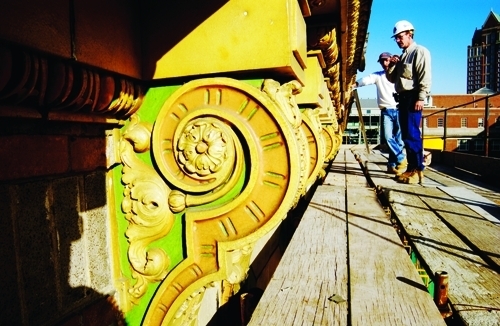
And AS220 administrators weren’t the only ones going in and out of the Dreyfus. From the beginning, photographers from AS220 chronicled the whole process, starting with a documentation of the building’s original condition, and then capturing images of the interior demolition, the cleanup, the restoration and the final result.
Construction crews and artists milled through the building together. Scott Lapham, darkroom manager at AS220 and founder of Photographic Memory, a youth-oriented program, sealed off one room on the fourth floor to create a camera obscura.
Lapham invited Dave Santos, the field superintendent for TRAC Builders, to look inside.
“When he told me to go into this dark room,” said Santos, “I didn’t know what was going on. But then I ended up bringing my kids in the next day so they could see it, too.”
Over time, being on site and engaged, and staying on site, is a big part of what makes these projects successful, said Clay Rockefeller, co-founder of The Steel Yard, an arts center that focuses on metal work, ceramics, and education.
“Investing your human capital into a project is a huge benefit to the end product,” he said. “It would be difficult for us to mediate complaints if we weren’t living there ourselves.”
The connections made through these projects are also unlike anything typically seen in commercial developments. That was evident at the ribbon-cutting ceremony for the Dreyfus on June 21. More than 100 people attended, including 30 who cut the ribbon together.
Most of the ribbon-cutters were public officials and financial supporters. But lined up with them were Santos, Bill Tracey, president of TRAC Builders, and Robert Chianelli, chief operating officer of TRAC Builders. After all, they’re now part of the AS220 family. •