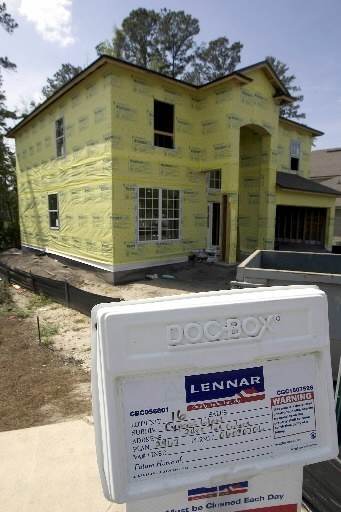
WASHINGTON – Sales of new single-family homes last month fell 15.8 percent compared with May 2006, to a seasonally adjusted annual rate of 915,000 sales, the U.S. Census Bureau and U.S. Department of Housing and Urban Development said in a joint report today.
Compared with the revised April rate of 930,000 home sales per year, the rate fell 1.6 percent in May.
The month-over-month decline was less steep than the 5.8 percent median prediction from a Bloomberg News survey of 72 economists, who predicted the annual sales pace would to 924,000 in May from April’s originally reported 981,000. Their May forecasts ranged from 850,000 sales per year to 990,000.
The median sales price of single-family homes rose to $236,100 from April’s $232,700 though it remained below the May 2006 median price of $238,200.
At the end of the month, the nation had an estimated inventory of 536,000 homes for sale, down from 542,000 houses at the end of April and 564,000 at the end of May 2006.
But that inventory represented a 7.1-month supply at the current pace of sales, up from April’s 7 months and the previous May’s 6.2 months.
In the Northeast, the annual sales pace was 81,000 in May, an 11.0-percent decline from the 91,000 per year pace the month before but an 19.1-percent increase from the 68,000 per year pace of May 2006. At the end of the month, 50,000 homes remained on the market – a 7.4-month supply at the current pace – down from April’s 51,000 and the previous May’s 54,000.
Sales also fell in the South and West compared with April – by 7.3 percent and 1.9 percent, respectively – but rose in the Midwest, soaring 31 percent.
“The strong headwinds haven’t abated at all. Tightening mortgage credit, coupled with affordability issues, will slow the recovery,” Bill Hampel, chief economist at the Credit Union National Association in Washington, told Bloomberg yesterday. John Shin, an economist at Lehman Brothers Holdings Inc. in New York, echoed his comments, saying: “Excess inventories and soft demand should keep homebuilders from increasing construction until after next year.”
Additional information, including the four-page New Residential Sales report, is available from the U.S. Commerce Department’s Bureau of the Census at www.census.gov/newhomesales.