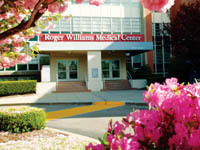
Roger Williams Medical Center was the first Rhode Island hospital to be targeted by a for-profit chain, but its deal with Columbia/HCA Healthcare Corp. fell through, and the Providence facility remains independent.
It was only a matter of time, and on July 1, 1996, it happened: A for-profit hospital chain, in this case Columbia/HCA Healthcare Corp., of Nashville, announced it had signed a letter of intent to acquire Roger Williams Medical Center in Providence.
Rhode Island’s hospitals had always been locally owned and nonprofit – a point of pride for the communities that hosted them. But the nation, especially in the South and West, was going in a different direction: toward large, multi-state, for-profit chains.
ISO 9001:2026: A Practical Opportunity to Build for What’s Next
For Rhode Island manufacturers, ISO 9001 has been much more than a certificate on the…
Learn More
By the time Columbia/HCA came to town, Rhode Island had gotten a taste of the consolidation trend: In 1994, Rhode Island Hospital and The Miriam Hospital had come together as Lifespan, a network that would grow to include Newport and Bradley hospitals as well.
Women & Infants, Butler and Kent hospitals followed suit in 1996, creating Care New England. But both the new networks kept their founders’ local control and charitable mission.
Columbia/HCA was a whole other animal. Formed by a mega-merger in 1994, it owned hundreds of hospitals and other health facilities – including, at the time, two surgical centers in Rhode Island – and had posted profits of just under $1 billion in 1995.
Roger Williams had been faltering, but Columbia/HCA said it could make it a vibrant and profitable facility, even as it increased charity care. But top officials disapproved; U.S. Rep. Patrick J. Kennedy was particularly vocal. And public opposition was strong.
A Brown University poll in February 1997, while the deal was still being reviewed by the state, found only 33 percent of Rhode Islanders approved of it going through. And 48 percent supported legislation to bar the takeover of a nonprofit hospital by a for-profit company.
That year, the General Assembly approved a sweeping new law, the Hospital Conversions Act, which didn’t go quite that far – but did impose extensive regulatory controls on the “conversion” of a hospital’s ownership, as well as on changes to some hospital services.
Then-Gov. Lincoln C. Almond vetoed the Hospital Conversions Act, saying it went too far, but the General Assembly overrode his veto.
In September 1997, Columbia/HCA, facing a major federal Medicare fraud investigation, withdrew from the Roger Williams deal, along with others across the country. But just as it was walking out the door, another giant, California-based Tenet Healthcare Corp., announced it was buying Landmark Medical Center in Woonsocket.
That deal was also doomed. Empowered by the new conversions law, then-Attorney General Jeffrey Pine scrutinized the plan relentlessly, until in January, both parties gave up.
“Landmark and Tenet together have spent thousands of hours and filed more than 50,000 pages of documents with the Attorney General’s office as part of the review process,” then-Landmark President Robert D. Walker said in a news release.
Landmark went on to consider a merger with Roger Williams, with then-Blue Cross & Blue Shield of Rhode Island CEO Ronald Battista mediating, but that failed as well.
Since then, Tenet has been involved in its own corruption scandal, and for-profit chains have come to be viewed as disruptive forces in many markets, drawing the most profitable business away from community hospitals.
No for-profit company has tried to enter Rhode Island again – though nonprofit CareGroup of Boston did try, unsuccessfully, to take over Care New England; Pine rejected the deal. Care New England also tried to merge with Lifespan, but the deal fell through after extensive scrutiny by Pine’s successor, Sheldon A. Whitehouse, and more public opposition.
Looking back, state Sen. Elizabeth H. Roberts, D-Cranston, who worked on the hospital law in her first year in office, is pleased with the impact of the conversions law.
Rhode Island’s hospitals face big challenges, she said, and sometimes mergers and ownership changes are needed. But she added: “I think it is a balance to protect access to care and protect the missions of those institutions, and it’s one I can live with.”
“And [the law] has kept the for-profit hospitals out of Rhode Island,” she continued. “I, for one, am not unhappy about that.”
’90s price wars left only 2 insurers in R.I.
Harvard Pilgrim Health Care of New England’s 177,000 subscribers in Rhode Island got just two months’ notice before the insurer pulled out of the state on Dec. 31, 1999, forcing scores of employers to scramble for new coverage and driving many people to get new doctors.
The Massachusetts-based company had no choice; for reasons that have made it an oft-cited example of how not to run an HMO – poorly integrated information systems, overambitious expansion – it was hemorrhaging money, having lost $100 million in Rhode Island alone.
Tufts Health Plan, another Bay State HMO, had dug itself into a similar hole, and in 1999 it also pulled out of Rhode Island – and New Hampshire – to cut its losses.
But Tufts wasn’t a major player here, and Harvard was: a solid No. 3 after Blue Cross & Blue Shield of Rhode Island, with about 467,000 members, and UnitedHealthcare of New England, with about 222,000. And it was the closest to a true HMO in the state, with five health centers that provided one-stop care for a large share of the members.
Harvard’s departure also came as health premiums in Rhode Island were beginning to rise steeply. In the early to mid-1990s, Health Insurance Commissioner Christopher F. Koller recalled last week, tough competition among HMOs had kept premiums artificially low.
The price wars were particularly dramatic in Rhode Island, and they cost not just Harvard and Tufts, but also Blue Cross dearly – the insurer lost $72.3 million in three years. To replenish their dangerously low reserves, all the carriers had raised premiums.
In November 1999, Curtis Ley, president of B.A. Ballou & Co., told PBN that his rates had shot up 11 percent and predicted that switching from Harvard would cost another 30 percent.
“The alternatives that we have as a company are now very limited,” he said. “We just have to take what’s handed to us, and that is not a competitive environment by any stretch.”
No new players have entered the market since then, and many blame the 1990s price war, which they say showed Blue Cross could under-price anyone that tried to enter its turf. Koller acknowledged that concerns about being able to compete in this market do probably keep some insurers at bay, but he’s also said many times that competition isn’t a long-term solution to the problem of health care affordability, because price wars can’t last forever.
But the 1990s did teach state regulators another lesson, he said: “We want to be very conscientious about monitoring health plan reserves and taking action as appropriate.”