The Washington Trust Company branch on Centerville Road in Warwick is built to impress: big, bright and airy, modern but with a distinct nod to New England tradition, and elegantly decorated inside, with an alcove that includes a coffee bar, TV and magazines.
Elizabeth B. Eckel, senior vice president for marketing, calls it a “home run.” Since it opened in 2003, the branch has grown to more than $80 million in deposits, and fueled all the major business lines: consumer banking, business banking and wealth management.
The site was carefully chosen to accomplish all that – close to the highway, in a densely populated, well-off area that also has significant commerce. The big blue-and-white sign beckons to the thousands of people who drive by.
Selling Luxury Real Estate Requires More Than Exposure
By Emilio DiSpirito IV License Partner | Private Office Advisor Engel & Völkers Oceanside www.DiSpiritoteam.com…
Learn More
“It’s met all our expectations,” Eckel said. Now the Westerly-based bank is eyeing other sites.
But as branch-building goes, Washington Trust seems more conservative than some of its competitors – especially Bank Rhode Island, which is halfway through a six-branch expansion, and Webster Bank, which is planning five or six in the region, two this year.
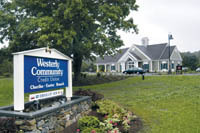
Only companies of a certain size can afford such buildout, but quite a few have joined the fray: from Fall River’s Citizens~Union Savings Bank, which just set up shop in Tiverton, to Credit Union Central Falls, Pawtucket Credit Union, even the small Westerly Community Credit Union, which this spring opened a branch in Richmond.
It’s a national phenomenon. The cover of the latest issue of the American Bankers Association’s ABA Journal has the headline, “Too Many Branches?” and the article inside notes that after a time when the bank branch was viewed as “done for,” since 2003, there’s been “a new era in branching,” accompanied by technological upgrades and redesign.
Federal Deposit Insurance Corporation statistics show at the national level, the number of bank branches has grown steadily for the last two decades, with small increases every year but 1992. (Simultaneously, however, savings institutions have lost branches.)
But the Rhode Island picture is quite different. In 1994, FDIC figures show, 19 banks had a total of 264 offices (includes more than branches) in the state. By 1998, the number had dropped 20 percent, to 212 offices owned by 16 banks. Since then, it’s rebounded slowly but steadily, to 233 as of June 30, 2004 – and there have been several more openings since then.
BankRI, which opened in 1996 with 12 branches divested by Fleet National Bank as part of its acquisition of Shawmut Bank, added only one more site in its first six years. Then, in 2002, it set out to build three more: in western Cranston, North Kingstown and Pawtucket. And last year, with the Pawtucket branch still in the works, another three-site expansion was launched. The first two opened this spring, in Lincoln and East Greenwich.
“The addition of this new branch is part of an aggressive expansion plan to capitalize on high-potential, organic-growth opportunities around the state,” BankRI President and CEO Merrill W. Sherman said about the East Greenwich site, which opened in June.
James V. DeRentis, executive vice president for retail banking and marketing, said banks thought years ago that they could cut costs by reducing branch use and focusing on technology, but while ATMs and Internet banking have reduced the number of teller transactions, the demand for branch services never went away.
“What happened was, consumers adapted to all the channels: ‘I want my branch, and I want my ATM, and I want my online banking,’” he said. “They’re willing to accept the new channel, but they’re loath to give up the old one.” In fact, industry surveys show between 77 percent and 93 percent of customers consider the branch their primary bank contact, he said.
For BankRI, which targets the business segment, branches are even more important, because those customers use branches heavily, to make deposits, get change, etc. So to lure them away from competitors, BankRI has sought to make its branches as nice and convenient as possible.
And they are: Open seven days a week, till 7 p.m., and located near other services, so you can stop by on the way to the dry cleaner’s or the grocery store. Some, branded as Excel sites, even include Internet kiosks, coffee bars, art galleries and children’s play areas.
The presence of competitors by no means scares off BankRI.
“If Citizens isn’t there, if Bank of America isn’t there, there isn’t business there,” DeRentis said. “It’s the same Burger King-McDonald’s philosophy, where you see one across from the other. You never want to be an island unto yourself, because banking is not a destination.
Citizens~Union took the same approach last year, when it opened a branch in downtown New Bedford just as Sovereign Bank was taking over Compass Bank.
“New Bedford had a terrific community bank, Compass Bank, that provided people with the quality of service that we also provide,” said Senior Vice President Julie Raposa. After the acquisition, many customers missed the hometown feel, she said, so Citizens~Union offered it to them just a couple of blocks away from the former main office.
“We see ourselves as somewhat unique in the financial marketplace,” Raposa said. “So many other banks are being absorbed, acquired, merged with larger regional or national banks, and we are still a community bank.”
The bank has also invested in technology, Raposa said, but nothing can replace a branch.
“People do want all that convenience, but they also want a place where they can go and sit down and talk about the important things that happen in their lives: purchasing a home, loans for a car, education for a child, retirement planning, trust services,” Raposa said. “You need a physical presence to be able to provide that level of service.”