RetailSolutions in Lincoln links manufacturers with consumer demand
When Pfizer launched Listerine Whitening mouthwash this month, it wanted to know right away how it did, how it compared with other flavors in various markets, and how effective a Sunday newspaper ad was at boosting sales.
ISO 9001:2026: A Practical Opportunity to Build for What’s Next
For Rhode Island manufacturers, ISO 9001 has been much more than a certificate on the…
Learn More
RetailSolutions delivered the data, down to the last bottle sold at each CVS store. Using sales information provided by the drugstore chain and other major retailers, the firm could tell Pfizer exactly how many bottles were sold every day, and which stores had sold none at all.
Should Pfizer want to know how well the new mouthwash sold in Latino neighborhoods, RetailSolutions could pin that down as well. And as sales data builds up, the firm could develop a stock replenishment model that would ensure no store with demand for Listerine Whitening ever runs out – and no store with minimal sales has boxes gathering dust.
It’s technology like this, experts say, that has made Wal-Mart powerful. Every supplier is tied into the store’s RetailLink system, constantly tracking demand for each product so not an inch of shelf space is wasted, but customers’ needs are always met.
RetailSolutions turns the tables, allowing manufacturers to benefit as much from point-of-sale data as the retail giants do. With RetailLink, a supplier can only track sales at Wal-Mart in particular, on Wal-Mart’s terms. Separately, CVS, Brooks, Target and Walgreens may provide sales data from their own stores.
But to see the big picture, and maybe find out, for example, if it’s really worth it to sell a product to Wal-Mart for just 5 percent over cost, a manufacturer needs to be able to see all the data together, sorted out and streamlined, analyzed from his perspective, not the stores’.
That is what RetailSolutions does, for giants such as Pfizer, the Coca-Cola Co., Bayer, SaraLee, Kodak, Procter & Gamble, Wyeth, Revlon, Johnson & Johnson, Unilever and L’Oreal, but also for smaller manufacturers who also need point-of-sale data to succeed.
Their smallest customer, in fact, is tracking just two items, said Andrea Vento, vice president of client services. Firms of that size can stay within their budgets by getting just a weekly report, as an Excel chart in their e-mail. For larger clients, RetailSolutions has Discover on Demand, a Web-based system they can log onto anytime to get updates within seconds.
To help clients manage the enormous amount of data available to them, RetailSolutions also assigns an analyst to each account and offers a range of consulting services: to help set up inventory management systems; look more broadly at product categories; conduct detailed sales analyses at the regional, ethnic, urban/non-urban or seasonal levels; develop targeted promotional strategies.
“We try to figure out: What are consumers doing?” said President John W. Jennings, a retail veteran who has served as executive vice president for marketing at Brooks Drug, and as vice president for purchasing at CVS. “I like to frame ourselves as consumer anthropologists.”
Access to the data varies: A store may allow, say, Pfizer to get sales data only for Listerine, or also for competitors such as Scope. And often the retailers’ databases are riddled with errors, which is why Chief Technology Officer Ken Leach and his team have developed a complex system to clean the data, identifying errors based on known patterns in the industry.
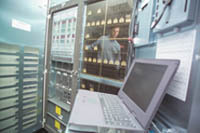
The resulting databases are enormous: more than 6 billion rows of data, stored securely in large towers in a climate-controlled room with backup power for emergencies and the capability to recover, in the event of a disaster, within 48 hours, Leach said.
Since 1996, the company has grown tenfold, Jennings said – until six months ago, with no sales and marketing staff, just through referrals. To finance further growth, Jennings recently completed a new round of financing with venture capitalists. And this month, he announced the opening of two branch offices, one in Chicago, one in Bentonville, Ark., home of Wal-Mart.
Sam Walton’s empire has been the toughest nut for RetailSolutions to crack, because unlike other chains, it won’t allow the firm to download sales data directly. But Leach’s team has now developed a kind of RetailSolutions on wheels, a self-contained tower that can put the entire system at a client’s disposal in his own building, where Wal-Mart does provide access. The first Discover Local system is going to Unilever, which is tracking cosmetics and pasta sauce sales with it, Leach said.
RetailSolutions has also just launched another product, DiscoverLink, that closes the circle, offering Wal-Mart-type technology to smaller retailers.