State loan program helps farmers attract visitors, reap profits
Jan and Michelle Eckhart started out growing strawberries in the 1970s, then expanded to Christmas trees and other types of berries. Over time, they’ve transformed their 100 acres in Middletown into a fruit lover’s paradise, with harvests from June through the fall.
For Leaders Who Don't Have Time to Get Sick
Top performers guard their calendars, delegate relentlessly and optimize every hour of the day. Health,…
Learn More
“We start out with strawberries in June, and then in July we have raspberries,” Jan Eckhart said. “Then we go into blueberries, and then peaches, blackberries, and then apples.”
In the fall, they have pumpkins. And then for the holidays, trees again.
The Eckharts’ crops are too small and diverse for the wholesale market – they could never compete with large commercial farms to sell, say, to Stop & Shop. But their Sweet Berry Farm has plenty of customers: at farmers’ markets, and at the stand right on the farm.
For years, they’ve welcomed visitors to “pick your own” berries, attracting local families and senior citizens. Now, increasingly, they’re also getting Newport tourists.
The Eckharts, who’ve just built a new farm stand with a large greenhouse and kitchen to expand their offerings for this year’s visitors, are among the targets of a new effort by the state to build agriculture-based tourism – “agritourism” – into a major new attraction.
It’s something “we never really expected,” Eckhart said. “They go to the mansions, they go to the beaches, and then they’re looking for activities, especially if they have children. So many things in Newport are not really geared for children.”
Already, Rhode Island farms are selling more of their fruits, vegetables, plants and other products directly to consumers than farms in all but one state, Massachusetts: an average of $20,539 worth, per farm, in 2002, according to the U.S. Department of Agriculture. (Bay State farms averaged $24,873; those in Vermont, $8,226.)
And even as old farms continue to be turned into subdivisions, Rhode Island’s more than 850 remaining farms – 80 percent of them family-owned – are grossing more than $100 million per year, according to the state Department of Environmental Management.
But most aren’t growing truckloads of potatoes for chip-makers, or filling silos with corn to make syrup for soda. They’re growing fruit and veggies, plants for people’s gardens, sod, ornamental trees and flowers. They’re raising horses, cattle, even alpacas.
Now from the sky, a Midwestern cornfield can have its appeal – but who’d want to spend a day with the kids there? Many Rhode Island farms, on the other hand, are perfect for that purpose.
Already, 125 to 150 local farms regularly welcome visitors, said Stu Nunnery, executive director of the Rhode Island Center for Agricultural Promotion & Education. Last September, the center, the DEM and the University of Rhode Island Cooperative Extension launched a program, “FarmWays,” to encourage them and help others follow their example.
Now the Rhode Island Economic Development Corporation has added its support, creating a new fund to provide loans of $10,000 to $25,000 apiece to farmers for upgrades geared to tourists.
“Rhode Island has long been a national leader with respect to its agricultural industry,” said EDC Executive Director Michael McMahon. “Our state’s efforts in the area of agritourism have gained national attention, and this new small-business loan fund is aimed at strengthening this core competency.”
The program, which also involves First Pioneer Farm Credit and the U.S. Small Business Administration, will make a total of $250,000 available. Farmers can use the money to upgrade their physical plants; for parking lots, bathrooms and other visitor amenities; to buy food-service equipment, or to develop Web sites.
“Few places in Rhode Island have as long a history as our farms,” Nunnery said in an interview. “Some have remnants of Indian settlements. They have culture, plants and animals, food, educational opportunities. What we’re trying to do now is help farmers develop those assets so they can sell them to the public.”
It’s no big challenge to set up a roadside stand, Nunnery said, but building a larger store, or organizing farm tours and educational activities, is a bigger challenge. You have to set up adequate parking, a public restroom, maybe buy commercial kitchen equipment.
“Most agricultural lending is for crops, buildings, equipment to produce commodities,” Nunnery said. “What this loan program does – and it’s very exciting – is it says the value of the farm as a destination is important in itself, so we’re going to provide loans to help make your destination attractive, accessible, amenable.”
Since the launch of FarmWays, Nunnery said, he’s built a database of 140 farms that either host visitors already, or could host visitors and want help doing it. The list is as diverse as Rhode Island’s agricultural life: from vineyards such as Newport and Greenvale, to dairy farms like Highland Farms, to fruit and vegetable farms like Sweet Berry. It includes farms with large, well-known retail operations, such as Shartner’s Farm in Exeter, and relative newcomers to tourism such as Glen Ridge Farm, Ann and Kevin Tarsagian’s alpaca farm in Portsmouth.
The Tarsagians raise breeding stock for alpaca farmers across the country, and they sell alpaca fibers and make some sweaters. It didn’t take long for them to realize that the gentle, woolly Andean animals were very appealing to children, and they’ve taken them to some local fairs, hosted groups of visitors, and even taken alpacas to the Providence Children’s Museum.
At this point, Ann Tarsagian said, they have no interest in making money from these activities. They just do it to share their love for the animals, and for their beautiful land.
“You don’t know the excitement of seeing a 7-year-old child look at this animal with those big eyes,” she said. “We get an amazing amount of pleasure.”
If at some point, the volume of visitors becomes so great that it disrupts their farm work, Tarsagian said, then they’ll start charging a fee. In the meantime, she said, “if we could get lucky and sell a few sweaters” every time a tour comes by, “that would be great.”
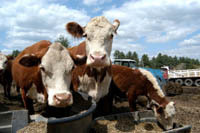
At Moosup River Farm, meanwhile, Ingrid and Peter Fratantuono are happily embracing the public’s renewed interest in farms. There’s a lot to see on their western Coventry property: They have greenhouses with flowers, fields with vegetables, Clydesdale horses, cattle – burly, white-faced, red Herefords – and pigs and turkeys. They grow most of the animals’ feed right on the farm, and use the manure as fertilizer.
“We have this sort of total system going,” said Peter Fratantuono. School groups visit regularly, and show them how they run the farm. They’re developing a new standards-based curriculum, so they’ll be even more attractive to educators. And from now until winter, they’ll be welcoming visitors at the farm stand and offering tours and activities.
“We’re trying to get into this wave of what Stu called a family experience,” he said. “I’m not sure how fast it’s going to take off; we’re at the point where we just have to market it.”
At Sweet Berry Farm, the Eckharts are also refining their offerings for schools, developing an “externship” program for teachers. And they’re gearing up for a busy summer, with new offerings at their farm stand, such as homemade breads and jams. It’s good money for them.
“You can do all right just selling a good product, and you can survive, but crops are often dependent on a lot of uncontrollable factors,” Jan Eckhart said. “When you have groups coming in for tours, if you lose one particular crop or whatever, it doesn’t impact you so much.”
Agritourism has “a lot of momentum” right now, he added, and that’s good for everyone.
“The farms are one of the main contributors of open space and quality of life,” Eckhart said. “I think people now are realizing the value of farms – of the ones that are left.”