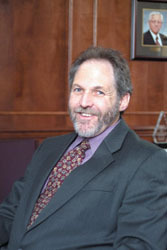
Providence Center President Dale Klatzker says his organization would suffer if proposed Medicaid cuts are approved.
Dale K. Klatzker
Position: President and CEO, The Providence Center
For Leaders Who Don't Have Time to Get Sick
Top performers guard their calendars, delegate relentlessly and optimize every hour of the day. Health,…
Learn More
Background: A veteran of mental health administration, Klatzker came to Rhode Island from Riverbend Community Mental Health, in Concord, N.H., a $17 million nonprofit center that he had run since 1994. Since 1997, he had also been vice president for behavioral health at Capital Region Healthcare and Concord Hospital, also in Concord. Previously, he had been president and CEO of Eastern Middlesex Human Services, in Wakefield, Mass.
Education: Bachelor’s degree, American studies, Brandeis University; master of social work, Boston University; doctorate in social policy, planning and administration, Brandeis University.
Residence: Rumford
Age: 50
Last July, Klatzker took the helm of The Providence Center, Rhode Island’s largest community mental health organization, upon the retirement of Charles E. Maynard, who had founded the center and led it for 36 years. In his new role, Klatzker oversees a budget of about $30 million – about half of Medicaid funds – and is responsible for the care of about 9,000 people, including about 2,800 children and adolescents. With Medicaid funding in jeopardy due to proposed cuts, and growing demand for services, the center is fighting to preserve what it has while also seeking to improve private insurers’ reimbursement rates and raise more private donations.
PBN: You’re a community mental health center. What does that mean?
Klatzker: We are part of a movement that started in the early 1960s, paralleling the community health centers, (to serve) people who have no means or limited means, close to where they live or work. Community mental health is community-based services – so not institutional, not hospital – an array of care for people with mental health and addictions regardless of their ability to pay.
PBN: Rhode Island has the highest rate of serious mental illness in the country (11 percent among people 18 and older, according to a federal report, versus 8.8 percent nationally). Why is that?
Klatzker: I think the data collection is a little suspect – they’re not comparing apples to apples across the states – but I also think the quality of services here is outstanding, and the Legislature and the governor, regardless of political party, have compassion for people. … This state does a particularly good job, and when you do that, you serve more people, and you find more who need to be served.
PBN: What kind of services do you provide?
Klatzker: Soup to nuts. You can come here for therapy. For the most severely ill populations, we do a whole package of services, because research shows that the way people get better is not just by seeing a psychiatrist or a counselor, but if you are suffering from a significant mental illness, you may need help finding a job or putting a roof over your head.
PBN: Only 3.4 percent of your income is from commercial insurers. Why?
Klatzker: A number of reasons. One is the organizational priority is on the most severely ill, and most of our funding supports that. Secondly, while we appreciate the managed care companies in the state, they under-fund and under-reimburse the services we provide.
PBN: How does a person who’s severely mentally ill end up here?
Klatzker: They may have ended up in a state hospital bed, or they’ll be treated at Butler Hospital and get transferred into our system. Police will drive people here, and people will end up in the emergency room, very frequently. Rhode Island Hospital has a very busy emergency room, and we’re in there with their staff.
PBN: How much can it cost to treat a patient here?
Klatzker: It can go up to $100,000-plus if someone’s persistently ill and needs a package of services, but the average may be $10,000 to $15,000 a year. Compare that to what it costs for a lot of other things in health care, and it’s a best buy for the buck.
PBN: Are there certain people you have to turn away?
Klatzker: People who are uninsured or underinsured, or who are at the early stages of their illness so they don’t have a long track record – they haven’t failed to the point where they qualify for services. Some of them will get by, some will self-medicate through drugs or alcohol, and that will become a problem, and some will get worse and ultimately end up in the system. There’s almost no prevention being done. And where you’d really want to spend the money is with the kids, and there’s very little being done there.
PBN: How much substance abuse do you see?
Klatzker: It’s either a primary or a co-occurring disorder in the vast majority of the people we see. If it’s not direct to the individual it’s within their family. … But there’s not enough funding. We receive about 4,000 calls a month (total), and in the last two weeks, we had to say no 120 times to people looking for substance abuse residential beds. That’s a lot.
PBN: With Medicaid a big part of your funding, how concerned are you about the situation in Washington?
Klatzker: Hugely. I’m the current chair of the National Council of Community Behavioral Healthcare, and we spend time lobbying and educating to ensure that there’s an adequate resource base. Like it or not, public funding, primarily Medicaid, has become the single-largest funding source for community mental health and addictions in the country, and if Congress does what the President’s suggesting, people will be without services. They won’t go away, and our problems with emergency rooms, with the corrections system, will get worse.
PBN: You’re starting to fund-raise more aggressively.
Klatzker: We need as much support from our community, the business community and the public, as we can get. We’re probably in our infancy in terms of looking at things like endowments, donations and capital, but we know we need to increasingly turn to the community for that kind of support. … If I had a dream, it would be that people really focused on the fact that one out of every five people had a mental health or substance abuse issue. If we put even just a small amount of our resources into that, I think we could do a better job. We all have to realize that this is something essential.