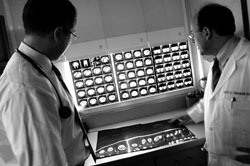
Radiation Oncology Assiciates Inc. doctors examine the X-ray images of a patient. The Providence-based radiation cancer treatment center could see up to 100 patients a day.
Providence radiation oncology center boasts high-tech therapy practices
Radiation Oncology Associates Inc.
Your Business Has Gone Global. Has Your Insurance?
A decade ago, “doing business internationally” was mostly a large-company concern. Today, a manufacturer in…
Learn More
Owners: Drs. Roger Brotman, Donald Joyce, Gabriela Masko, Nicklas Oldenburg, Kathy Radie-Keane and Scott Triedman
Type of business: Radiation cancer treatment center
Employees: 44 (including doctors)
Location: 825 North Main St., Providence
Year founded: 1978
Annual sales: WND
The waiting room is decorated with live plants and fresh flowers, and fine arts prints dress up the corridors and exam rooms. In the newest treatment room, the ceiling is a backlit picture of early autumn woods, as you’d see them if you were looking up into the sky.
Radiation Oncology Associates puts a lot of effort into making patients’ experience pleasant, because inherently, it is not. If you’re here, it means you have cancer, which is scary enough. You may have already undergone surgery and/or chemotherapy.
And while radiation therapy itself does not hurt, and makes only some patients feel ill, lying down under a massive machine, day after day, to get a part of your body treated isn’t something people would do if it didn’t offer the hope of a longer life.
“We realize how scary it is for people when they come here,” said Dr. Nicklas Oldenburg, one of six partners in the practice. “We focus on trying to take that fear away.” Most patients here come to be cured, he said, and the majority succeed.
Founded by Dr. Banice M. Webber in 1978 as a one-doctor practice, Radiation Oncology Associates has grown into southern New England’s largest free-standing radiation oncology facility, having treated more than 22,000 patients over the years. “At least half the people in Rhode Island who’ve needed radiation treatment have gotten it here,” Oldenburg said.
Though the field has grown, the practice is still one of only a handful in the state, second in size only to Rhode Island Hospital’s facility, Dr. Scott Triedman, also a partner, said. On any given day, 90 to 100 patients will be treated here, on three separate “linear accelerators,” as the radiation-dispensing machines are called.
Depending on the case, a person may get as many as 40 treatments.
Along with treating patients here, all six doctors are active in local hospitals’ tumor boards – medical teams that review individual cancer cases to determine the best treatment – and all are on the clinical faculty at Brown University School of Medicine. One of the partners, Dr. Kathy Radie-Keane, also heads the oncology department at Roger Williams Medical Center.
Patients are from all over Rhode Island and southern New England, Triedman said. By the time they arrive, they’ve already been diagnosed with cancer; depending on their specific circumstances, some will get radiation as their first treatment, or get it after chemotherapy, or undergo tumor removal surgery, then use radiation to kill off any remaining cancer cells.
Sometimes, to protect other parts of the body, special metal shields are also made.
The preparations alone take several hours, Oldenburg said, especially for patients whose tumors are in spots where stray radiation could cause real problems – treatment of a prostate gland, for example, could end up affecting the bladder; the head and neck are also considered extra-sensitive, as is the left breast, since it’s right over the heart.
Two of the practice’s three linear accelerators can do “intensity modulated radiation therapy” (IMRT), a more targeted kind of therapy that uses three or four times as many radiation beams for each spot as older machines; so, for example, if a prostate is being targeted, the heart of the tumor can get a very intense beam, while the sides get less radiation. Among oncologists worldwide, IMRT is considered one of the great advances in cancer treatment.
The doctors said they do face special challenges, too: They have to keep on top of the latest technologies, which are very expensive – the practice just spent more than $2 million on a new radiation machine and related software, for example – yet insurers and Medicare won’t pay them extra just because their costs have gone up.
“A few years ago, we decided to hire a psychologist, because patients and their families are under a lot of stress,” Triedman recalled.
Asked what it’s like to work in such an emotional field, Oldenburg said it’s inspiring.
“People ask me, ‘Isn’t this the most depressing job?’” he said. “I find that not to be true. I find that for most people, this is something that changes their lives. People who hadn’t spoken to their sister in two years call her again, or if they’d been working 100 hours a week, they stop. They take a life-altering event and change their lives around. A lot of people never forget that every day is a blessing from this point on.”