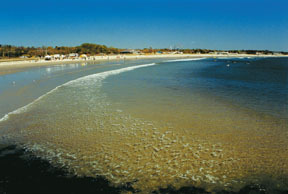
Town leaders in South County are frothing over a proposed budget change that would yank the towns’ share of parking fees at state beaches.
In Gov. Don Carcieri’s proposed budget, the state would keep all the parking fees collected at the many popular state beaches in Narragansett, Westerly, Charlestown and South Kingstown. About $50,000 would be used to reimburse the towns for the money they spend each summer on police, fire and ambulance runs to the beaches.
But $50,000 is only a fraction of the at least $500,000 the towns have received in past years from beach parking fees, and in any case the new billing system would be a bureaucratic mess, say town officials.
Selling Luxury Real Estate Requires More Than Exposure
By Emilio DiSpirito IV License Partner | Private Office Advisor Engel & Völkers Oceanside www.DiSpiritoteam.com…
Learn More
“Right now we would lose approximately $255,000 per year. We can recover some of it but the recovery would be very little, and it would be an accounting nightmare,” said Narragansett Town Manager Maurice J. Loontjens.
Last year, each town kept 27 percent of all dollars collected at the beach parking lots within its town borders. That number was already reduced from 2001, when the towns kept 40 percent of state beach parking fees.
That money helped the towns offset the cost of sending police and other emergency workers to car accidents and problems on the beach on a daily basis, say town officials. Last summer, Narragansett police made 147 runs to the beach and firefighters responded to 38 calls at beaches, racking up $268,000 in cost to the town, said Loontjens.
Narragansett, home to four state beaches, received about $256,000 from the parking fees last year at Salty Brine, Scarborough, Capt. Roger W. Wheeler and East Matanuck State Beach. Westerly, home to Misquamicut State Beach, received $199,000 last year. Charlestown, home to Ninigret/Charlestown Breachway State Beach, received $32,500.
The proposed change is a response to the Carcieri administration’s directive to all state departments to trim their budgets by 8 percent, said Frederick J. Vincent, associate director of the state Department of Environmental Management, which runs the state beaches.
Without yanking parking money from the towns, the DEM would be forced to close at least one of the beaches, he said.
“All executive agencies were mandated to meet an 8 percent budget reduction target. In our case, that would be a cut of $2.6 million … (and a) cut of $456,000 from the DEM’s division of parks and recreation budget next year.” said Vincent. “We would have to lay off 11 full-time people, out of a current staff of 66. So you can see that that kind of cut would have a significant impact on service operations and lead to the closure of a major park facility. That division has very little options short of closing a facility when you reduce staff like that.”
The state already gets all revenue from seasonal passes and concessions at the state beaches.
If the change were enacted, beginning July 1 the towns would have to document each emergency service call and be reimbursed later. But that won’t cut it, said Loontjens – in Narragansett alone, the cost of police and fire runs was $268,000, he said. And it would be difficult for towns to bill the state for its emergency services associated with the beaches, because of the wide range of calls that police and rescue workers respond to during beach season.
“In the old days at Scarborough, we used to have a nurse there, and that took care of all the problems. Now everyone on the beach has a cell phone, and we get 9-1-1 calls all summer long … with four people responding to anything from a broken hip to a sunburn,” said Loontjens. “And billing is difficult, because if somebody gets into an accident a mile away from the beach on their way back to Cranston, we’re not going to ask, ‘Well, were you at the beach?’ So it’s going to make it very, very difficult to be fully reimbursed.”
Loontjen and officials from Charlestown, Westerly and South Kingstown have all said their towns might have to raise property taxes to offset the loss of beach parking revenue.
Vincent, the DEM official, said that he empathizes with the situation the towns are potentially facing. But he pointed out that the towns also benefit financially from playing host to hundreds of thousands of beachgoers every summer.
“We are a major attraction that drives the local economies during the peak tourist season. In addition to incurring costs, there’s also the economic upside. There’s many benefits to local business, the creation of local jobs to staff those facilities,” said Vincent. “We want to continue to work with those communities. I realize this is a very bitter pill for those communities. These are just very challenging budget times.”
For the complete current issue, visit our subscription Web site, or call (401) 273-2201, ext. 227 or 234.