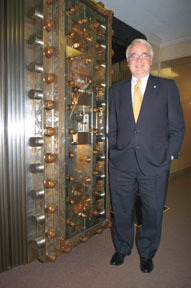
of The Washington Trust Company.
Name: John C. Warren
Position: Chairman and CEO, The Washington Trust Company
Age: 58
A modernized health plan: Supporting cost management and the employee experience.
The Surest health plan came from a group of innovators wondering: What if health care…
Learn More
Professional background: Warren joined Washington Trust as its president
and chief operating officer in 1996, and was appointed chairman in April 1999.
Early in his career, Warren spent 15 years with Shawmut National Corp., where
he rose to the position of senior vice president of capital markets. He left
Shawmut National in 1988 to become president of Sterling Bancshares. He served
in the U.S. Army as a linguist from 1967 to 1971.
Education: Undergraduate degree from Yale University in 1967. MBA from
Harvard Business School, Program for Management Development in 1987.
Residence: Narragansett
As the chief executive of The Washington Trust Company, Warren oversees
the oldest community bank in America, today a $1.8-billion financial institution.
Founded in Westerly in 1800, the bank was named after George Washington,
who had died a year earlier. At the time, Westerly was a farming village with
a population of around 400 people. A few local entrepreneurs decided that the
people of southern Rhode Island and southeastern Connecticut needed a bank of
their own, as the closest banks were located many miles away in Providence and
New Haven. Several local merchants and community leaders were elected to serve
as directors and officers of the new bank, then called The Washington Bank.
Two hundred years after its founding, in 2000 Washington Trust made its
first moves to extend into different parts of Rhode Island when the bank augmented
its asset management business through the purchase of Providence-based Phoenix
Investment Management. Washington Trust gained a much larger retail- and business-banking
foothold in the greater Providence area last year, with the acquisition of First
Financial Corp., the parent company of the First Bank and Trust Company. The
decision, made during a time of national recession and scandals in the banking
world, allowed Washington Trust to open new branch offices in Cranston and Providence.
After acquiring First Financial Corp. last year, on April 17 Washington
Trust reported first quarter 2003 net income of $4.7 million, an increase of
26.9 percent from the first quarter of 2002. Last week, Washington Trust celebrated
the opening of its first branch in Warwick.
PBN: I want to start by asking about Washington Trust’s new branch in Warwick.
Why did Washington Trust decide to start expanding in the northern part of the
state, and can we expect to see more of that?
Warren: Well, we’re really very excited about the move to Warwick. The actual choice of the location occurred before our acquisition of First Financial, the parent of First Bank and Trust, and they had locations in Cranston and Providence. So Warwick was a natural location, even had we not already been looking there. We opened an office in North Kingstown in 1997, and from there we were seeing Warwick customers come to us, we were seeing commercial loan opportunities in the Warwick area, and it became more and more evident that the next natural branch to open would be in Warwick.
How is the First Financial acquisition panning out so far?
It was a wonderful acquisition for us. I think it was a win-win situation. I think the customers of First Financial and First Bank and Trust were very happy. The conversion was seamless. I mentioned at our annual meeting recently that I even received some letters from customers thanking us for having done such a good conversion, and I couldn’t believe I was getting letters on something like that. There are probably 5,000 new customers from First Bank and Trust that became a part of Washington Trust with this acquisition, many of them business customers, many of them personal customers. And on top of all the products that First Bank had been able to offer, we were able to really expand the mortgage- and home-equity credit lines that we were offering. Trust and investment services, and product that First Bank was not large enough to offer, we were offering.
Can Washington Trust stockholders expect any new acquisitions in the next
year or so?
Well we always look at opportunities. I think right now we want to stick to our business and make sure we do a really good job opening the doors in Warwick and paying attention to the customers that we have in Warwick. And we want to pay attention to all the customers we have in the Providence and Cranston market. So what you’ll see is Washington Trust people working very hard in Warwick, in Cranston, in Providence. We want to do a great job there and really bring our expertise to those markets.
Here in Rhode Island, Fleet Bank seems to be struggling, and Citizens,
a smaller bank, is booming. As Washington Trust grows, are there lessons you
can learn about the size or type of bank that can really be a success in this
economy in this state right now?
Sure. I mean, a couple of different things. We learn that the customers really pay attention. So as we expand, the important thing is to make sure that what a customer sees is what Washington Trust is known and respected for, which is quality of service, integrity and involvement in the community. And then you have to deliver the products, great products for the customers. And so as we go to each new location we’ll make sure to provide that. You can be a mega-corporation but not providing those kinds of services, and your size doesn’t help you at all. You know, I think Citizens has done a good job. We’re paying attention to what we’re doing, and we want to make sure that people think of Washington Trust as the Rhode Island bank.
Other banks have been saying in the past months that they’re concerned
about their static commercial loan portfolios. How is your commercial loan portfolio?
Are you seeing any evidence of increased capital expenditure out there? I guess
I’m trying to see if you’re gauging the state’s economy through your own business
in any way.
We had some growth in our commercial loan portfolio in the first quarter, but the real concern with the war in Iraq and the overall weakness in the economy is, when will that turn occur. And we haven’t yet seen if the economy truly will recover after the war is over, like (Federal Reserve Bank) Chairman Alan Greenspan would like us to think. I don’t know. I hope it will, but we don’t know yet.
Loan rates are so low, and particularly interest rates on home mortgages.
How long can these numbers last, or do you think a new norm is being established?
Right now there’s no reason for interest rates to go higher. You know, the economy is weak, there’s no inflation. I’d say each year for the past three years, people including myself thought that perhaps interest rates would be moving higher. Each year they’ve stayed the same or gone lower. In the world of economics and the financial markets you never say never. I remember the 1980s, when there were some young people working for me back in Boston, and rates were doubled digit at that point, they told me that we would never see hat-sized interest rates again. That’s sevens, eights and nines. (laughs.) I said, you don’t ever say never. And right now we’re seeing interest rates that existed when John F. Kennedy was president, when Dwight Eisenhower was president. It can actually stay like that for quite a while. There are huge capacity opportunities throughout the world. Whether it’s China, Mexico, Ireland, Europe – every manufacturer has the ability to very easily move production facilities and just float where the economic opportunity is. And right now there doesn’t appear to be a single company experiencing any kind of capacity constraints. And if you don’t have that, what you have is competition and people fighting to get more business, and that doesn’t create inflation. If anything, it makes people worry about deflation, as prices keep coming down. So I think interest rates can stay low. It’s a unique world out there.
Again, along similar lines, so many folks are refinancing these days. I’m
assuming the bank doesn’t make money on a refinance. I wonder what’s in it for
the bank – are you just kind of taking a hit in the name of customer satisfaction
or is there an upside for you when people refinance?
Many of the people we do it for are our customers. But many of the loans we
actually write of refinance, we will actually sell the loan. We’ll resell the
loan to Fannie Mae or Freddy Mac, you know because I know people who have refinanced
already this year. I mean, refinanced in January and three months later they
were back at the attorney’s office with the bank, rewriting their loan again.
The opportunity was there, rates dropped again, and they took another half or
three-quarters of a percent off their mortgage rate.
For the complete current issue, visit our subscription Web site, or call (401) 273-2201, ext. 227 or 234.