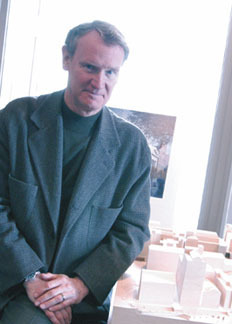
to be comfortable with the college's
building design.
When a prominent design school goes about planning a new, centerpiece building for its campus, attention invariably falls to, well, the design.
For the Rhode Island School of Design’s planned RISD Center, the scrutiny has been especially acute. Since the design by Spanish architect Jose Rafael Moneo was unveiled last October, it has evoked strong reactions from architects and city residents alike.
RISD’s administration sees the six-story, $46 million center – which will vastly expand the RISD Museum and provide much-needed classroom space – as the anchor of its broad plan to elevate the school’s profile to new heights, both locally and internationally. The North Main Street site, just below the existing museum on Benefit Street, will foster a stronger civic link between RISD and Providence, school officials say.
A modernized health plan: Supporting cost management and the employee experience.
The Surest health plan came from a group of innovators wondering: What if health care…
Learn More
It also will occupy one of the most architecturally sensitive areas of the city. Some critics have said the building’s modern design will mar the historic character of College Hill. Supporters say the building is a fine example of modernism made to blend into a historic context.
From whichever vantage point, there’s little question that the new brick-and-glass structure will reshape the bottom of College Hill. And in a way, that’s the point, said RISD President Roger Mandle.
“We want it to be obvious, to show where RISD is,” Mandle said during a recent interview. “RISD has always been this discreet little campus. But we want this to beckon people to come to see RISD. It’s a signal to the community that we want their involvement.”
The 57,000-square-foot building will create an inviting new museum entrance on North Main Street, connecting to the existing museum, which will be gutted and renovated. Pedestrians lured in by the ground-level café will be able to take an escalator to museum space on the third floor, filled with natural light and 18-foot walls.
While RISD is bent on making a statement with the RISD Center, Mandle says the school – and Moneo – have taken painstaking steps to fit the building into a patchwork of period architecture. By Mandle’s count, as many as 10 distinct architectural styles adorn the block, spanning more than two centuries.
The complexities posed in shoehorning the center into the architectural hodgepodge was the main reason that RISD tapped Moneo, an architect known for melding contemporary designs into historic contexts. And Mandle insists that Moneo delivered.
The exterior of the building’s first three floors will be brick, helping to blend in with its mostly brick surroundings. The top three floors will be all glass, a cube-like shape that is expected give off a soft glow at night. The building’s height is equal to that of other buildings in the area and the angles have been designed to line up with those of neighboring structures. In fact, RISD will need no zoning variances when construction begins in spring 2004.
But the emphasis on fitting in did not muffle the design, Mandle said.
“We did not want to build another neo-colonial building,” he said. “We wanted to build something that spoke to our time.”
Some critics charge that the blocky shape of the design and the illuminating cube will blight the area’s architectural integrity.
“This blockhead of a building will be a blunt rebuke to the oldest street in the city,” Providence Journal columnist David Brussat wrote last November. A number of letters to the editor in the Journal also have bashed the RISD Center design.
A few local architects, however, say that the jumble of architectural styles at the bottom of College Hill gives RISD more latitude in the center’s design than one might think.
“It will be a destination building, and I think destination buildings quite properly draw attention to themselves,” said Mack Woodward, architectural historian for the Rhode Island Historical Preservation and Heritage Commission.
Woodward said the RISD Center design seems to fit into the massing of structures on the block while forging its own identity. “It’s definitely an urban building rather than a stand-alone structure.”
He added that it often takes time for a building’s design to take hold. He cited the Providence County Courthouse and RISD’s College Building at South Main and College streets, both Georgian-style structures built in the 1920s and 30s.
“Many people thought both of those buildings were a travesty at the time,” Woodward said. “But when you look at that block, I think most people would say that that’s a really fine piece of urbanism. They do what they’re supposed to do.”
William Morgan, another local architectural historian, agrees that placing too great an emphasis on historical context can smother bold, innovative design – a “trap” he says the RISD Center falls into.
“The design is OK, but it doesn’t make your pulse race,” said Morgan, a former architecture critic for the Louisville Courier-Journal, who also has taught architecture courses at Roger Williams University and Wheaton College.
“You’re not going to get good architecture unless you’re willing to take some chances,” Morgan said. “If you believe in the integrity of a place, allow the architect to sense that character, rather than putting him in a box.”
Mandle said that some skepticism over the RISD Center design is to be expected, given the fact that Providence has “not been served well” by much of its contemporary architecture.
But in this case, Mandel insists that Moneo struck the right balance between historical context and modernism. He describes the RISD Center design as a microcosm of the art and design work done by RISD students: with its ear to the past, but its eyes on the horizon – projecting forward.
“People need to have faith that RISD’s community of architects and artists and designers have the collective experience to do right not only by its own campus but also by its community,” Mandle said. “I believe that, in the end, the design will stand the test of time.”
For the complete current issue, visit our subscription Web site, or call (401) 273-2201, ext. 227 or 234.