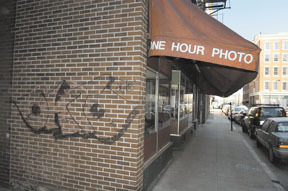
in downtown Providence.
Graffiti vandalism is a chronic and costly problem in downtown Providence, say business and property owners. People whose properties are vandalized on a regular basis say they routinely pay between $30 and $175 to clean up graffiti every time vandals strike. And vandals strike on an almost daily basis in certain streets of the city’s business district – particularly in Downcity and the Jewelry District, they say.
“If you get hit by graffiti it’s a great concern. It’s a shame. It has a bad effect on the image of the area, and it costs money,” said Dan Baudouin, executive director of the Providence Foundation.
Worse, the unending war on graffiti is an emotional drain on those involved in the long battle to improve the vitality of the city’s business district, say people involved.
A modernized health plan: Supporting cost management and the employee experience.
The Surest health plan came from a group of innovators wondering: What if health care…
Learn More
“Graffiti represents a sort of cynicism that is costly to all of our efforts to revitalize our city. It’s as simple as that,” said Arnold “Buff” Chase, managing general partner of Cornish Associates, which currently owns eight buildings on Westminster Street in downtown Providence.
The property and business owners agree that graffiti is a common problem that needs to be dealt with. The graffiti problem regularly comes up at meetings of the Downtown Business Association, the Greater Providence Chamber of Commerce and the Providence Foundation.
But those most affected by graffiti vandalism disagree to some extent about what to do about the problem. Indeed, some were hesitant to even discuss the graffiti problem for this story, fearing it would encourage graffiti vandals seeking attention. Others spoke freely, saying they were happy to call attention to the issue in the hope that it would spur a more active approach to dealing with graffiti in the city.
In the war on graffiti, the single most important thing that business leaders can do is to create a business improvement sector in downtown Providence said Peter Armato, president and CEO of the Downcity Partnership, an organization focused on the revitalization of Providence’s Downcity District.
Armato said that the city is not the right vehicle for maintaining every piece of private property in the downtown area. And individual property owners can be more effective in dealing with this problem if they collaborate.
“Let’s be real here, it’s the job of the property owners to take care of their own buildings. This is an issue that’s as old as cities. It needs to be dealt with through consistent maintenance and removing the graffiti as soon as it appears. The city has made an admirable effort in its efforts to control graffiti, but it needs to be supplemented,” said Armato. “Not all property owners can take care of the problem so quickly. Why not set up a system where I’m paying my fees to this business improvement district which has a maintenance staff, and I give them the authority to remove this graffiti as soon as it appears on my property?”
But other business and property owners said the Providence Police Dept. has to step up its commitment to battling graffiti. Vandals are committing a crime in the heart of the city with startling regularity, they say. Why can’t the police get on the ball?
“We pretty much get hit every Thursday night. Occasionally Saturday nights, but Thursday is the more predictable one,” said a manager of a corporate property in downtown Providence who wanted to remain anonymous. “An area has to be under control, and that means you have to pay attention to all infractions, and graffiti is one of those.”
Recently, members of the Providence business community, the academic community and Providence police officials formed the Downtown Security Network to help fight the graffiti problem, among other security issues. What to do about graffiti has been a constant topic at the organization’s monthly meetings, said Armato.
During former Providence Mayor Vincent A. Cianci Jr.’s administration, the city had an anti-graffiti hotline, and employed an anti-graffiti patrol to combat the problem, according to the city of Providence Web site. The patrol was dispatched by radio and removed paint with an airless paint sprayer, or with high pressure water and sand called hydrosanding, or with soluble chemicals.
From its inception in September 1993, the Mayor’s Anti-Graffiti Network removed more than 15,000 graffiti “tags” across the city, according to the city’s Web site.
New Mayor David Ciccilline’s administration did not respond to repeated requests for interviews with the mayor’s staff and the police, or for information about its graffiti policy.
Business and property owners may disagree to some extent about how to combat the graffiti problem. But they agreed on one thing unanimously: Everyone interviewed asked that this report should avoid the use of the term ‘graffiti artist.’
“I know in some circles there’s an artistic component to graffiti. That doesn’t
exist here. This is just pure vandalism. We need to work with police to stop
it,” said Chase.