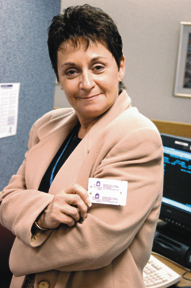
of patient registration at Fatima
Hospital.
Deborah Ardente was paying for toiletries when she came up with an idea for how to save the lives of some patients who arrive at her emergency room unconscious.
“I thought of it, actually one day standing in line at CVS,” said Ardente, who is the clinical coordinator of patient registration at Our Lady of Fatima Hospital in North Providence. “I thought, ‘wouldn’t it be great if we could register patients and know who they are with one of these little key chain tags with a barcode on the back?’”
On Oct. 24, Our Lady of Fatima Hospital began issuing key chain scan tags to every patient that comes through its doors. The plastic tags, which reveal a patient’s complete medical history with one swipe through a barcode scanner, look like the ones customers get at Stop & Shop or, for that matter, CVS.
A modernized health plan: Supporting cost management and the employee experience.
The Surest health plan came from a group of innovators wondering: What if health care…
Learn More
Like thousands of hospitals, Fatima has issued credit-card-sized patient-information cards that work with a bar code reader since the technology became available. But Fatima is likely the first hospital in the nation to shrink the scan cards for use on a key chain, according to Amy Keran, a spokeswoman for Minnesota-based Datacard, Inc., one of the biggest dealers for plastic cards in hospitals nationally.
“We don’t know of any other hospitals that are using these key chains,” said Keran.
Fatima Hospital’s new key chain tags are made by Datacard. The hospital got the cards from Rhode Island Business Equipment Company, a dealer of Datacard equipment in East Providence. Ribeco made the old cards the hospital used.
Ardente said she has received calls from hospitals in Indiana, Missouri and Delaware inquiring about the coded key tags. She said that South County Hospital has approached Fatima administrators to ask about the price and implementation of the key tags.
The problem with the old, credit-card style cards is that people didn’t keep them on their person, and doctors had to ask their lengthy lists of medical questions for incoming patients. Hospital administrators hope that by issuing the key chain scan tags, the tags will become a permanent attachment to key rings. Thus, patients entering or returning to the hospital will have the tag’s significant coded data with them, which will increase hospital efficiency by allowing doctors to bypass their battery of questions.
The hospital has already issued more than 600 of the key chain medical tags, and is already seeing patients come through the door with the key chain tags attached to their keys, according to Ardente. That’s helpful for older patients who visit the hospital on a regular basis. But it’s especially useful when a patient is unable to communicate to doctors.
“I’ve seen many patients come in without ID, unconscious joggers, or they don’t speak English. But they almost always have a set of keys,” said Ardente.
Ardente approached hospital administrators about six months ago with the idea for a key tag patient-identification system. The package of five scanners, two printers, 25,000 blank key tags and training tools cost the hospital $12,000, said Ardente.
Ardente, who had been a floor nurse for 21 years, became director of registration just a little over a year and a half ago. Then inspiration struck. She said that virtually every patient who has been issued one has embraced her brainchild key chain tags.
“We haven’t had anyone refuse one. It’s different if you go into a supermarket and they ask you to carry it – it can save you a couple of dollars here and there. But you know, this can save your life,” said Ardente.
On the front of each key tag is Fatima Hospital’s logo, address, telephone number and Web site address. On the back is a barcode, which reveals the patient’s individual medical records number when scanned.
While any scanner will reveal the medical records number, that number reveals nothing about a patient’s medical history – medical personnel type the number into a hospital computer to pull up a patient’s medical file.
So the key tags pass muster with the new federal Health Insurance Portability and Accountability Act, regulations aimed at simplifying the administration of health insurance through electronic transmission of patient records. Passed by Congress in 1996, the law creates stringent new requirements for the protection of any individually identifiable health information that is maintained or transmitted by electronic media or any other, set to go into effect in April 2003.
North Providence Mayor A. Ralph Mollis has agreed to look into buying the equipment needed to install key-tag readers in town ambulances. Such a system would potentially save lives, allowing emergency medical workers to transfer information immediately, past medical history, medicines, allergies. And when the patient comes through the ER door, physicians at Fatima would be well prepared, having been in contact with EMTs.
Ardente said Fatima is approaching Providence officials and those in other nearby cities and towns in the hope that they will consider adopting the system as well.
“It opens up a world of opportunities,” said Ardente. “We see ambulances from all over, so it would be wonderful if we could have them all equipped to read these key chain tags.”
Hospital officials started the new system’s kickoff five weeks ago at a senior citizens center in North Providence. Ardente said they are equipping nursing homes in the area, and plan to initiate the new system in every one of the hospital’s affiliated medical offices.
Ardente said hospital officials have targeted the elderly for the key-tag launch because they are the group most likely to make multiple hospital visits. She said the hospital is also investigating the idea of issuing the key tags in area schools.
For the complete current issue, visit our subscription Web site, or call (401) 273-2201, ext. 227 or 234.