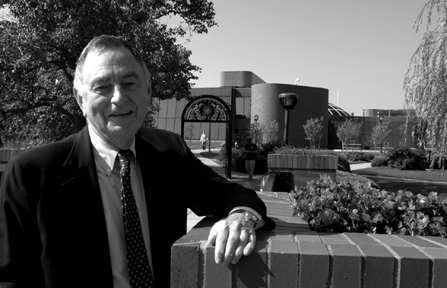
Name: William T. O’Hara
Position: O’Hara, president emeritus of Bryant College, is currently executive director of the school’s Institute for Family Enterprise.
Background: Born in New Haven, Connecticut. Practiced law for five years before entering higher education, working first as a clerk for a federal judge in Washington, D.C., then as a federal public defender, then as counsel for a congressional subcommittee on higher education during the Kennedy administration. O’Hara then became the associate dean of the University of Connecticut Law School, and was later named the law school’s assistant president. In 1972, O’Hara became the president of Mount Saint Mary College, in Newburgh, New York. In 1976, O’Hara became president of Bryant College, a position he held until 1989. Following a sabbatical, O’Hara established the Institute for Family Enterprise at Bryant College, and chaired then-Governor Bruce Sundlun’s Task Force on Ethics Reform in Rhode Island State Government. O’Hara is writing a book about the world’s oldest family-owned companies, which will be published next year by Adams Media.
Your Business Has Gone Global. Has Your Insurance?
A decade ago, “doing business internationally” was mostly a large-company concern. Today, a manufacturer in…
Learn More
Education: B.S., Trinity College; J.D. Georgetown Law Center; Master’s in law, New York University.
Age: 70
Residence: Wakefield
PBN: Aside from your professional interest and training as an attorney, you’ve spent most of your career in some way arbitrating conflict. What’s your personal draw to that type of approach to solving problems, whether it be a business or a political or a personal problem. You seem to enjoy solving people’s problems.
O’HARA: I do, and I think there are an awful lot of stereotypes about law and lawyers in the general public. If I look back and if I remember correctly, I found that law school was a very competitive environment, very adversarial – that’s what they emphasized… us versus them. And then there was this very small niche at the time – remember this was the 1950s – when they were just beginning to look at things like arbitration and mediation. Getting into those courses, I was finding that the law did offer an opportunity to do some peacemaking, instead of the adversarial posture, and certainly that has a place. But my personality, and the match with resolving problems, bringing people together, and cutting down on the cost of conflict, all fell within that area of what they call alternative dispute resolution – ADR.
As you read the paper every morning, are there aspects of Rhode Island government or politics or business where you read and think, ‘wow, an arbitrator would really be able to solve this particular problem.’
Well let me answer it this way: What I would like to see is more of an awareness – whether it’s a family business, or two partners at a law firm, or two secretaries that can’t get along down the hall – of bringing in the person who understands the psychology of facilitating conflict. I can carry a message to someone across the room a lot easier than you could, because of the history and the antagonisms that have been generated. So I can take part of your story and present it to the other person and it’s not as threatening. It’s not necessarily coming from you. I can go in and say, ‘well what if Mr. Ortiz was able to yield on this point, would you be able to yield on some of your points?’ It almost always lubricates the process when people communicate through a third person.
As you’re talking about the tactics that you use, I’m thinking about [former U.S. Senator George] Mitchell when he negotiated the peace agreement in Northern Ireland. Are there real learnable techniques, or do you really rely on instinct and raw people skills when you’re resolving a conflict with warring parties.
Yeah. In talking with my students about that – I teach an MBA course on negotiation and conflict resolution – what I really say at the outset to my students is that it’s a combination of both. There are certain kinds of techniques, certain areas that you’re aware of, and then I think for the very best and most effective mediators there’s an instinct. There are certain natural inclinations that make some people better facilitators and conflict resolvers than others. You can play minor league ball and be pretty darn good, but then in the major leagues there’s that intangible that makes a person a top player. Certainly that’s true in conflict resolution.
Talk to me about the work you did as chairman of Governor Sundlun’s Task Force on Ethics Reform in Rhode Island State Government.
Governor Sundlun had been elected just about the time when the whole credit union debacle came about, and he was required to close the banks. He was faced with this crisis and he was new on the job, and everything was happening like overnight, and what he saw was an opportunity to take this debacle and try to bring about some reform. And he had been connected with the college – he had been on the board of trustees – so we had some kind of connection. And he came to me and asked me if I would head up the task force. And I wasn’t necessarily well versed in ethics at the time, but there was an interest once it was put before me – not a bad idea, not a bad area to get some experience in. The task force met for, oh, about a year, year and a half before we came in with about 78 recommendations, of which close to 70 were adopted by the legislature. So when we finished up, Rhode Island had the most stringent, or close to the most stringent, ethics code of any state in the union.
For the complete current issue, visit our subscription Web page, or call (401) 273-2201 ext. 227 or 234.