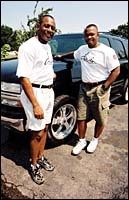
Co. owners, Hank Seemore,
right, with Wayne Procope,
comptroller
When Davin Wheel Company launched its business in East Providence two years ago, the fledgling company considered itself a great American success story in the making – three buddies, one original idea, and a plan for cornering the market.
Hank Seemore, David Folks and Ian Hardman set out to design and market the world’s first continuous motion wheel rim for luxury cars. A spinning hub cap! Apparent to admiring observers, they said.
The Rolex of hubcaps, the partners believed. They knew their wheels wouldn’t be a hard sell. They would appeal to the wealthy automobile enthusiast, the folks that set the trends in a niche market. They hired a crack team and launched their business in the fall of 2000 as an 11-person company with big plans.
Selling Luxury Real Estate Requires More Than Exposure
By Emilio DiSpirito IV License Partner | Private Office Advisor Engel & Völkers Oceanside www.DiSpiritoteam.com…
Learn More
But before they could start making spinning hubcaps, the partners knew they had to comply with federal employment regulations, establish a payroll and file the proper exemptions, and hunt for benefits packages. That really set their heads spinning.
They were idea guys — they didn’t want to be in the HR business. They worried that dealing with the minutiae of human resources would bog them down. Yet, they knew that setting up a proper HR department was a crucial step in building a solid foundation on which to grow their business.
So Hardman, Folks and Seemore did something an increasing number of small businesses are doing across the country. They decided to let a professional employer organization run their human resource department. In their case it was Administaff, Inc.
"Our backgrounds are in banking, finance and marketing. None of us has experience in human resources," said Seemore. "One mismanaged workers compensation claim could put a company out of business. We wanted to look for efficiency and manage risk. That’s our approach. We want to be as lean as possible, but at the same time this just gives you the comfy cozy feeling of being with a big firm."
Professional employer organizations, or PEOs, are personnel-management companies that serve as an off-site human resources department for small and medium-sized businesses. A PEO enters into a co-employment relationship with the owners of a business, and shares many of the responsibilities of being an employer.
Contracting a PEO has become increasingly popular in recent years for many small companies with plans to grow. But in recent weeks, some analysts have begun to warn that PEOs may become a less attractive option for small businesses if the economy stays weak and health care costs continue to rise.
Typically, business owners can choose to pick from a wide range of human resources offered by PEOs, including government compliance, recruiting, benefits management, employee performance management, employer liability management. Most small- and medium-sized businesses that contract with PEOs say their cost is less than it would be if they were creating an in-house HR department.
National PEOs such as Administaff, which represent tens of thousands of employees, typically negotiate discounts on health benefits from insurance companies. A PEO’s ability to deliver affordable health insurance is especially attractive to businesses that employ a handful of workers.
"They save you a ton of money on health insurance," said Mary Murphy, general manager of Mobility Solutions, Inc., a small business in Woonsocket that sells handicap-accessible minivans and adaptive equipment such as hydraulic lifts and stair-climbers.
That company, which turned one year old on May 1, has six employees whose human resource issues are managed by Genesis Consolidated Services, Inc., a Lexington, Mass-based PEO.
"When I laid out all the work that it takes to handle HR – the benefits, the employment taxes, the legal team – the small amount of money that I pay [Genesis] per employee – it was definitely worth it," said Murphy. "I don’t have to deal with anything. I call in payroll once a week."
Mobility Solutions pays Genesis $90 a week to handle the business’s payroll, provide workers compensation insurance, health insurance and other benefits, and ensure that the company is OSHA compliant. That’s $15 per person per week. By that count, Murphy estimated that her company is saving $12,000 to $15,000 a year on human resources, factoring in all elements.
For a small company with a strategic plan for growth, such savings can be a crucial piece of the equation. At Davin Wheels, Seemore said the company hopes to employ 30 staff in several regional offices in five years.
"It definitely will help to grow, just in being able to offer what we do to the folks we have on board. Before we contacted Administaff, we never knew we could actually offer our staff such an array of benefits – health insurance, a good 401k, a credit union. It gives us a big company feel, even though we have a small staff," said Seemore.
Largely as a result of the ease and savings they offer business owners, PEOs are gaining in popularity. The industry is growing by more than 35 percent every year, according to the PEO.com Group, an online trade organization. Ten years ago, the industry was in its infancy. Today, there are more than 2,000 PEOs in the United States, co-employing more than two million workers, according to PEO.com.
But there are recent indications that PEOs may become less-viable partners for small -business owners if the economy does not rebound and health costs continue to spiral upward. A major harbinger occurred just last week, when Salomon Smith cut its investment rating on Administaff Inc., the bellwether national PEO firm, to "neutral" from "outperform," after the company reported second-quarter earnings sharply below Wall Street estimates.
"ASF dramatically missed second-quarter estimates due to higher health costs, raising the concern that the PEO business is too unpredictable to be investable," wrote Salomon analyst David Riedel in a note to clients. Looking ahead, "investors will likely avoid Administaff, as earnings disappointments in each of the past three quarters have soured investors on the shares," he predicted.
Separately, Morgan Stanley said it cut its price target on Administaff to $8 from $20.
"We don’t think the business model is permanently broken, but we don’t forecast normalized profitability until late 2003 and liquidity concerns are rising," wrote Morgan Stanley analyst Chris Gutek in a note to clients.