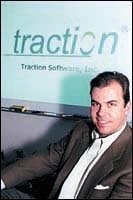
for Traction Software
Armed with a PowerPoint presentation detailing his company’s business model, Tim Simonson was in front of a New York venture capitalist on Wednesday describing how Providence-based Traction Software, Inc. would make this prospective investor millions.
After his pitch, Traction’s CEO had two other important appointments later that day in the city that might prove just as important in his hunt for venture capital. He met with clients.
Having customers using a proven product is vital to investors, many of whom are still stinging from pouring millions into high-tech companies that had cutting-edge ideas, but no way of turning a profit.
ISO 9001:2026: A Practical Opportunity to Build for What’s Next
For Rhode Island manufacturers, ISO 9001 has been much more than a certificate on the…
Learn More
Simonson believes it’s just a matter of time before the six-year-old Traction Software obtains the funds it needs to widely market the company’s two software packages, Traction TeamPage and All Sources.
“A great deal of the technology risk is mitigated by the fact that the product is very mature and stable. We have paying customers,” said Simonson. Clients of the developer of hypertext systems include financial services companies and the U.S. government, including the FBI.
Experts familiar with Rhode Island companies seeking venture capital say strong business models like Traction Software are abundant in the state.
“Companies that are purely speculative will not get funding. Those days are over,” said William Jackson, chairman of the Brown Venture Forum, a group that helps link entrepreneurs with funding. “What (investors) are looking for is a product in hand and a business plan that makes sense. We have companies in Rhode Island that are at that level.”
Those companies are not going unnoticed. Jackson said he knows of about $28 million invested in four companies in the last few months and current term sheets for funding a few other companies. He would not comment on the specific deals because the companies have not yet made them public, but said investments have been as high as $10 million per project.
“That is a first in the state. Five years ago $10 million investments were not happening,” said Jackson.
Zero Stage Capital, New Hampshire’s MerchantBanc, and Point Judith Capital Partners, among several others, are keeping their eyes on potential deals with Rhode Island entrepreneurs.
Jackson and others familiar with the scene say Rhode Island has managed to escape the effects of the nosedive in venture capital funds over the last two years, mostly because there wasn’t much investing being made to begin with in Rhode Island.
According to a recent survey, two venture capital deals were completed in Rhode Island in the first quarter, amounting to $12 million. It’s a drop in the bucket compared to the $829 million invested last quarter in all of New England, according to the MoneyTree Survey prepared by PricewaterhouseCoopers, Venture Economics, and the National Venture Capital Association.
New England, which represents the second largest region of venture captal activity behind California’s Silicon Valley, experienced a 45 percent drop in funding from a year earlier. Silicon Valley saw funds plummet by 47 percent.
What’s driving funding in Silicon Valley and in Massachusetts is far different than what’s happening in the Ocean State.
“In the late ’90s, there was a glut of venture capital in Boston and Silicon Valley. The supply and demand was out of balance. Here in Rhode Island I think there are plenty of investment opportunities relative to the capital in the region,” said Gina Raimondo, whose venture capital company is a partner in Point Judith Capital Partners, a fund geared toward emerging technology companies in Rhode Island and Southeastern Massachusetts.
Raimondo, a senior vice president for Massachusetts-based Village Ventures, said she sees a lot of potential in biotech companies trying to get off the ground in Rhode Island, and software and other technology companies are getting stronger.
In fact, Point Judith recently agreed to invest in a software company. Raimondo wouldn’t reveal details about the deal. Point Judith is focused on investments ranging from $1 million to $10 million per project, she said.
Raimondo believes her fund is in a good position, because it knows the players in Rhode Island and also because her group carries a healthy portfolio. She said it doesn’t have the blemishes that some of the larger funds created by investing in companies that have left fund managers scrambling to turn around.
“We don’t have partners struggling to resuscitate a failing company,” she said.
Garrett Hunter, president of the Business Development Co. of Rhode Island, which invests and makes loans to early-stage companies, said investors are beginning to recognize the resources Rhode Island companies can draw from.
Brown University, the Rhode Island School of Design, Johnson & Wales University, and the Naval Undersea Warfare Center, among other institutions, are producing innovators, said Hunter.
“You have universities and colleges that are educating people in medicine, computer science and areas that are spawning entrepreneurial ideas. Venture capital is looking for communities like that,” he said.
Hunter added that the state’s Slater Centers for technology and the Rhode Island Technology Council, and events like the Brown Venture Forums and the Rhode Island Venture Forum are helping businesses hone their business plans.
Thorne Sparkman, director for the Slater Center for Interactive Technologies, echoed Hunter’s comments about the strengths of the state. However, aside from having great products and services to market, Rhode Island could use more “serial entrepreneurs.”
“There’s a need for those people who start companies for a living over and over again. Those people know how to attract venture capital – they have built relationships. Knowing how to attract a dozen world-class software executives is a specific skill,” he said.
Sparkman said the state doesn’t have a large number of big, public companies to use as a training ground. What the state does have is a great quality of life, access to education and affordable housing, which is a great selling point to attract experienced executives.
“The DNA is here. The timing and situation could not be any better in recruiting people here,” he said. “I give it 18 months and then we’ll see a growth in venture capital.”