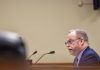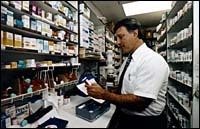
Backer at East Side Prescription
Center. (Tom Croke)
Last week, President Bush unveiled a plan to help seniors pay less money for prescription drugs. But at least one Rhode Island lawmaker wasn’t impressed.
“I think President Bush’s plan falls far short of what we need to do to solve this problem,” said Rep. Paul E. Moura (D-Providence), who introduced legislation earlier this year aimed at reining in prescription-drug prices.
For Leaders Who Don't Have Time to Get Sick
Top performers guard their calendars, delegate relentlessly and optimize every hour of the day. Health,…
Learn More
It’s a problem facing state lawmakers nationwide, as their constituents clamor for relief from soaring prescription-drug prices. While some states — particularly in New England — have been trailblazers in the effort to control drug prices, many state lawmakers say the problem is best solved at the federal level.
Rhode Island has given some recent relief to seniors with high prescription-drug bills through the expansion of the Rhode Island Pharmaceutical Assistance for the Elderly.
As of July 1, the program now covers osteoporosis drugs and includes a “catastrophic cap,” for the state’s poorest seniors, who already have 60 percent of their drug costs covered by the state. Under the new cap, the state will pay all costs in excess of $1,500 a year for those seniors.
Lt. Gov. Charles J. Fogarty said Rhode Island has done a good job protecting its seniors from exorbitant drug prices. He points to the addition of the RIPAE Plus program started last year, which offers some prescription-drug subsidies for middle-income, senior couples earning as much as $40,000 annually.
But despite the expansion of RIPAE, Fogarty said something must be done at the national level.
“Even with this program, a number of seniors just can’t cover these (prescription-drug) costs on their incomes,” Fogarty said. “We clearly need national assistance on this, but it’s an issue that seems to be eluding Congress.”
Moura’s legislation, modeled after a program in Maine, would have allowed the state to use its bulk purchasing power to negotiate discounts for prescription drugs, with the savings going to state residents who lack prescription-drug insurance. The bill was tied up in the House Finance Committee when the General Assembly session ended last month.
Although Moura said his bill had decent bipartisan support, he said legislators wanted to wait to see if Congress would act on the issue.
They’re still waiting.
“There was a general sense that this is a federal issue, and my colleagues were hoping that Congress would take action on this,” Moura said. “But if you don’t see something happen this year, states will have no choice but to act. There will be a big push next year on the state level for legislation like mine.”
Congress has considered various proposals to add a prescription-drug benefit to Medicare as part of a broad reform of that program. The issue was central to last year’s presidential campaign, but there has been little debate on the issue this year in Congress.
The issue has taken center stage nationally in recent weeks following Bush’s proposal, which would allow seniors to buy “discount cards” for $25. The plan, which reportedly would save seniors as much 30 percent on prescription-drug costs, has been criticized as a Congressional Democrats’ Band-Aid solution.
The prescription-drug issue recently gained attention locally too, as a result of a study released earlier this month by Congressman Jim Langevin (D-RI).
Langevin’s report shows that Rhode Island seniors pay an average of 78 percent more for some of the most commonly prescribed drugs than seniors in other developed countries such as Germany and the United Kingdom.
The Congressman used the study to underscore his support for a House bill that would require drug companies to charge U.S. consumers the same prices that they sell drugs in foreign countries. The Prescription Drug Fairness Act of 2001 would save Rhode Island seniors roughly 40 percent on their prescription-drug costs, according to Langevin.
While Congress mulls the issue, Fogarty said the state also is considering regional solutions.
The Northeast Legislative Association on Prescription Drug Prices, an eight-state organization formed last year to serve as a clearinghouse for information on regional prescription drug prices, will meet Friday in Boston.
Fogarty said he expects the group to review last month’s federal appeals court ruling that struck down a prescription-drug program in Vermont. The program relied on a federal waiver to use Medicaid dollars to subsidize the prescription-drug costs of residents who aren’t on Medicaid. Maine has a similar program.
Fogarty also said Gov. Lincoln Almond’s administration still is considering joining a drug purchasing pool set up by Maine, Vermont and New Hampshire. The program, to be launched in November, reportedly would cut the states’ prescription drug expenditures by 10 to 15 percent.
“That’s a significant savings,” Fogarty said. “If we can achieve that, I say let’s do it.”