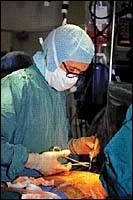
concentrates intensely.
(PBN file photo)
On a bad day, third-year medical resident Ben Lee will begin his shift at Hasbro Children’s Hospital at 7 a.m. and won’t finish until 6 p.m. — the next day.
A 36-hour shift, plopped in the middle of a 100-hour workweek, is fairly common for residents at teaching hospitals such as Hasbro. Grueling schedules and sleep deprivation have long been rites of passage for doctors in training.
Your Business Has Gone Global. Has Your Insurance?
A decade ago, “doing business internationally” was mostly a large-company concern. Today, a manufacturer in…
Learn More
But the tradition, deeply ingrained in what some call the “culture of medicine,” has been under attack in recent years.
“It conveys the image that doctors are superhuman and will sacrifice everything for their calling,” Lee said following a presentation on the issue by residents and faculty at Hasbro last month. “It’s implied that anything less is a failure of your personality, and to me that’s delusional.”
Like many of his fellow residents, Lee says he routinely works in excess of 100 hours per week. But unlike many of his colleagues, Lee can get by on just a few hours of sleep a night. “A lot of people can’t do that, and they shouldn’t have to,” he said.
An ongoing backlash by resident physicians is partly the result of a 1999 Institute of Medicine report, which claims that medical errors in U.S. hospitals kill nearly 100,000 people a year. Although the report gave short shrift to the risks of sleep deprivation among medical residents, many say the problem is central to the medical-error issue.
“The medical community has promised to fix this problem (of sleep-deprived medical residents) for decades, but nothing has happened,” said American Medical Student Association President Jaya Agrawal, a fourth-year medical student at Brown University and who performed resident rotations at Rhode Island Hospital. “Everyone in the medical community knows there is a potential impact on patient safety, but the public isn’t aware of the problem.”
The issue has garnered some national attention since April, when a petition was filed with the U.S. Occupational Safety and Health Administration on behalf of medical residents and interns.
The petition asks OSHA to cap residents’ workweeks at 80 hours and to restrict individual shifts to a maximum of 24 hours. It also proposes a limit of residents’ on-call shifts to every third night (residents often work on call every other night) and asks OSHA to require a 24-hour off-duty period for residents once a week.
Physicians-in-training historically have worked between 60 and 130 hours a week to meet their programs’ educational and clinical requirements, according to the American Medical Association.
But unlike other industries responsible for public health and safety, such as the aviation industry, the medical field is virtually unregulated when it comes to employee work hours.
One national organization, the Accreditation Council for Graduate Medical Education, has standards related to resident duty hours — including many requirements that are identical to the proposals in the OSHA petition.
But medical-resident advocates say the ACGME standards are voluntary and too often are ignored by hospitals. In 2000, the ACGME issued citations for work-hour violations to 35 percent of general-surgery residency programs it reviewed.
It’s doubtful that OSHA will implement any of the petition’s proposed changes, according to AMSA officials. But the advocacy groups that filed the petition – including AMSA and Public Citizen, a nonprofit watchdog group – also are lobbying for federal legislation that would mirror the OSHA petition. Congressman John Conyers, D-Mich., reportedly plans to introduce such a bill in the fall.
A bill that would have limited medical-resident work hours was introduced in Rhode Island in recent years, although the legislation was never passed.
Many medical residents say they would rather see change come from within the industry, rather than through state or federal regulation. But the recent push for regulatory restrictions are a necessary last resort, some say.
“I would like to see the program step up and protect its own residents,” said Lee. “But if that doesn’t happen, we should take it to the state level.”
Some surveys of medical residents show that sleep deprivation poses glaring risks not only to patients but also to residents’ own health:
- Nearly half of pediatric residents in one survey reported falling asleep at the wheel while driving home after a long shift.
- Forty-one percent of resident doctors in one survey attributed their most serious clinical mistake to exhaustion, according to the AMSA.
- A study by Australian researchers — published in a 1997 issue of the journal Nature — showed that a person’s cognitive function after 24 hours without sleep is roughly the same as someone who is legally drunk. Medical residents routinely work shifts in excess of 24 hours.
- Studies reportedly have shown that pregnant medical residents run an increased risk of complications as a result of fatigue.
But clinical studies examining the correlation between resident sleep deprivation and patient safety have been inconclusive, according to some experts.
Dr. Judith Owens, director of the pediatric sleep-disorders clinic at Hasbro, said much of the research done on medical-resident sleep deprivation is spotty because sample sizes have been generally small and based on subjective reports.
Still, few dispute that exhaustion from long work hours affects resident doctors’ moods and puts them at higher risk of auto accidents.
“There is a definite effect on mood,” Owens said during her presentation to residents at Hasbro. “(Sleep deprivation) increases depression, anger and hostility and decreases the motivation to perform. I think it’s pretty clear that even though more research needs to be done, there is a definite problem that needs to be addressed.”
Critics say that two powerful forces stand in the way of improving resident working conditions: the economic constraints faced by hospitals and a medical culture that promotes long work hours.
“There is a martyr syndrome among some residents,” said Alistair Erskine, a third-year pediatric resident at Hasbro who has been active in the effort to reduce resident work hours.
The other problem — the fiscal challenge — has only worsened in recent years as reimbursement funding for teaching hospitals has dwindled. Hospital administrators are loath to hire ancillary staff to relieve residents of some duties, according to some observers.
“It’s really a labor-force issue for hospitals,” said Mark R. Rosekind, former director of the Fatigue Countermeasures Program at NASA’s Ames Research Center. Rosekind now is a consultant for the National Transportation Safety Board and has studied the fatigue issue in the medical and transportation fields.
“You have a certain number of patients that need to be cared for, a certain number of people to care for them and a set number of hours that need to be worked,” Rosekind said. “It becomes a simple mathematics problem.”
Another problem is the difficulty in enforcing any regulations that may come about. The state of New York, for example, is the only state in the U.S. with work-hour regulations for medical residents. But more than a third of residents were required by their residency program to exceed the state’s 80-hour-a-week limit, according to a 1998 review by the state’s health department.
Rosekind said the issue is too complex to be boiled down to capped work hours like the ones proposed in the OSHA petition. He said he hopes the medical community will learn from reform efforts in other industries such as trucking and aviation, which he says relied too heavily on regulations to solve the problem.
“These industries tried to fix the fatigue problem by regulating it away,” Rosekind said. “But there’s no simple, one-size-fits-all solution. Regulations might be needed — you can’t work residents forever — but regulations alone are insufficient to solve the problem.”
Rosekind said residents should be taught strategies for combating fatigue, such as how to schedule naps and when to use caffeine.
If any regulations are created, Owens of the Hasbro sleep-disorders clinic says there should be a way to quantify their impact.
“Rhode Island is the perfect microcosm to make some changes and study the effects,” she said.