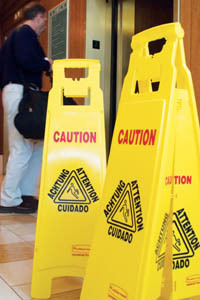
Signs at The Westin Providence warn guests and employees about wet floors.
Federal figures show that between 1996 and 2004 the number of nonfatal workplace injuries and illnesses at Rhode Island’s food and beverage establishments almost tripled, from about 400 to about 1,100. At the same time, the industry’s work force increased by more than one-third.
Rhode Island manufacturers, by comparison, saw the number of recorded injuries and illnesses in their industry drop by more than half in that time period, from 7,800 to 3,400, while their work force dwindled by one-third, according to the Bureau of Labor Statistics.
Selling Luxury Real Estate Requires More Than Exposure
By Emilio DiSpirito IV License Partner | Private Office Advisor Engel & Völkers Oceanside www.DiSpiritoteam.com…
Learn More
As Rhode Island’s employment base shifts toward service industries and away from manufacturing, the types of worker safety issues that are of greatest concern are also shifting.
Though figures show that service industries, excluding health care, generally experience fewer work-related injuries, because working in restaurants, hotels or offices involves less hazardous working conditions than in manufacturing, injuries do still happen.
“Overall hazards in service are not the same as in construction or manufacturing, but they are still hazards,” said Michael Whittaker, loss prevention manager for The Beacon Mutual Insurance Co., which provides workers’ compensation coverage for about 90 percent of Rhode Island employers, including most small businesses.
Injuries involving lifting items are the No. 1 subject of workers’ comp claims in the past five years, said Beacon spokesman Jeff Johnson. Lifting hazards can apply to service facilities, including hotels, restaurants, grocery stores and warehouses.
Whittaker said ergonomics can be a safety challenge in offices as well. To prevent ergonomic injuries such as carpal tunnel syndrome, Beacon sends specialists to offices to train employees how to sit and at what height to put their computer screens. Specialists might also suggest equipment such as headsets for phones.
Jim Celenza, director of the R.I. Committee on Occupational Safety and Health, said he does not think some industries in the service sector are as aware of safety issues as industries where hazards can result in more serious injuries. Smaller companies especially might not have the time or money to implement safety programs, he said.
Retail stores, restaurants, hotels and offices, in general, do not experience regular inspections from the U.S. Occupational Safety and Health Administration, though they will be inspected if someone files a complaint or there are a substantial number of injuries or severe injuries, said Maryann Medeiros, a compliance assistance specialist at OSHA in Providence.
“I wouldn’t say they are overlooked,” Medeiros said. “They are definitely not overlooked with compliance assistance.”
OSHA’s New England offices have been talking about setting up an alliance with hotels and restaurants because of the number of young workers employed at those facilities, she said. OSHA’s alliances provide education about its standards and compliance in an effort to prevent injury, illnesses and fatalities.
Rhode Island’s OSHA consultation program also is heightening its focus on the hotel industry, said Jim Gamelin, project manager for the program. The consultation program provides free, confidential assessments of work sites for safety hazards and suggestions for improving safety.
Each year the federal government requires the office to identify industries in the state to which it plans to promote its services. The requirement helps OSHA’s federal office justify funding 90 percent of the program’s costs.
Gamelin said he plans to promote the consultation program to the hospitality industry, along with landscaping and health care, because “most of these have never experienced an OSHA inspection or interaction with OSHA.”
Leisure and hospitality employers reported roughly 9 percent of the total non-fatal workplace injuries and illnesses in Rhode Island in 2004, labor figures show.
Manufacturers reported about 20 percent and health care and social assistance providers about 24 percent. The financial and insurance industries, on the other hand, were involved in only about 1 percent of occupational injuries and illnesses.
“I’ve seen a significant transition and focus on the types of businesses that federal OSHA inspects and the companies we service through consultation,” said Gamelin, who’s worked in the consultation program for 29 years. “The shift has been more toward the service sector in general.”
A lack of safety training and safety awareness is one concern in the hospitality industry, he said. Safety hazards in hotels include slips and falls, exposure to cleaning chemicals and blood pathogens, and repetitive stress injuries.
But the hotel industry as a whole has been taking safety “much more seriously” within the last four years, said Howard Allen, director of security at The Westin Providence hotel.
The Westin has a safety committee that meets once a month to review employees’ safety concerns and injuries, Allen said. They determine whether it is necessary to buy new equipment like buckets, mops, new wet-floor signs, etc.
“Training and accountability is a big key,” he said, adding that The Westin provides basic safety training on a yearly basis, including new worker orientation and retraining when an accident occurs.
Hotels of all sizes have some type of safety awareness program, said Allen, who’s been working in the industry for about 25 years.
“[Hotel] companies as a whole are being much more proactive,” he said. “You don’t want to have an employee out of work. You want employees to be healthy in the workplace and do their job.”